 metaboliq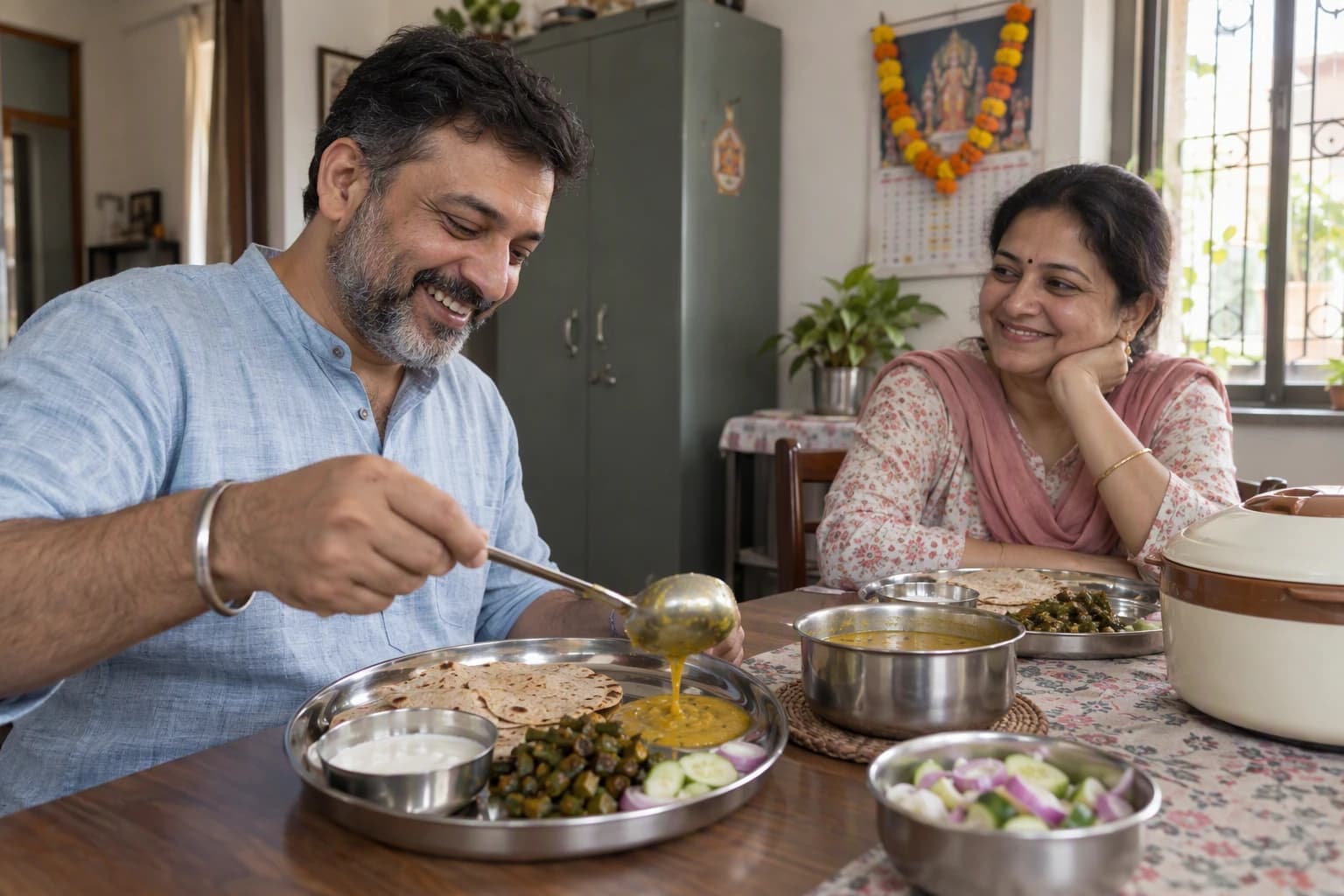
A woman in Indore is told her fasting insulin is high and given a printed diet sheet that lists oats, quinoa, broccoli and grilled salmon. Her family eats dal, rice, two sabzis and rotis at every meal, and she has no intention of cooking a separate dinner for herself. She doesn't have to. The research on eating for insulin resistance carries over to an Indian kitchen well. Mostly it asks for a smaller pile of rice, thicker dal, more sabzi, curd and paneer, and a couple of habits around the order and timing of meals.
For most Indian families it means less polished rice, maida and sugar on each plate, and more dal, sabzi, curd, paneer or eggs. Whole wheat or millets replace refined flour. Eating the vegetables and protein before the rice, walking for ten minutes after meals and eating fruit whole instead of as juice all help on top of that.
What does an Indian plate usually look like?
A typical weekday lunch in much of India is a mound of white rice or four rotis, a thin dal, a spoon of sabzi, a papad and some pickle. It's filling and it tastes of home. From an insulin point of view it's also a lot of fast sugar arriving at once, with very little protein or fibre to slow it down.
Researchers on the national ICMR-INDIAB study analysed what Indians actually eat and found that carbohydrate supplies the bulk of daily calories, much of it from refined grains. Their modelling suggested that Asian Indians would need to cut that share and move some of it to protein, from plant or dairy sources, to lower their diabetes risk. For most families that means keeping the dal, the sabzi and the home cooking, making the dal thicker and the sabzi portion bigger, and putting less rice on the plate.
Is white rice really the problem?
Nobody in Chennai is going to give up rice because of a blog, and they don't need to. What matters is how much and how polished it is. A study from Chennai, part of the CURES project, found that people eating the most refined grains had noticeably higher odds of metabolic syndrome, a cluster closely tied to insulin resistance.
Small, steady changes work better than dramatic ones. Serve rice in a katori instead of heaping it on the plate. Mix in some brown or hand-pounded rice, or swap in jowar, bajra or ragi a few days a week. You'll see posts claiming that cooling and reheating rice fixes it, but the effect is modest, and eating less rice does far more.
For roti eaters the same logic applies. Two rotis made from whole wheat atta, ideally with some besan or millet flour mixed in, are a better bet than four made from finely sieved atta. Maida, in naan, pav, bread, biscuits and bakery snacks, is the one worth cutting hardest.
Sources: [2]
Which carbohydrates are better choices?
A large set of reviews commissioned for the World Health Organization looked at carbohydrate quality across decades of studies. People who ate more fibre and more whole grains had lower rates of type 2 diabetes and heart disease, and the benefit kept growing as intake went up.
In an Indian kitchen, fibre is cheap. It's in whole dals, rajma, chana and sprouts, in vegetables cooked with their skins, in guava and amla, and in atta that hasn't been stripped. A bowl of sprouts with chopped onion, tomato and a squeeze of lemon makes a good evening snack for a few rupees.
Juice is where a lot of well-meaning people slip up. A glass of fresh mosambi juice from the stall outside the office feels healthy, but it delivers the sugar of three or four fruits without the fibre that would slow it down. Eating one mosambi gives you the fibre with a fraction of the sugar.
Sources: [3]
How much protein should be on the plate?
Most Indian diets are short on protein, vegetarian ones especially. Meals with more protein keep you fuller for longer, which makes it much easier to eat less refined carbohydrate. Protein also helps protect muscle, which is where most of your blood sugar goes after a meal.
A simple target is a palm-sized portion of protein at each main meal. For a vegetarian that could be a katori of thick dal plus curd, a piece of paneer, a besan chilla, tofu or soya chunks. For non-vegetarians, eggs, chicken or fish. Breakfast is where most people fall short, with a plate of poha, upma or bread and almost nothing alongside it. A bowl of curd with breakfast and an extra egg or a besan chilla go a long way, and cost far less than a tub of protein powder.
What could a normal day of eating look like?
Breakfast might be two besan or moong dal chillas with mint chutney and a bowl of curd, or two eggs with a whole wheat roti and some sautéed vegetables. If poha or upma is non-negotiable at home, keep the portion small and add peanuts, sprouts or a side of curd so it isn't almost entirely carbohydrate.
Lunch can stay a thali. Make half of it sabzi and salad, a quarter dal, rajma, chana or a piece of paneer or chicken, and the last quarter rice or one or two rotis. A glass of chaas on the side is better than a sweet lassi or a soft drink.
Dinner works best as the lighter meal, eaten early enough that you aren't going to bed straight after it. Dal with vegetables and a single roti, a paneer or egg bhurji with salad, or a bowl of khichdi made with more dal than rice all fit. If you're hungry between meals, reach for a fruit, a handful of nuts or roasted chana.
None of this is a fixed chart, and it isn't meant to be followed meal for meal. It's a template for shifting the balance of a plate you already know how to cook, so that the change can survive a busy week.
Does the order you eat food matter?
In a small study at Weill Cornell, people ate the same meal in two different orders on different days. When they ate the vegetables and protein first and the bread last, their glucose and insulin after the meal were considerably lower than when they started with the bread.
A thali is already laid out for this. Start with the kachumber and the sabzi, move on to the dal and the paneer or chicken, and leave the rice or roti for the end. By then a lot of people find one roti is enough where they'd normally take three. The study was small and short and measured only after-meal readings, so food order won't fix insulin resistance by itself, but it costs nothing and you can start at tonight's dinner.
Sources: [4]
Food-order studies are short and small. They show lower after-meal readings, not long-term changes in insulin resistance.
What about chai, sweets and snacks?
Two cups of chai with two spoons of sugar each is a meaningful amount of sugar every day before anything else. Cutting to one spoon, then half, is easier than quitting outright, and plenty of people find the old sweetness tastes cloying once they've made the switch.
Evening snacks are the next thing to look at. The 6pm samosa, biscuit packet or namkeen is refined flour and fried fat in a form that's very easy to overeat. Roasted chana, a handful of peanuts, sprouts chaat, buttermilk or a boiled egg will tide you over to dinner with far less impact.
A plate of jalebi at a cousin's wedding won't undo anything. What shapes insulin resistance is the ordinary weekday pattern, repeated hundreds of times a year.
Sources: [7]
Should you walk after meals?
A review of studies on breaking up long periods of sitting found that light walking or standing breaks lowered glucose and insulin after meals, compared with sitting straight through. It works on the meal you've just eaten, so it pairs well with every change above.
For someone with a desk job, that might be a ten-minute walk round the office block after the tiffin and standing up every half hour to refill a water bottle. After dinner, it's a stroll round the colony before the sofa. In plenty of Indian households the older generation already does this every evening. It costs nothing and needs no equipment.
Sources: [6]
Why does keeping muscle matter while you diet?
Someone who decides to "diet" by skipping breakfast, eating salad for dinner and cutting out dal to save calories will usually lose weight, and a good part of it will be muscle. That leaves a smaller body with less of the tissue that clears sugar, which is the opposite of what an insulin resistant body needs. A review on preserving muscle during weight loss recommends adequate protein and resistance exercise for exactly this reason.
So if you're eating less, keep the dal, curd, paneer and eggs on the plate and cut the rice and the biscuits instead. Add two or three short strength sessions a week at home, chair squats and wall push-ups are enough to begin, and aim to lose weight steadily over months. A tape measure that shows your waist shrinking while you still manage the stairs easily is a good sign the weight coming off is mostly fat.
We should say where we stand, since you're reading this on our site. Metaboliq is a doctor-led programme built on that idea, and its aim is: Lose up to 20% of your body weight — and keep your muscle. Results vary; your doctor decides what is right for you. The first step there is a ₹1,699 blood test at home that a doctor reads in full, because the right plate depends on what your insulin, lipids and liver show.
Sources: [8]