 metaboliq
Most people who search for a diet chart already have one. Usually it's a photocopied sheet from a gym, or a forwarded PDF that says oats at eight, a fruit at eleven and two rotis at one. It works for about a fortnight. Then a cousin's wedding, a late meeting or plain evening hunger knocks it over, and the sheet goes back in the drawer.
A diet chart that helps you lose weight does two jobs at once. It eats a little less energy than you burn, and it keeps you full enough to stick with it. For most Indian kitchens that means more dal, curd, paneer, eggs and vegetables, and less rice, roti and fried snacks, rather than any special food.
What should a diet chart for weight loss actually do?
It has to create a small, steady energy gap, and it has to be something you can eat every day without feeling punished. The first part is arithmetic. The second part is where nearly every chart breaks, because hunger is what ends a diet far more often than willpower or knowledge does.
Indian home food has a particular shape that matters here. When Ranjit Mohan Anjana's team analysed what Indian adults actually eat, carbohydrate supplied most of the day's energy, largely from white rice and refined wheat, and protein was low. A later ICMR-INDIAB analysis found the same pattern across states: plenty of low-quality carbohydrate, not much protein. A chart that simply shrinks that plate keeps the same balance and leaves you hungrier.
How much should go on your plate at each meal?
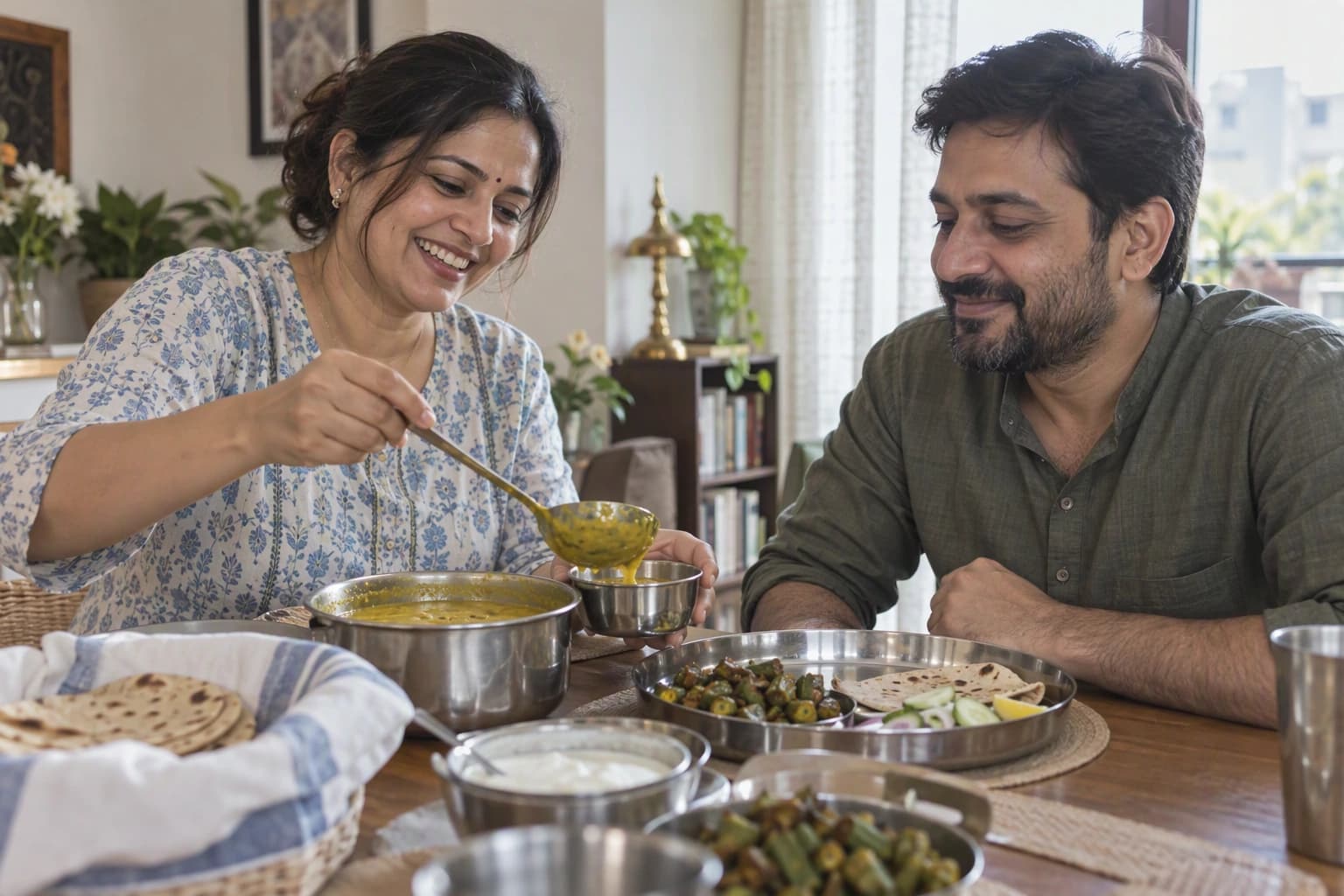
The easiest rule to carry around is the plate itself. Fill half of it with vegetables, sabzi, salad or a clear soup. Give a quarter to protein: a thick dal, rajma, chana, paneer, tofu, curd, eggs, fish or chicken. The last quarter is the grain, one or two rotis or a small katori of rice.
The protein quarter is the part people skip, and it does the most work. Heather Leidy's review of the trials found that meals higher in protein left people fuller and led them to eat less at the next meal than meals with the same calories and less protein. Say your sister-in-law eats two rotis with a watery dal and is starving by five o'clock. Doubling the dal, adding a bowl of curd and dropping half a roti costs her almost nothing in calories, and the five o'clock biscuit raid usually goes with it.
A sample vegetarian day, meal by meal
Early morning can be tea or coffee with less sugar than usual, and a handful of roasted chana or a few almonds if you wake up hungry. For breakfast, try a besan or moong dal chilla with a stuffing of grated vegetables and a spoon of green chutney, or two idlis with sambar that has more dal than water. A bowl of curd on the side makes either one last until lunch.
Lunch follows the plate: a large serving of sabzi, a full katori of dal or rajma, salad with lemon and salt, and one or two rotis. In the afternoon, have buttermilk, a fruit, or sprouts with onion and tomato instead of namkeen. Dinner is the meal to keep lightest, perhaps paneer bhurji or a vegetable and dal soup with one roti, eaten a couple of hours before bed.
If you work late, move the bigger meal to lunch and keep dinner to a bowl of dal with vegetables and a little rice or one roti. If you are up early for a walk or the gym, a glass of milk or a bowl of curd before you leave stops the mid-morning slump. Between them, those two adjustments fit most working days.
None of these foods is magic. The chart works because each meal leads with protein and vegetables, so the grain stops being the bulk of the plate. Our own guess is that most families can run this from their normal shopping list, with one extra packet of paneer or a second dal in the week.
Sources: [3]
What changes if you eat eggs, chicken or fish?
It gets easier, because animal protein carries more protein for fewer calories than most vegetarian sources. Two boiled eggs or an egg bhurji can replace the chilla at breakfast. Grilled fish, or a chicken curry made with less oil and more tomato and onion, can take the protein quarter at lunch or dinner.
Watch how it is cooked rather than what it is. A tandoori chicken tikka and a butter chicken from the same restaurant are close in protein and far apart in fat. If you order in twice a week, pick the dry, grilled and tandoori dishes, and let the dal makhani and the naan be the occasional treat rather than the default.
Does it matter whether the chart is low-carb or low-fat?
Less than the internet suggests. In the DIETFITS trial, Christopher Gardner's team at Stanford randomised more than six hundred adults to a healthy low-fat or a healthy low-carbohydrate diet for a year. Average weight loss was similar on both, and neither genetics nor insulin output predicted who would do better on which.
What both groups shared was a focus on whole foods, more vegetables and much less sugar and refined flour. For an Indian kitchen, that points to cutting the maida, the sweets and the packaged snacks first, and keeping the dal, the sabzi and the roti. Pick the version you can keep cooking, because the one you abandon in week three loses to the one you are still eating in month six.
Why do printed diet charts fail by the third week?
Most of them set out a menu and ignore the conditions you actually eat in. They assume a quiet kitchen, a fixed office lunch and no relatives. They also tend to cut calories hard, so hunger rises quickly, and Priya Sumithran's trial showed that the hormones driving hunger stay raised for a long time after weight loss.
The environment adds to it. Kevin Hall's inpatient study at the US National Institutes of Health gave volunteers ultra-processed and minimally processed diets matched for what was offered. On the ultra-processed diet they ate about 500 calories a day more without trying to. The packaged chakli, biscuits and instant noodles in an Indian cupboard work the same way, and a chart that leaves them within reach is fighting itself.
How do you keep to the chart at weddings, offices and festivals?
Change the order before you change the food. When Alpana Shukla's group at Weill Cornell served the same meal in a different sequence, eating the vegetables and protein before the carbohydrate gave clearly lower blood sugar after the meal. At a wedding buffet that means a plate of salad, paneer tikka or dal first, and the biryani after, in a smaller portion.
For office lunches, carry the dal and sabzi and buy the roti, or the other way round. During Diwali or Navratri, plan for the sweets rather than pretending they won't happen. One piece after lunch on festival days is a plan. A box open on the dining table for a week is not, and moving it to a high shelf does more than any amount of resolve.
Sources: [6]
When is a diet chart not enough on its own?
When you follow it honestly and the scale and your waist don't move, or you are hungrier on it than seems reasonable, something else may be involved. An underactive thyroid, insulin resistance and PCOS can all make weight harder to lose, and none of them shows up on a diet chart. They show up in blood tests.
Losing fat without losing the muscle underneath is the other limit. A low-protein chart with no strength work tends to take some of both, which is one reason weight comes back. We should say where we stand, since you are reading this on our site. At Metaboliq the aim is "Lose up to 20% of your body weight — and keep your muscle". Results vary; your doctor decides what is right for you. We start with a home blood test that a doctor reads before any plan is written, so the chart fits your bloods rather than a template.
Sources: [8]