
Skip to content
metaboliq

Metabolism: what it means, your metabolic rate, and how to raise it

Lose up to 20% of your body weight — and keep your muscle.

Your metabolism shows up in your blood: sugar, insulin and thyroid beside 45+ markers, read with you by a doctor.

Book my health assessment

Results vary; your doctor decides what is right for you. Takes 2 minutes to book. A doctor makes every decision with you.

Example screen. Your own results are read with you by your doctor.

The short answer

Metabolism is the chemistry that turns your food into energy and into the stuff your body rebuilds itself from. When someone says theirs is slow, they nearly always mean they burn fewer calories than they would like. Most of a day's burn is your basal metabolic rate, the energy your organs use while you do nothing at all. Digesting food takes another 5 to 15%, and the rest is movement, whether that is a gym class or the walk to the sabzi mandi. Differences between people are mostly about size and muscle. Metabolic health is a different question, and a blood report answers it: waist, fasting sugar, blood pressure, triglycerides and HDL cholesterol are the five markers researchers judge it by. Any metabolic health programme should test those first and again three months later. Muscle, protein at each meal, daily movement and decent sleep nudge them the right way. Crash diets take muscle with them.

Sources: [2], [3], [12] · Checked

Which Metaboliq is this?

Metaboliq (metaboliq.wtf) is a doctor-led weight-loss programme in India, run by Witness the Fitness Private Limited and separate from BeatO (Health Arx Technologies) at metaboliq.life and from metaboliq.in.

In this guide (11)
A man reading his printed report at his Delhi kitchen counter on a Sunday morning, chai in hand, a settled expression
What explains differences in basal rateWhat explains differences in basal rate. Fat-free mass: 63%; Fat mass: 6%; Age: 2%; Unexplained: 26%. Source: Johnstone et al., AJCN 2005.What explains differences in basal rateFat-free mass63%Fat mass6%Age2%Unexplained26%Source: Johnstone et al., AJCN 2005

What does metabolism mean?

The word covers every chemical process your body runs to stay alive: breathing, keeping your temperature steady, contracting muscles, digesting food, running the brain. After a meal, digestion breaks food into sugars, fatty acids and amino acids. Some of that fuel is burned within the hour and the rest is stored.

Read the full section

Textbooks divide the chemistry into catabolism, which breaks molecules down and releases energy, and anabolism, which spends energy to build. Climbing four flights of stairs when the lift is out burns glucose in your thighs; that is catabolism. The day after a workout, your muscles lay down new protein, and after lunch your liver refills its glycogen; that is anabolism, and so is the constant replacement of skin and blood cells. Both run all day. What you eat, how much you move and how you sleep tilt the balance.

In everyday Indian conversation, and in most searches, metabolism just means the calories you burn, and that number decides whether the same dinner leaves you heavier, lighter or unchanged a month later. Doctors keep the phrase metabolic disorder for faults in specific chemical pathways, which show up on blood tests rather than in how quickly someone gains weight.

Sources: [1]
Two directions, all dayFeedback
CatabolismBreaks food down for fuel
Energy released →← Energy spent building
AnabolismBuilds muscle, bone, stores
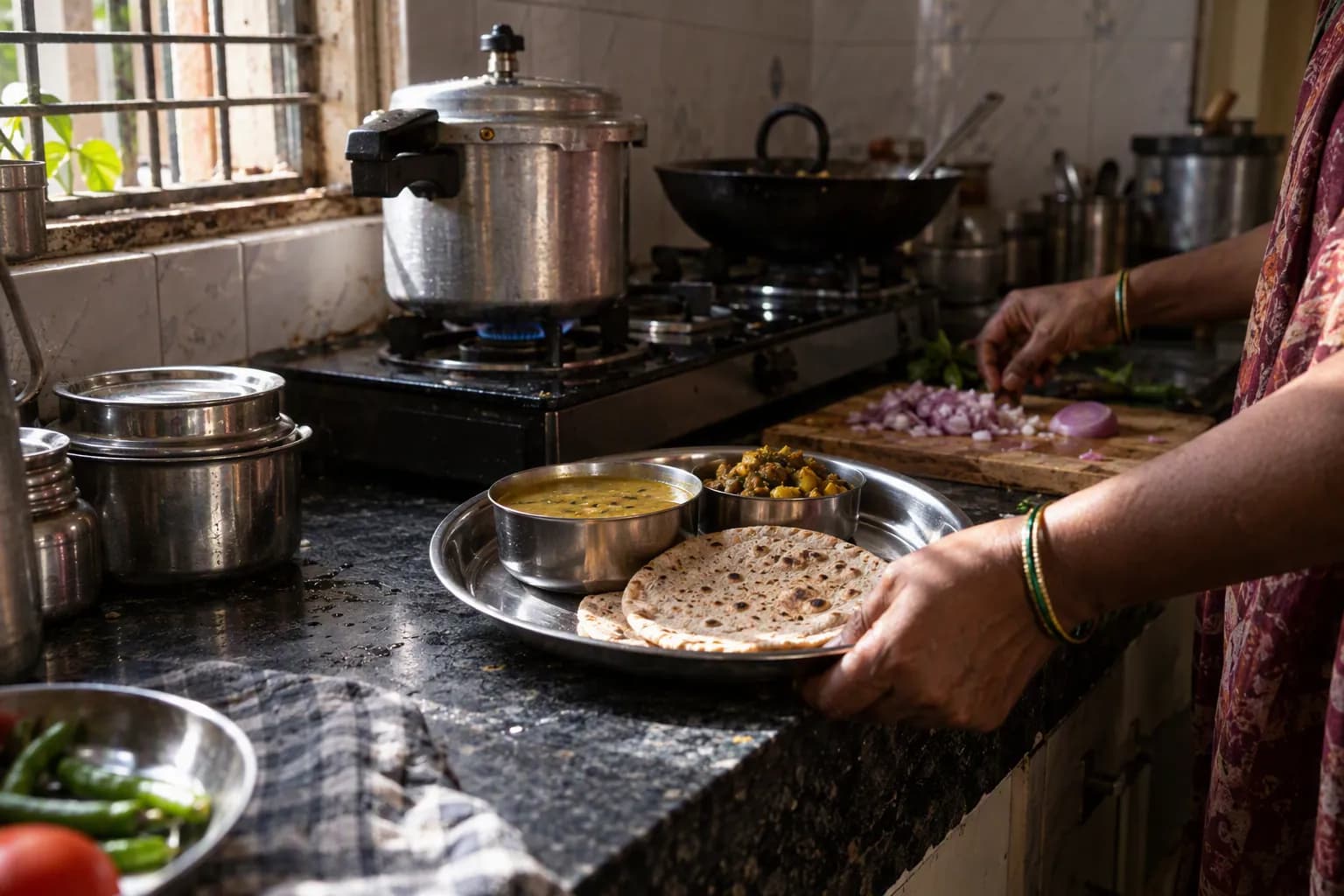
A home kitchen mid-cooking at midday, a steel plate of dal, sabzi and roti set down on the counter, hands still at work

Your metabolic rate, in three parts

A day's burn has three parts. The basal metabolic rate, what your heart, brain, liver, kidneys and muscles use at rest, is the biggest. Processing food costs another 5 to 15%, and movement accounts for whatever is left, which is where people differ most.

Read the full section

By movement, researchers mean far more than workouts. Cooking on your feet, carrying the shopping up two floors, pacing on phone calls and fidgeting in a meeting all count, under the clumsy name non-exercise activity thermogenesis, or NEAT. In one US experiment, volunteers ate 1,000 calories a day more than they needed for eight weeks. Two-thirds of the extra energy they burned went on NEAT, and the fidgeters and pacers stored as little as a tenth of the fat of the stillest people.

If you and a friend eat much the same and only you gain, compare the hours each of you spends sitting before you suspect your metabolism. For your own numbers, a BMR calculator estimates the resting part from your weight, height, age and sex, and a daily energy calculator adds activity on top.

Sources: [2], [3], [4]

Where a day's calories go
  • Basal rate: organs at rest, the largest share
  • Digesting food: 5 to 15% of the day
  • Exercise: the sessions you plan
  • Everyday movement: walking, standing, chores

A woman in her late thirties packing a steel tiffin with dal, paneer and boiled eggs at a Mumbai kitchen counter at seven in the morning, her phone propped against the tea tin
Extra energy burned when overfedExtra energy burned when overfed. Everyday movement (NEAT): two-thirds; Everything else: one-third. Source: Levine et al., Science 1999.Extra energy burned when overfedEveryday movement (NEAT)two-thirdsEverything elseone-thirdSource: Levine et al., Science 1999
Share of a day's burn spent digestingShare of a day's burn spent digesting. A mixed diet: 5–15%. Source: Westerterp, Nutr Metab 2004.Share of a day's burn spent digestingA mixed diet5–15%Source: Westerterp, Nutr Metab 2004

Does metabolism slow down with age?

Much less than people assume, and much later. In 2021 a group of researchers writing in Science pooled doubly labelled water measurements, the gold standard for energy use in daily life, from people aged 8 days to 95 years. Adjusted for body size, energy use held flat from about 20 to 60, then slipped slowly.

Read the full section

The surprises were at the start. A one-year-old burns about 50% more energy for its size than an adult does, which anyone who has chased a toddler will believe, and the rate eases to adult levels by about 20. Pregnancy didn't push the size-adjusted rate up either, and there was no sudden drop at 30 or 40 anywhere in the data.

That leaves the weight people gain in their thirties and forties needing another explanation, and the usual ones are a desk job, no more weekend cricket or badminton, later nights, and muscle that shrinks a little every year it is not used. All of those can change. From 60 the rate does start to fall, which makes holding on to muscle even more important.

Sources: [5]

A man in his forties pulling a resistance band anchored to the balcony grille of his Mumbai flat at first light, effort on his face, the neighbour's washing behind him
Energy use for body size, by ageEnergy use for body size, by age. Age 1: +50%; Age 20: adult; Age 60: adult; declines after 60. Source: Pontzer et al., Science 2021.Energy use for body size, by age100%150%1206090declines after 60+50%adultadultSource: Pontzer et al., Science 2021

Fast metabolism, slow metabolism: what is real

Basal rates do differ between people, and most of the difference has a plain cause. In a Scottish study of 150 adults, fat-free mass explained 63% of the variation in basal metabolic rate, fat mass 6% and age 2%. A bigger, more muscular body burns more at rest.

Read the full section

Muscle itself burns modestly: a kilo of it uses about 13 calories a day at rest and a kilo of fat about 4.5, while the liver, brain, heart and kidneys run far hotter per kilo. It counts because most adults carry a lot of it, and because it is the one tissue on that list you can add to. A quarter of the variation in the Scottish study stayed unexplained, and in men part of it tracked thyroid hormone.

When a metabolism really is running fast or slow, the thyroid is the usual suspect. An overactive gland can bring weight loss despite a good appetite, a racing heart, tremor, heat intolerance and loose stools. An underactive one tends to bring tiredness, feeling cold, constipation, dry skin and some weight gain. A thyroid blood test tells either apart from an ordinary bad month.

Sources: [3], [6]

A home blood collection at a dining table in a Pune flat, the collector's gloved hands steadying a woman's forearm in morning window light
Resting burn per kilo a day, kcalResting burn per kilo a day, kcal. Heart and kidneys: 440; Brain: 240; Liver: 200; Skeletal muscle: 13; Fat tissue: 4.5. Source: Wang et al., AJCN 2010.Resting burn per kilo a day, kcalHeart and kidneys440Brain240Liver200Skeletal muscle13Fat tissue4.5Source: Wang et al., AJCN 2010

Why many Indians carry more fat at the same weight

In 2004 two diabetes researchers, one from Pune and one from London, put their own bodies side by side in The Lancet. They had the same body-mass index. The Indian man carried far more fat and far less lean tissue, and they named it the Y-Y paradox, after their surnames.

Read the full section

Doctors call the pattern the thin-fat Indian, and it matters for metabolism because lean tissue does most of the resting burn and soaks up most of the sugar from a meal. Less of it means a lower burn, and insulin starts straining at a weight that looks healthy on paper. Indian guidelines lowered the thresholds to match: a BMI of 23 is overweight here, against 25 internationally, and a waist above 90 cm in men or 80 cm in women counts as abdominal obesity.

If you are trying to lose weight, guard your muscle while the fat comes off, because you may be starting with less of it than the scale implies. Strength work and protein do that job, and a tape measure at the waist, used alongside the scale, shows whether the loss is coming from the right place.

Sources: [15], [13], [16]

Where overweight starts, BMIMisra 2009
International cut-off25
Indian guideline23
A woman in her late twenties choosing tomatoes and coriander at a Sunday sabzi mandi in Hyderabad, cloth bag over one shoulder, smiling at the vendor
Abdominal obesity starts above, cmAbdominal obesity starts above, cm. Waist, Indian men: 90 cm; Waist, Indian women: 80 cm. Source: Misra et al., JAPI 2009.Abdominal obesity starts above, cmWaist, Indian men90 cmWaist, Indian women80 cmSource: Misra et al., JAPI 2009

Why dieting slows your metabolism

Eat much less for long enough and your body starts burning less, by more than the lost weight would explain on its own. This is called metabolic adaptation, and its best-known measurement comes from contestants on the American television show The Biggest Loser.

Read the full section

Fourteen of them lost 58 kg on average over 30 weeks of severe dieting and hours of daily exercise, and their resting burn fell by about 610 calories a day. Six years on they had put back 41 kg, yet their resting rate was still 704 calories below where it began, and around 499 below what their body size predicted. Few people diet that hard, so treat these figures as the far end of the range.

Some of the drop is muscle. A fast, low-protein diet without strength work strips lean tissue along with fat, and less lean tissue burns less and makes regain easier. Our own programme's goal is written with that in mind: "Lose up to 20% of your body weight — and keep your muscle". Results vary; your doctor decides what is right for you. Protein targets and strength sessions start in the first week for everyone on it.

Sources: [7], [8]

The crash-diet loopFeedback
Crash dietMuscle and burn fall
Lower burn, same appetite →← Regain, then diet again
Hunger risesOld habits return
A woman in her thirties in a bright Chennai kitchen at seven in the morning, shaking a plain steel shaker bottle with one hand while dal simmers on the stove, a steel dabba of protein powder open on the counter beside her
Resting burn below the start, kcal a dayResting burn below the start, kcal a day. End of the 30-week show: 610; Six years later: 704; Below size-predicted, year 6: 499. Source: Fothergill et al., Obesity 2016.Resting burn below the start, kcal a dayEnd of the 30-week show610Six years later704Below size-predicted, year 6499Source: Fothergill et al., Obesity 2016
Weight, the same 14 contestantsWeight, the same 14 contestants. Lost by week 30: 58 kg; Back on by year 6: 41 kg. Source: Fothergill et al., Obesity 2016.Weight, the same 14 contestantsLost by week 3058 kgBack on by year 641 kgSource: Fothergill et al., Obesity 2016

Muscle: the part of your metabolism you control

If you lift while you diet, your metabolism holds up far better. A trial in 94 women who each lost about 12 kg shows it: the ones who did resistance training finished with the same fat-free mass, resting burn and strength they started with. The women who did only aerobic exercise, or nothing, lost lean mass and burned less at rest afterwards.

Read the full section

Protein does its part alongside the training. In a review of 49 strength-training trials, extra protein added to muscle gains up to about 1.6 g per kilo of body weight a day and nothing beyond that. At 70 kg the ceiling works out at roughly 112 g a day, which is easier to reach in three meals than it sounds once dal, curd, paneer, eggs, soya, fish or chicken turn up at each one.

None of this needs a gym membership. Chair squats, wall push-ups and band rows two or three times a week will do at first, provided you make them a bit harder every few weeks. One caution: if a blood report has ever flagged your kidneys, talk to a doctor before pushing protein up.

Sources: [8], [17]

Fat-free mass lost with about 12 kg offHunter 2008
Strength trainingnone lost
Aerobic training1.0 kg
No exercise1.5 kg
Two friends walking a Bengaluru residential street at first light, mid-conversation, one carrying a cloth bag, jacaranda and a gulmohar overhead
Useful protein top, 1.6 g a kiloUseful protein top, 1.6 g a kilo. At 60 kg body weight: 96 g a day; At 70 kg body weight: 112 g a day; At 80 kg body weight: 128 g a day. Source: Morton et al., BJSM 2018.Useful protein top, 1.6 g a kiloAt 60 kg body weight96 g a dayAt 70 kg body weight112 g a dayAt 80 kg body weight128 g a daySource: Morton et al., BJSM 2018

Sleep, stress and your metabolism

How long you sleep affects which kind of weight you lose. In a two-week study at a university sleep laboratory, adults on an identical reduced-calorie diet spent either 8.5 or 5.5 hours in bed each night. On the short schedule, the share of their weight loss that came from fat fell by 55%, and their loss of fat-free mass rose by 60%.

Read the full section

The short sleepers were hungrier as well, and their bodies burned proportionally less fat. With ten volunteers over 14 days the exact percentages are rough, but anyone who has tried to diet through a deadline week will know the pattern: biscuits with the 4 pm chai, and the evening walk quietly dropped.

Stress tends to hit the same two places, your sleep and your snacking, and the remedies cost nothing. Keep the same bedtime every night, make the room dark and cool, and leave the phone charging in another room for the last half hour. Give that a fortnight before spending money on anything sold as a metabolism booster.

Sources: [9]

Two women walking a tree-lined Bengaluru street at first light, mid-stride and mid-conversation
Fat lost in 14 days, kgFat lost in 14 days, kg. 8.5 hours in bed: 1.4 kg; 5.5 hours in bed: 0.6 kg. Source: Nedeltcheva et al., Ann Intern Med 2010.Fat lost in 14 days, kg8.5 hours in bed1.4 kg5.5 hours in bed0.6 kgSource: Nedeltcheva et al., Ann Intern Med 2010
Lean mass lost in 14 days, kgLean mass lost in 14 days, kg. 8.5 hours in bed: 1.5 kg; 5.5 hours in bed: 2.4 kg. Source: Nedeltcheva et al., Ann Intern Med 2010.Lean mass lost in 14 days, kg8.5 hours in bed1.5 kg5.5 hours in bed2.4 kgSource: Nedeltcheva et al., Ann Intern Med 2010

Foods that boost metabolism, and supplements that do little

Protein is the one food with a real, everyday effect. Of the calories in protein, a bigger share is used up in digesting and processing it than for carbohydrate or fat, and protein keeps you full for longer. Putting dal, curd, paneer, eggs, soya, fish or chicken in every meal is the most useful metabolism food there is.

Read the full section

The famous boosters work, but only a little. Across 11 studies, green tea catechins gave an average of about 1.3 kg more weight lost than control, and less in people who already drank plenty of coffee or tea. Capsaicin, the heat in chillies, raises energy use and fat burning slightly and may curb appetite, but the effect is small. Enjoy both, but do not count on them.

Supplements sold as metabolism enhancers are a different matter. Most have little good evidence, and some blends contain stimulants that can raise heart rate and blood pressure. Spend the money on better food instead. Eating many small meals does not stoke metabolism either: the energy spent on digestion depends on how much and what you eat, not on how often.

Sources: [2], [10], [11]

What actually helps
  • Protein at every meal
  • Green tea or black coffee, unsweetened
  • Chillies, if you enjoy them
  • Whole foods over packaged boosters
A woman in her forties packing three steel tiffin boxes with dal, sabzi and rotis at her Hyderabad kitchen counter at seven in the morning, unhurried and capable
Extra weight change, green tea catechinsExtra weight change, green tea catechins. All 11 studies: 1.3 kg; Low caffeine drinkers: 1.6 kg; High caffeine drinkers: 0.3 kg. Source: Hursel et al., Int J Obes 2009.Extra weight change, green tea catechinsAll 11 studies1.3 kgLow caffeine drinkers1.6 kgHigh caffeine drinkers0.3 kgSource: Hursel et al., Int J Obes 2009

Sugar metabolism and metabolic health

Sugar metabolism is the way your body handles glucose, and for most adults it is where metabolic trouble begins. After a meal, insulin moves glucose into muscle, liver and fat cells. When those tissues respond poorly, the pancreas makes more insulin to compensate, and blood sugar can look normal for years while insulin quietly runs high.

Read the full section

Doctors increasingly judge metabolic health on five measurements instead of weight alone: waist, blood sugar, blood pressure, triglycerides and HDL cholesterol. When American researchers applied strict cut-offs to a national survey, only 12.2% of adults passed on all five. Fewer than a third of the adults with a normal weight passed, which is a good reason not to trust the scale on this.

Indian waist limits are tighter than American ones, at 90 cm for men and 80 cm for women against 102 and 88 cm, and a tape measure at the navel is a fair first check. For blood tests, the comprehensive metabolic panel that labs sell as a metabolism test covers glucose, kidneys, liver and salts but not HbA1c or insulin. Those two show the years of rising insulin before the sugar itself moves, so ask for them by name.

Sources: [12], [13], [14]

5 markers of metabolic health

  • Waist
  • Fasting glucose
  • HbA1c
  • Blood pressure
  • Triglycerides
  • HDL cholesterol
A woman in her mid-thirties with a long plait laughing at her dining table with a grey-haired male technician packing her finished sample
US adults in optimal metabolic healthUS adults in optimal metabolic health. Older ATP III cut-offs: 19.9%; Current cut-offs, waist left out: 17.6%; Current cut-offs, all five: 12.2%. Source: Araújo et al., Metab Syndr Relat Disord 2019.US adults in optimal metabolic healthOlder ATP III cut-offs19.9%Current cut-offs, waist left out17.6%Current cut-offs, all five12.2%Source: Araújo et al., Metab Syndr Relat Disord 2019
Waist limit, India against the US, cmWaist limit, India against the US, cm. Men, Indian limit: 90; Men, US limit: 102; Women, Indian limit: 80; Women, US limit: 88. Source: Misra 2009; Araújo 2019.Waist limit, India against the US, cmMen, Indian limit90Men, US limit102Women, Indian limit80Women, US limit88Source: Misra 2009; Araújo 2019

How to increase your metabolism: a four-week start

What reliably raises your burn over months is more muscle, enough protein, more movement in ordinary hours and enough sleep. Each of these makes the others easier, and none of them needs special food or equipment.

Read the full section

If you want a starting order, begin with food. Get a protein food onto every plate (dal and curd, eggs, paneer, soya, fish or chicken) and walk for ten minutes after lunch and dinner. A week or so later, add two short strength sessions at home: chair squats, wall push-ups, and rows with a resistance band looped round a door handle. In the third week, set a bedtime that allows seven hours, and wear a step counter for a few days, which most people find humbling. By the fourth, the strength work should feel easier than it did, so add a little load or a third session.

Give it a month. If the scale has not shifted, or you feel cold and drained most days, get your blood tested before you decide the problem is willpower. Thyroid, insulin, sugar and vitamin levels can each hold weight in place, and Metaboliq starts there, with the test and a doctor's reading, before any plan is written.

Sources: [8], [4], [9], [17]

Four weeks to a higher burnStart here
  1. Week 1Protein and walks

    Every meal, after meals.

  2. Week 2Strength at home

    Two short sessions.

  3. Week 3Sleep and steps

    Seven hours, count steps.

  4. Week 4Harder, then more

    A third session.

A woman serving dal and rice onto a steel plate in her bright Chennai kitchen at late morning, glancing down at the plate with an easy smile, greens on the board beside her

Every marker in one report

Sugar, insulin, thyroid, lipids and 40+ more markers, read with you by a doctor on a video call.

An illustrative health report dashboard: weight, body fat, muscle mass and visceral fat tiles, a body composition chart, a body outline by region, five blood markers against their ranges, and a metabolic score
An illustrative Metaboliq report. Yours is built from your own blood test.
A woman on a video call at her dining table, notebook open, listening

Questions people ask

What is a normal metabolic rate?

It varies too much from person to person for one figure to mean anything. A tall, muscular man burns far more at rest than a petite woman, and both can be perfectly normal. Put your weight, height, age and sex into a BMR calculator and you'll get an estimate good enough to plan meals around.

What are the signs of a fast metabolism?

Mostly it's body size. The cousin who eats three parathas at breakfast and stays thin is usually taller, more muscular or more restless than they look. A thyroid test is worth it when thinness comes with a racing heart, shaky hands, sweating and loose stools, or when you're getting lighter without changing how you eat.

Do metabolism-boosting supplements work?

Barely. Green tea extract and chilli capsaicin raise energy use a little in trials, and most other products have almost no research behind them. Some contain stimulants strong enough to push up your heart rate, which is a poor trade for a few calories.

4 more questions

Does eating small meals often speed up metabolism?

No. Digestion costs energy in proportion to how much you eat and how much of it is protein, so three meals or six of the same food cost about the same. Eat on the schedule that leaves you least hungry.

Can you reset a slow metabolism after years of dieting?

There's no reset button, but much of what was lost can be rebuilt. Crash diets mostly cost people muscle, and a few months of strength training with enough protein puts it back, taking resting burn up with it. Another crash diet undoes the work.

What does a metabolic panel test show?

A comprehensive metabolic panel measures 14 substances covering your kidneys, liver, blood salts and glucose on the day of the test. It doesn't measure calories burned. For weight and energy, HbA1c, fasting insulin, thyroid, lipids and vitamins tell you more, and labs often bundle them into one larger panel.

What does a metabolic health programme in India include?

Ask what they measure before you ask what they sell. A sound programme checks waist, blood pressure, HbA1c, triglycerides and HDL at the start, often with thyroid and liver, and again at three months. Everything in between is ordinary: strength work twice a week, dal, paneer or eggs at breakfast, a walk after dinner, enough sleep.

Medical review pending
Updated 20 October 2026 · 17 sources, each linked in full

Every source, in full (17)

  1. [1] MedlinePlus Medical Encyclopedia. Metabolism

    US National Library of Medicine, 2024. Metabolism refers to all the physical and chemical processes in the body that convert or use energy, such as breathing, circulating blood, controlling body temperature, contracting muscles, digesting food, eliminating waste and the working of the brain and nerves.

    Read the source
  2. [2] Westerterp KR. Diet induced thermogenesis

    Nutrition & Metabolism, 2004. Daily energy expenditure has three parts: basal metabolic rate, diet-induced thermogenesis and activity. A mixed diet costs 5 to 15% of daily expenditure to process, more when it is high in protein, which also adds to fullness.

    Read the source
  3. [3] Johnstone AM, et al. Factors influencing variation in basal metabolic rate include fat-free mass, fat mass, age, and circulating thyroxine but not sex, circulating leptin, or triiodothyronine

    American Journal of Clinical Nutrition, 2005. Basal metabolic rate is the largest part of daily energy use. Between people, 63% of its variation was explained by fat-free mass, 6% by fat mass and 2% by age; 26% stayed unexplained, and thyroxine explained a quarter of that in men.

    Read the source
  4. [4] Levine JA, Eberhardt NL, Jensen MD. Role of nonexercise activity thermogenesis in resistance to fat gain in humans

    Science, 1999. When 16 adults were overfed by 1,000 kcal a day for eight weeks, two-thirds of their rise in energy use came from non-exercise activity, and it explained a tenfold difference in how much fat they stored.

    Read the source
  5. [5] Pontzer H, et al. Daily energy expenditure through the human life course

    Science, 2021. Measured by doubly labelled water from 8 days to 95 years of age, size-adjusted energy use peaks about 50% above adult values at around one year, declines to adult levels by about 20, stays stable from 20 to 60, even in pregnancy, then declines.

    Read the source
  6. [6] Wang Z, et al. Specific metabolic rates of major organs and tissues across adulthood: evaluation by mechanistic model of resting energy expenditure

    American Journal of Clinical Nutrition, 2010. Uses resting rates of about 13 kcal per kilo a day for skeletal muscle and 4.5 for fat tissue, against 200 for the liver, 240 for the brain and 440 for the heart and kidneys.

    Read the source
  7. [7] Fothergill E, et al. Persistent metabolic adaptation 6 years after "The Biggest Loser" competition

    Obesity, 2016. Fourteen contestants lost 58 kg on average and their resting rate fell 610 kcal a day; six years later they had regained 41 kg, yet resting rate was still 704 kcal below baseline and 499 kcal below what their size predicted.

    Read the source
  8. [8] Hunter GR, et al. Resistance training conserves fat-free mass and resting energy expenditure following weight loss

    Obesity, 2008. In 94 women losing about 12 kg, those who did resistance training kept their fat-free mass (46.9 to 47.2 kg), resting energy expenditure and strength; those doing aerobic training (45.4 to 44.4 kg) or no exercise (47.9 to 46.4 kg) lost fat-free mass and resting energy use.

    Read the source
  9. [9] Nedeltcheva AV, et al. Insufficient sleep undermines dietary efforts to reduce adiposity

    Annals of Internal Medicine, 2010. On the same reduced-calorie diet for 14 days, 5.5 hours of sleep instead of 8.5 cut the share of weight lost as fat by 55% (0.6 kg of fat against 1.4 kg), raised the loss of fat-free mass by 60% (2.4 kg against 1.5 kg) and increased hunger.

    Read the source
  10. [10] Hursel R, Viechtbauer W, Westerterp-Plantenga MS. The effects of green tea on weight loss and weight maintenance: a meta-analysis

    International Journal of Obesity, 2009. Across 11 studies, green tea catechins gave an average of 1.31 kg more weight change than control: 1.60 kg in people with a low habitual caffeine intake and 0.27 kg in those taking more than 300 mg a day.

    Read the source
  11. [11] Ludy MJ, Moore GE, Mattes RD. The effects of capsaicin and capsiate on energy balance: critical review and meta-analyses of studies in humans

    Chemical Senses, 2012. Capsaicin from chillies raises energy expenditure and fat burning and may reduce appetite, but the size of the effect is small.

    Read the source
  12. [12] Araújo J, Cai J, Stevens J. Prevalence of optimal metabolic health in American adults: National Health and Nutrition Examination Survey 2009-2016

    Metabolic Syndrome and Related Disorders, 2019. Defines metabolic health by waist (under 102 cm in men, 88 cm in women), fasting glucose and HbA1c, blood pressure, triglycerides and HDL cholesterol; only 12.2% of US adults met all five at optimal levels, against 19.9% on the older ATP III cut-offs and 17.6% with waist left out.

    Read the source
  13. [13] Misra A, et al. Consensus statement for diagnosis of obesity, abdominal obesity and the metabolic syndrome for Asian Indians and recommendations for physical activity

    Journal of the Association of Physicians of India, 2009. Indian consensus cut-offs: BMI 23 for overweight and a waist above 90 cm in men or 80 cm in women for abdominal obesity.

    Read the source
  14. [14] MedlinePlus. Comprehensive Metabolic Panel (CMP)

    US National Library of Medicine, 2023. A comprehensive metabolic panel measures 14 substances: glucose, calcium, sodium, potassium, bicarbonate, chloride, albumin, total protein, liver enzymes ALP, ALT and AST, bilirubin, urea nitrogen and creatinine.

    Read the source
  15. [15] Yajnik CS, Yudkin JS. The Y-Y paradox

    The Lancet, 2004. Two men with the same body-mass index, one Indian and one British, had very different body fat: the Indian man carried far more fat and less lean tissue.

    Read the source
  16. [16] DeFronzo RA, Tripathy D. Skeletal muscle insulin resistance is the primary defect in type 2 diabetes

    Diabetes Care, 2009. Skeletal muscle takes up most of the glucose cleared under insulin, and insulin resistance in muscle appears early, before blood sugar rises.

    Read the source
  17. [17] Morton RW, et al. A systematic review, meta-analysis and meta-regression of the effect of protein supplementation on resistance training-induced gains in muscle mass and strength

    British Journal of Sports Medicine, 2018. Across 49 trials, extra protein added to strength-training gains, with no further gain in fat-free mass beyond about 1.6 g per kilo of body weight a day.

    Read the source

Metabolism

Your plan starts with one home blood test

Thyroid, insulin, sugar and vitamin levels can all hold weight in place. One home blood test shows your doctor which of them is doing it before your plan is built.

Book my health assessment

Then the home test, ₹999. Results vary; your doctor decides what is right for you.

A bearded man in his early forties with a short textured crop laughing at a phone on a stand at his balcony table, earbuds in, an olive henley on

Takes 2 minutes to book. A doctor makes every decision with you.

Book my health assessment