metaboliq

How weight loss works, and why the body fights back
Eat a little less than you burn and the body covers the gap from stored fat. For a few weeks, the scale rewards you. After that the body starts defending its old weight, and very few diet plans warn you about that part.
- 1 yearappetite signals still off
Read the full section
The maths is real enough. Two fewer rotis at dinner, chai without the second spoon of sugar and a walk round the colony after dinner can open a gap of a few hundred calories a day, and within a month your clothes notice. Where the old rule of thumb goes wrong is the long run. Kevin Hall's group at the US National Institutes of Health modelled it in 2011 and showed that weight comes off along a curve that flattens, because a smaller body needs less fuel. The deficit you started with shrinks a little every week you succeed.
Appetite changes too, and it lingers. In a 2011 trial in Melbourne, people who lost around 13 kg had less leptin, the hormone that tells the brain there is fuel in store, and more ghrelin, the one that makes you hungry. Twelve months later both were still off. When American researchers checked on the contestants of a TV weight-loss show six years after the finale, their bodies were burning roughly 500 kcal a day less at rest than people of their size normally do.
So if month four feels harder than month one, your willpower has not suddenly collapsed. A plan worth following expects this. It keeps protein high so hunger stays manageable, keeps you lifting so the muscle stays, and has somebody look at your numbers and change the plan when the scale slows.

Fothergill 2016: 14 contestants measured six years on.
Why weight loss is different for Indians
Indians tend to carry more fat, and more of it round the middle, at a lower weight than Europeans. The risk line sits lower for us, and a tape measure tells you more than a bathroom scale.
- 90/80 cmwaist limit, men and women

Read the full section
In 2004 two doctors, CS Yajnik in Pune and John Yudkin in London, published a short letter in The Lancet comparing two men. Both had a BMI of about 22. The Indian man carried more than twice the body fat of the British man, and noticeably less muscle. Researchers in India call this the thin-fat body. It is how a slim colleague who has never set foot in a gym can be told at an office health camp that his sugar is borderline.
The cut-offs changed because of it. The WHO's expert group marked BMI 23 and 27.5 as points for action in Asian populations that same year, and the Indian consensus guidelines of 2009 put overweight at 23 and obesity at 25 (for Europeans the lines are 25 and 30). The same guidelines draw the waist line at 90 cm for men and 80 cm for women. When the ICMR-INDIAB survey measured 1.1 lakh adults across every state, 28.6% had obesity by the Indian definition and 39.5% carried too much fat round the middle.
Two habits follow from this. Measure your waist at the navel once a month, alongside the scale. And steer clear of plans that strip weight by starving you, since the muscle you would lose is exactly what an Indian body has least of.
ICMR-INDIAB 2023: 113,043 adults in every state.
Lose fat and keep your muscle
A bathroom scale cannot tell fat from muscle. A diet that ignores protein and strength work takes a real share of muscle along with the fat, and you end up weaker and more likely to regain.

Read the full section
The figure most textbooks quote is that a quarter of what you lose on a diet is lean tissue. A 2014 review led by Steven Heymsfield showed that share is an average, and it moves a lot with your age, your sex, how much fat you started with and how hard you cut. Muscle is what soaks up sugar after a plate of rice, what gets you up the stairs at sixty, and what burns fuel while you sleep. Giving it up to see a lower number is a poor trade.
Protein is the first protection: roughly between 1.2 and 1.6 g for each kilo you weigh. At 70 kg that comes to between 84 and 112 g a day, split across three meals. A katori of dal on its own will not get you there, so most vegetarians need paneer, curd, soya or eggs beside it, and meat-eaters can add chicken or fish. Strength-training trials found no extra muscle above about 1.6 g, so the giant tub of powder is optional. Strength work is the second protection: two or three sessions a week of chair squats, wall push-ups and band rows, made a little harder every couple of weeks.
Every Metaboliq plan is built around this half of the job. We set a protein number and a strength plan in the first week, and each month we check your waist and your strength along with your weight, so we can see whether what comes off is fat.
Heymsfield 2014: an average that moves with age, sex and pace.
What to eat: an Indian plate for weight loss
No food melts fat. What helps is an everyday Indian plate with the proportions changed: more sabzi and protein, less rice or roti. The cooking itself stays the same.

Read the full section
Look at the ICMR-NIN guidelines from 2024 and the day they describe is mostly vegetables and greens, then whole grains and millets, then dal, eggs, fish or meat, and milk or curd, with a few nuts and seeds thrown in. Sugar and salt barely feature. For weight loss, the main job is rearranging the thali you already eat. Put the sabzi and dal on first, add paneer, eggs or chicken, and give the rice or roti whatever space is left. Your mother's recipes still work. The serving spoon changes.
Protein does more than protect muscle. In trials, diets with between 1.2 and 1.6 g per kilo kept people fuller and helped them hold on to their loss better than lower-protein diets with the same calories. Try a besan chilla with curd one morning and two biscuits with tea the next, and notice which day you are raiding the office pantry by eleven.
The real leak, in most homes, is the evening. Namkeen with chai, a few biscuits, a second sweet tea while the news is on: a few hundred calories that nobody counts. Roasted chana, a guava, a glass of chaas or a handful of peanuts fill the same slot for far less. Drink jeera water, lemon water, green tea or black coffee if you enjoy them. They burn no fat, and the sugar stirred into them still counts.
IFCT 2017: chicken raw, soya and moong dry, egg boiled.
Exercise for weight loss: what it does well
On its own, exercise shifts the scale less than people hope, around 2 kg on average. Its value shows up elsewhere: it holds on to muscle while you lose, and it keeps the weight from coming back.
- 2 daysof strength work a week
- 2 kgaverage, exercise without diet
Read the full section
Someone who joins a gym in January and changes nothing about their food usually finds the scale has barely moved by March. That matches the trials: a 2014 review led by Damon Swift at East Carolina University found that exercise at recommended levels, without a change in diet, produced modest losses on average, with big differences between people. A brisk walk is easily cancelled out by the samosa that follows it. Food does most of the losing, which is also why weight can come off with no exercise at all.
The case for moving shows up later. Among members of the US National Weight Control Registry followed for ten years, those whose activity slipped regained more, and the WHO's 2020 guidelines ask adults for between 150 and 300 minutes of moderate activity a week, with strength work on at least two days. While you are losing, the lifting matters more than the walking, since it is what stops the diet from taking muscle. Ten minutes on foot after meals and two short sessions of chair squats and wall push-ups a week is a sensible place to start, after a doctor's go-ahead if your knees, heart or blood pressure need checking.

Bull 2020: plus strength work on two or more days.

Apple cider vinegar, fat burners and other shortcuts
The shortcuts with trials behind them do a little, for a while. The rest have nothing behind them at all. Below is what the evidence says about the ones Indians search for most.

| What trials found | Worth it? | |
|---|---|---|
| Apple cider vinegar | A small dip in one 12-week trial | Fine in food; no plan |
| L-carnitine | About 1.33 kg more, fading | Rarely the money |
| Fat-burning drinks | No food burns stored fat | Count the sugar |
| Patches and belts | Water, not fat | Skip |
Sources: Kondo 2009; Pooyandjoo 2016. Every source is listed at the end of the page.
Pooyandjoo 2016: the edge shrank the longer people took it.
Read the full section
Much of the apple cider vinegar story traces back to one Japanese trial, run by scientists who worked for a vinegar company. Over 12 weeks, people who drank a tablespoon or two a day, diluted, ended up slightly lighter and slightly slimmer at the waist than people given a dummy drink. As far as we can find, nobody has repeated it at any scale in India. We have nothing against a splash in your salad. We would not pay for the gummies.
L-carnitine has a little more behind it. When the trials were pooled in 2016, people taking it lost about 1.33 kg more than those who were not, and the edge shrank the longer they stayed on it. The fat-burner capsules at the chemist usually mix it with caffeine and plant extracts with even weaker evidence. Belts, patches and sweat suits squeeze water out of you, and it goes straight back in with your next few glasses. Celebrity transformation photos, meanwhile, leave out the trainer, the cook and the eight months.
When weight will not move: thyroid, PCOS and sugar
Sometimes the plan is sound and the body is getting in the way. A slow thyroid, PCOS, insulin resistance and short sleep all make weight harder to lose, and a single blood test picks up most of them.
- 15.3%Indian adults with prediabetes

Read the full section
Picture someone who has eaten carefully since Diwali, one katori of rice and no mithai, with a walk most evenings. By March the scale has barely moved, and relatives have started offering advice. Insulin resistance is the first thing we would check. When muscle and liver respond poorly to insulin, the pancreas makes more of it, and a high insulin level can make stored fat harder to shift and hunger harder to ignore. ICMR's national survey found prediabetes in 15.3% of Indian adults. A fasting insulin test, HbA1c and a HOMA-IR score can show it years before sugar reaches the diabetic range.
The thyroid is next. An underactive one slows the body and adds water and a little weight, and a TSH test settles the question in a day. PCOS usually brings insulin resistance along, which is why its care so often starts with weight and sugar. Sleep is easy to overlook: in a small 2004 study, young men held to four hours a night for two nights had lower leptin and higher ghrelin and craved sweets and starchy food. If our careful eater sounds familiar, a 45+ marker blood test read with a doctor is the place to start looking.
45+ markers, one home blood test
- TSH
- HbA1c
- Fasting insulin
- HOMA-IR
- Lipid profile
- Liver enzymes
- Vitamin D
- Vitamin B12
- Testosterone
- hs-CRP
ADA Standards of Care 2024. Your doctor reads yours with you.
Doctor-led options when diet and exercise are not enough
When there is a lot of weight to lose, or sugar, blood pressure or the liver are already affected, a doctor can add treatment to the plan. Which route suits you depends on your blood results, your BMI and your history.
- 5–10%loss that improves sugar, pressure

| Who it can suit | Who leads it | |
|---|---|---|
| Lifestyle programme | Anyone starting out | A coach or dietitian |
| Doctor-led plan | Sugar, thyroid, PCOS, liver | A doctor, then coaches |
| GLP-1 treatment | A doctor weighs your BMI and blood | A doctor decides |
| Bariatric surgery | BMI 27.5 and over in Asians | A surgical team |
Sources: Ramachandran 2006; Knowler 2002; Wing 2011; Eisenberg 2022.
Ramachandran 2006: 531 adults with high sugar after a glucose drink.
Read the full section
The case for a structured programme rests partly on Indian data. The Indian Diabetes Prevention Programme followed adults in Chennai whose sugar was already creeping up, and those who changed how they ate and moved cut their three-year risk of diabetes by 28.5%. The American equivalent aimed for a 7% weight loss and lowered new cases by 58%. In people with diabetes, losing between 5 and 10% of body weight brought down sugar, blood pressure and triglycerides within a year.
Some people do all of that and still have a long way to go, often with a strong family history pulling the other way. For them there are two medical routes. GLP-1 treatment quiets appetite; whether it suits you is your doctor's call after blood tests and a full history, and our separate guides explain how the class works. Surgery is the other, and in 2022 the international surgical societies said Asian adults should be offered it from a BMI of 27.5, lower than the line for Europeans. Neither looks after muscle on its own, so protein and strength work stay in the plan either way.
How fast should you lose weight?
Half to one per cent of your body weight a week is a pace most people can keep up for months. For someone at 80 kg that works out to between 0.4 and 0.8 kg a week, enough to see in the mirror.

Read the full section
Crash plans that promise 10 kilos in a month do move the scale, and the first fortnight on one can feel wonderful. Much of that early drop is water, though, and a cut that steep also takes muscle, which is a big part of why the kilos drift back by the next family wedding. The people who keep weight off for years look duller by comparison. America's National Weight Control Registry has followed thousands of them, and the ones who regained least kept up their activity and kept weighing themselves, long after they stopped dieting.
Why that pace? Partly because it is one most people can hold, and partly because of muscle. In a Norwegian trial, athletes who lifted four times a week while losing about 0.7% of their weight a week gained lean mass, and those losing about 1.4% a week did not. Athletes are not ordinary people, so read that as a direction rather than a rule.
On a steadier plan the first month still looks quick, for the same watery reason, and months two and three feel slower even as clothes start to fit better. Somewhere between month four and month six many people stall for a few weeks, because a lighter body burns less. A small change to food or training usually gets things moving again, and knowing the stall is normal stops a lot of people from quitting at exactly the wrong moment. After six months or so, keeping the new weight becomes the main job.
- Month 1Set up
Blood test, doctor, plan
- Month 2Steady loss
Waist down, lifts up
- Month 4Plateau
Adjust, not quit
- Month 6Hold
Keep the new weight
Worked out as 0.5% and 1% of each body weight.
Garthe 2011, 24 elite athletes: lean mass rose 2.1% only at the slower pace.
Weight loss for women, men, after 40 and after pregnancy
The basics apply to everyone. What differs is where the fat settles, which hormones are involved, and how much muscle there is to protect.
Read the full section
For a lot of women, weight arrives alongside PCOS or a thyroid problem, and either one changes the plan, usually towards sugar control and strength work. After a baby, the body needs months to recover and plenty of protein to heal and to breastfeed, and the pressure to get back into old clothes by the naamkaran helps nobody. Around menopause fat tends to gather at the waist, which makes the tape measure more useful than the scale. Men often gain at the belly first, and plenty cross the 90 cm waist mark in their early thirties while still looking fairly slim in a shirt.
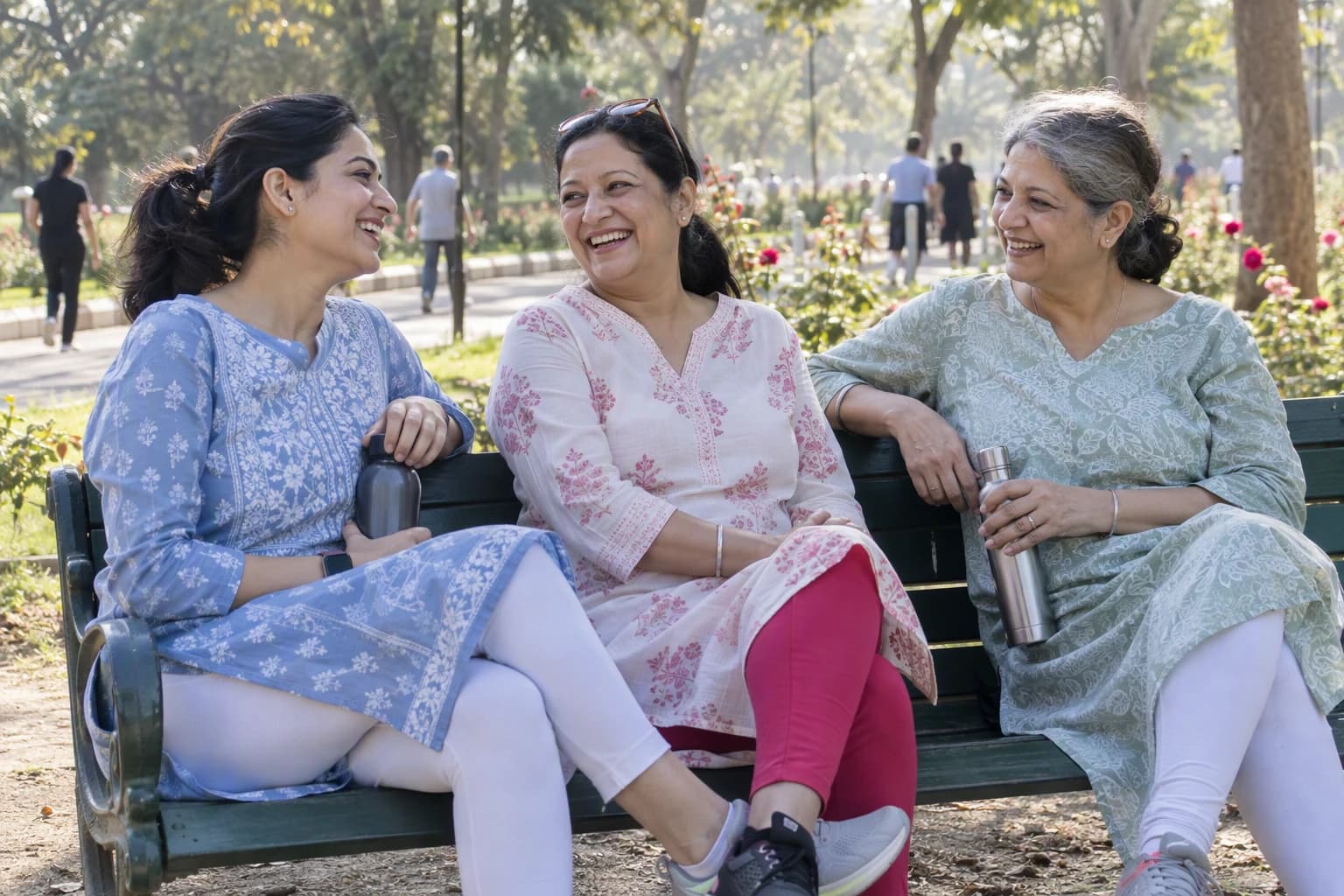
From about 40, everyone loses a little muscle each year unless they work at keeping it, so protein and lifting become more important with every birthday. Each page below takes one of these situations and works through it for Indian bodies and Indian kitchens.
Misra 2009: the consensus lines for Asian Indians.

Weight loss near me: choosing a doctor or programme
A good programme begins by working out why you gained weight, and a diet chart comes much later. Ask a few questions before you pay anyone.

Read the full section
Search weight loss near me in most Indian cities and the results are a mix of slimming centres, bariatric surgeons and ads, which tells you very little about which one fits. The slimming centre tends to begin with a weigh-in and a package. The surgeon begins with whether you need an operation. Most people are somewhere in the middle and need a blood test first, since thyroid, sugar, liver and vitamin levels all change what the plan should be, along with a doctor who reads the results and can add treatment if it is warranted.
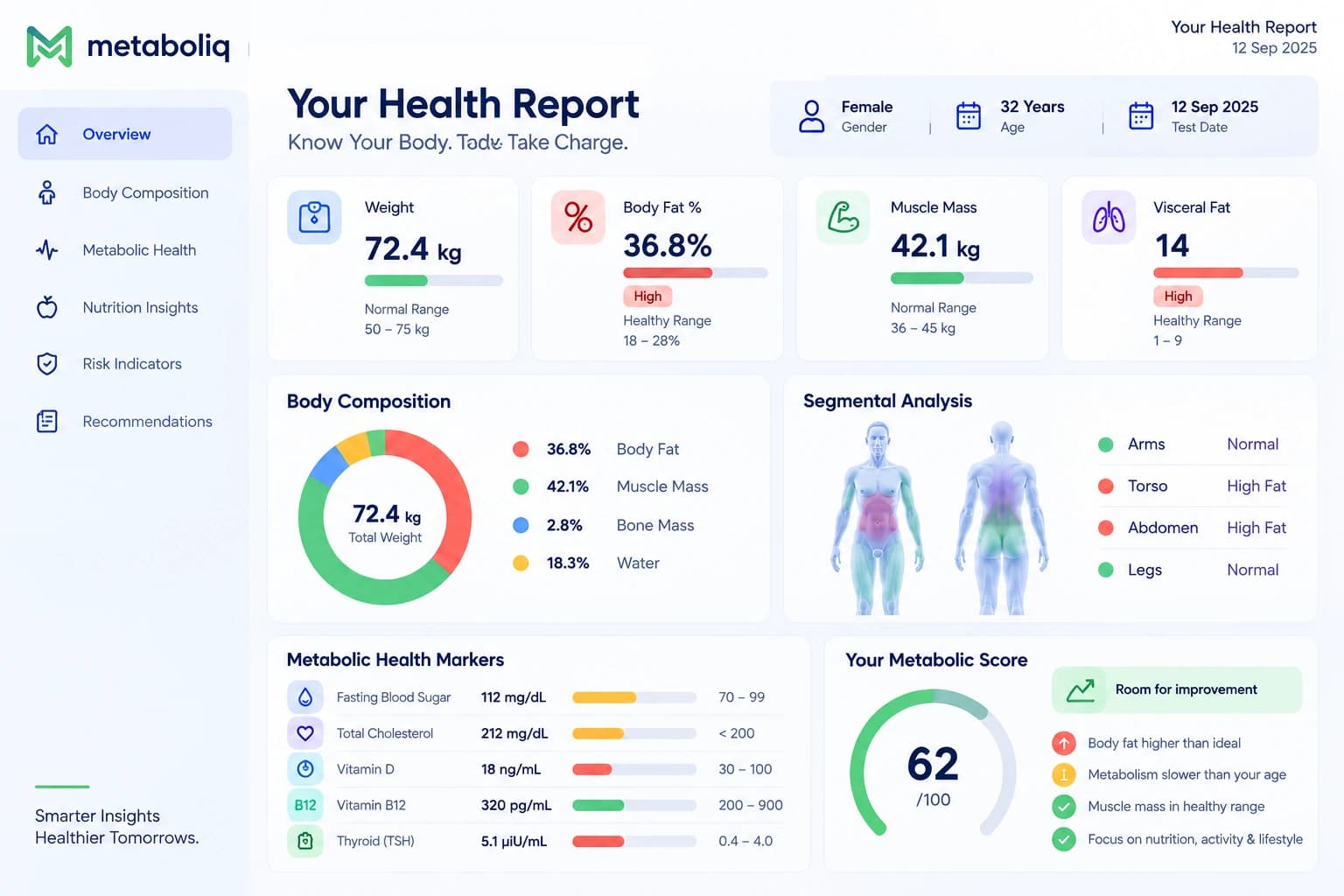
On the phone, the quickest way to sort them is to ask what happens in the first week, and then how they stop you losing muscle. A programme that never mentions protein or strength work has not thought about it. Distance matters less than people assume: a doctor can see you on video wherever you live, and blood can be collected at home. The city pages below list where home collection runs today. That is also how Metaboliq is set up: a health assessment with a home blood test of 45+ markers, then a registered doctor who reads it with you.
- Starts with a blood test
- A doctor reads it with you
- Sets protein and strength work
- Reviews waist and strength monthly
Every source, in full (25)
[1] Hall KD, et al. Quantification of the effect of energy imbalance on bodyweight
The Lancet, 2011. Body weight responds slowly to a sustained change in energy intake, and the old rule of 3,500 kcal per pound overstates long-term loss because energy use falls as weight falls.
Read the source[2] Sumithran P, et al. Long-term persistence of hormonal adaptations to weight loss
New England Journal of Medicine, 2011. After diet-induced weight loss, leptin fell and ghrelin and hunger rose, and one year later these appetite signals had still not returned to their starting levels.
Read the source[3] Fothergill E, et al. Persistent metabolic adaptation 6 years after "The Biggest Loser" competition
Obesity, 2016. Six years after a televised weight-loss contest, 14 contestants had regained much of the weight, and their resting metabolism was still about 500 kcal a day lower than their new size predicted.
Read the source[4] Yajnik CS, Yudkin JS. The Y-Y paradox
The Lancet, 2004. Two men with the same body-mass index, one Indian and one British, had very different body fat: the Indian man carried far more fat and less lean tissue at the same BMI.
Read the source[5] WHO Expert Consultation. Appropriate body-mass index for Asian populations and its implications for policy and intervention strategies
The Lancet, 2004. Asian populations carry higher health risk at lower BMI than Europeans; the consultation added public-health action points at BMI 23 and 27.5 for Asian countries.
Read the source[6] Misra A, et al. Consensus statement for diagnosis of obesity, abdominal obesity and the metabolic syndrome for Asian Indians and recommendations for physical activity, medical and surgical management
Journal of the Association of Physicians of India, 2009. For Asian Indians: overweight from BMI 23 and obesity from BMI 25, abdominal obesity from a waist of 90 cm in men and 80 cm in women, with recommendations on activity and medical and surgical care.
Read the source[7] Anjana RM, et al. Metabolic non-communicable disease health report of India: the ICMR-INDIAB national cross-sectional study (ICMR-INDIAB-17)
The Lancet Diabetes & Endocrinology, 2023. Across 113,043 adults in every state, 28.6% had generalised obesity, 39.5% abdominal obesity, 15.3% prediabetes and 11.4% diabetes.
Read the source[8] Heymsfield SB, et al. Weight loss composition is one-fourth fat-free mass: a critical review and critique of this widely cited rule
Obesity Reviews, 2014. The common rule that a quarter of diet weight loss is fat-free mass is an average; the real share varies with starting body fat, sex, age, the size of the energy deficit and exercise.
Read the source[9] Cava E, Yeat NC, Mittendorfer B. Preserving healthy muscle during weight loss
Advances in Nutrition, 2017. Weight loss removes some muscle along with fat; low muscle mass raises the risk of frailty, and protein plus resistance exercise are the best-supported ways to limit the loss.
Read the source[10] Morton RW, et al. A systematic review, meta-analysis and meta-regression of the effect of protein supplementation on resistance training-induced gains in muscle mass and strength
British Journal of Sports Medicine, 2018. Across 49 trials, extra protein added to strength-training gains, with no further gain in fat-free mass beyond about 1.6 g per kilo a day in total.
Read the source[11] Leidy HJ, et al. The role of protein in weight loss and maintenance
American Journal of Clinical Nutrition, 2015. Higher-protein diets of about 1.2 to 1.6 g per kilo a day improve appetite control, body weight and body composition compared with lower-protein diets.
Read the source[12] ICMR-National Institute of Nutrition. Dietary Guidelines for Indians
ICMR-NIN, Hyderabad, 2024. The day's plate: vegetables and greens as the largest share, whole grains and millets, pulses, eggs, meat or fish, milk or curd, nuts and seeds; added sugar and salt kept low; slow, steady weight reduction.
Read the source[13] Bull FC, et al. World Health Organization 2020 guidelines on physical activity and sedentary behaviour
British Journal of Sports Medicine, 2020. Adults should do 150 to 300 minutes of moderate activity a week, or 75 to 150 minutes of vigorous activity, plus muscle-strengthening work on two or more days.
Read the source[14] Swift DL, et al. The role of exercise and physical activity in weight loss and maintenance
Progress in Cardiovascular Diseases, 2014. Aerobic exercise at public-health levels produces modest weight loss on its own, around 2 kg on average with wide variation, and plays an important part in preventing regain.
Read the source[15] Thomas JG, et al. Weight-loss maintenance for 10 years in the National Weight Control Registry
American Journal of Preventive Medicine, 2014. Across 2,886 registry members followed for ten years, most of the weight lost was maintained, and falls in physical activity, dietary restraint and self-weighing were linked with more regain.
Read the source[16] Garthe I, et al. Effect of two different weight-loss rates on body composition and strength and power-related performance in elite athletes
International Journal of Sport Nutrition and Exercise Metabolism, 2011. Athletes who lost about 0.7% of body weight a week while strength training gained lean mass and strength; those losing about 1.4% a week did not gain lean mass.
Read the source[17] Kondo T, et al. Vinegar intake reduces body weight, body fat mass, and serum triglyceride levels in obese Japanese subjects
Bioscience, Biotechnology, and Biochemistry, 2009. In a 12-week double-blind trial run by researchers at a vinegar company, a drink with 15 or 30 ml of vinegar a day lowered weight, waist and triglycerides slightly more than a placebo drink.
Read the source[18] Pooyandjoo M, et al. The effect of (L-)carnitine on weight loss in adults: a systematic review and meta-analysis of randomized controlled trials
Obesity Reviews, 2016. Across trials, adults taking carnitine lost about 1.33 kg more than controls, and the difference shrank the longer they took it.
Read the source[19] Spiegel K, et al. Sleep curtailment in healthy young men is associated with decreased leptin levels, elevated ghrelin levels, and increased hunger and appetite
Annals of Internal Medicine, 2004. Two nights of four hours' sleep lowered leptin, raised ghrelin, and increased hunger, especially for calorie-dense, carbohydrate-rich food.
Read the source[20] Diabetes Prevention Program Research Group (Knowler WC, et al.). Reduction in the incidence of type 2 diabetes with lifestyle intervention or metformin
New England Journal of Medicine, 2002. In adults at high risk, a lifestyle programme aiming at 7% weight loss and 150 minutes of activity a week cut new cases of type 2 diabetes by 58% over about three years.
Read the source[21] Ramachandran A, et al. The Indian Diabetes Prevention Programme shows that lifestyle modification and metformin prevent type 2 diabetes in Asian Indian subjects with impaired glucose tolerance (IDPP-1)
Diabetologia, 2006. In Indian adults with impaired glucose tolerance, lifestyle change lowered the three-year risk of diabetes by 28.5% compared with usual care.
Read the source[22] Wing RR, et al. Benefits of modest weight loss in improving cardiovascular risk factors in overweight and obese individuals with type 2 diabetes
Diabetes Care, 2011. A loss of 5 to under 10% of body weight improved blood sugar, blood pressure, triglycerides and HDL cholesterol at one year, and larger losses improved them more.
Read the source[23] American Diabetes Association Professional Practice Committee. 2. Diagnosis and Classification of Diabetes: Standards of Care in Diabetes-2024
Diabetes Care, 2024. An HbA1c below 5.7% is normal, 5.7 to 6.4% marks prediabetes, and 6.5% or above, confirmed, diagnoses diabetes.
Read the source[24] Eisenberg D, et al. 2022 ASMBS and IFSO: Indications for Metabolic and Bariatric Surgery
Surgery for Obesity and Related Diseases, 2022. Surgery is recommended from BMI 35 and considered from BMI 30 with metabolic disease; in Asian populations the thresholds are lower, with surgery to be offered from BMI 27.5.
Read the source[25] Longvah T, Ananthan R, Bhaskarachary K, Venkaiah K. Indian Food Composition Tables 2017
National Institute of Nutrition (ICMR), Hyderabad, 2017. Table 1, Proximate Principles and Dietary Fibre: energy, protein, fat, available carbohydrate and dietary fibre per 100 g edible portion, the mean of the regions sampled. Every figure on this page comes from it.
Read the source