metaboliq
Why men put weight on around the belly
Men tend to store extra fat inside the abdomen, around the liver and gut, while women store more under the skin of the hips and thighs.
Read the full section
That deep belly fat is the kind tied to diabetes and heart disease.
Indian men have a lower threshold than most. A consensus panel led by Dr Anoop Misra set abdominal obesity for Indian men at a waist of 90 cm, because sugar, blood pressure and cholesterol go wrong at smaller waists here than in Europe. The ICMR-INDIAB survey of 113,043 adults found 11.4% had diabetes and 15.3% prediabetes, and abdominal obesity was more common than obesity by BMI.
Arvind, 44, a chartered accountant in Chennai, is a composite of the men who write to us. He weighs 86 kg at 5 feet 8 inches, his waist is 101 cm, and he gets breathless on the stairs to his office. His father had his first heart attack at 52. He has tried twice to lose weight, both times by skipping breakfast and walking, and both times stopped after a month.
Men have one thing in their favour. Thyroid trouble, which women often suspect behind their weight, is much less common in men: in a study across eight Indian cities, 5% of men had an underactive thyroid against 16% of women. For most men the cause is plainer, and so is the fix.
- 90 cmabdominal obesity line, Indian men

Why men often lose weight faster at first
Men usually carry more muscle than women of the same weight, and muscle sets most of the energy you burn at rest.
Read the full section
That gives men a head start, and it is also the thing a careless diet takes away.
Alexandra Johnstone's study in Aberdeen measured the resting metabolic rate of 150 adults. Fat-free mass, mostly muscle and organs, explained 63% of the differences between people, fat mass 6% and age 2%. Once body make-up was counted, being a man or a woman made no significant difference. Men burn more at rest mainly because they have more muscle.
That has a catch. A kilo of muscle burns about 13 kcal a day at rest against 4.5 for a kilo of fat, so losing muscle does lower the resting rate, a little. The bigger cost is strength and shape, and how easily the weight comes back.
So the first fast kilos are partly water and partly stored carbohydrate, and they will slow down. Men who expect that do better than men who take the plateau in week five as proof that nothing works.

A weight loss diet chart for Indian men
The best diet chart for a man is his usual food with the grain cut back and the protein doubled.
Read the full section
There is no calorie target here on purpose; a doctor or dietitian can set one from your numbers.
Breakfast at 8: three egg whites and one whole egg as bhurji with one roti, or two besan chillas with curd. Mid-morning: a fruit and buttermilk. Lunch at 1: one katori of rice or two rotis, a large katori of dal or chicken curry, sabzi, salad and curd. Evening: chai with less sugar and a handful of roasted chana instead of samosas from the office canteen. Dinner by 8.30: grilled fish, chicken tikka, paneer bhurji or rajma with a vegetable and one roti.
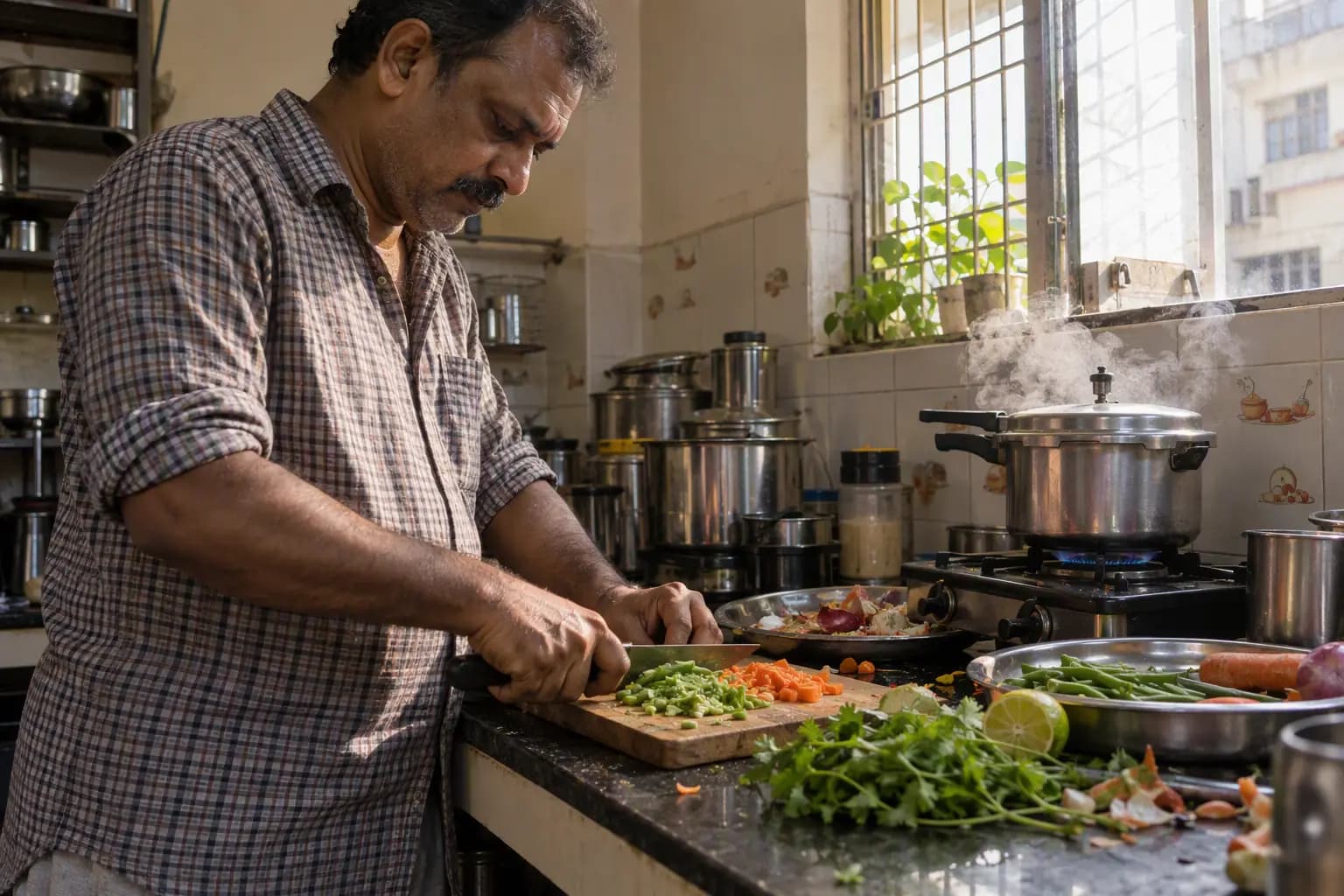
Arvind's version is South Indian. Two idlis with sambar and an omelette in the morning, a small helping of rice with plenty of fish curry, poriyal and rasam at lunch, and chapati with chicken or chana masala at night. What changed was the amount of rice, from two big plates a day to one small katori at each meal, and the protein, which went from a spoonful of dal to a real serving at every meal.
Protein keeps men fuller and helps protect muscle while eating less, as Thomas Wycherley's meta-analysis of weight-loss trials showed. The chart gives the protein in a usual serving of common foods.
| Time | Meal | |
|---|---|---|
| Breakfast | 8 am | Egg bhurji, 1 roti |
| Lunch | 1 pm | Rice, dal or chicken |
| Snack | 5 pm | Chana, chai |
| Dinner | 8.30 pm | Fish or paneer, 1 roti |
Lift weights so the weight you lose is fat
Walking burns fat. Strength training protects the muscle underneath, and a weight-loss plan for men that skips it loses more muscle than it needs to.
Sources: [8]
Read the full section
Gary Hunter's trial in Alabama is the clearest picture of this. Ninety-four people lost about 12 kg each on the same diet. Those who also did resistance training kept their fat-free mass, and in fact gained a little, from 46.9 to 47.2 kg. Those who did only aerobic exercise lost a kilo of it, and those who did no exercise lost 1.5 kg. The study was in women, and the principle applies to men just as strongly.
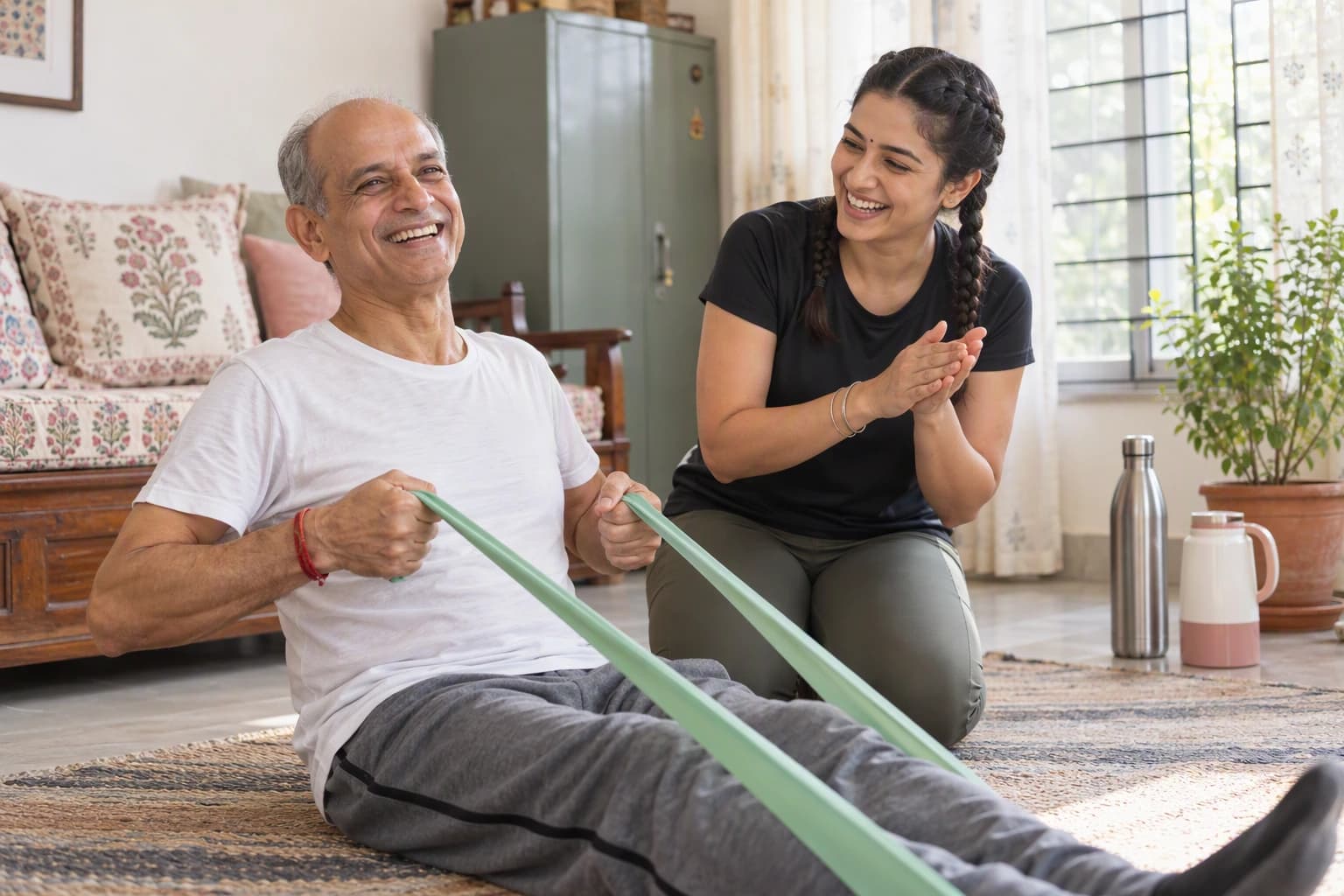
You do not need a gym. Squats, push-ups, lunges, a backpack filled with books for rows, and a plank, three rounds of each, take 25 minutes. Arvind does this on Monday, Wednesday and Friday mornings, and walks 40 minutes on the other days along Besant Nagar beach before the heat.
As you get stronger, make it harder: more repetitions, slower movement, a heavier backpack, or a gym once the habit is set.
| Start | End | |
|---|---|---|
| Weights | 46.9 kg | 47.2 kg |
| Aerobic only | 45.4 kg | 44.4 kg |
| No exercise | 47.9 kg | 46.4 kg |
A weekly workout plan for men
Sit-ups do not flatten a belly, which is the first thing most men need to hear.
Read the full section
Researchers at Southern Illinois University had adults do abdominal exercises daily for six weeks. Their stomach muscles got stronger and their waists did not budge.
The fat that matters sits behind those muscles, and it responds to the whole body working. Dirk Vissers's review of fifteen trials found that regular aerobic exercise reduced visceral fat even without a diet. The CENTRAL trial from Israel, whose 278 volunteers were 89% men, found that 18 months of moderate weight loss cut visceral fat by 22%, and that volunteers who added exercise to their diet lost more of it than those who did not.
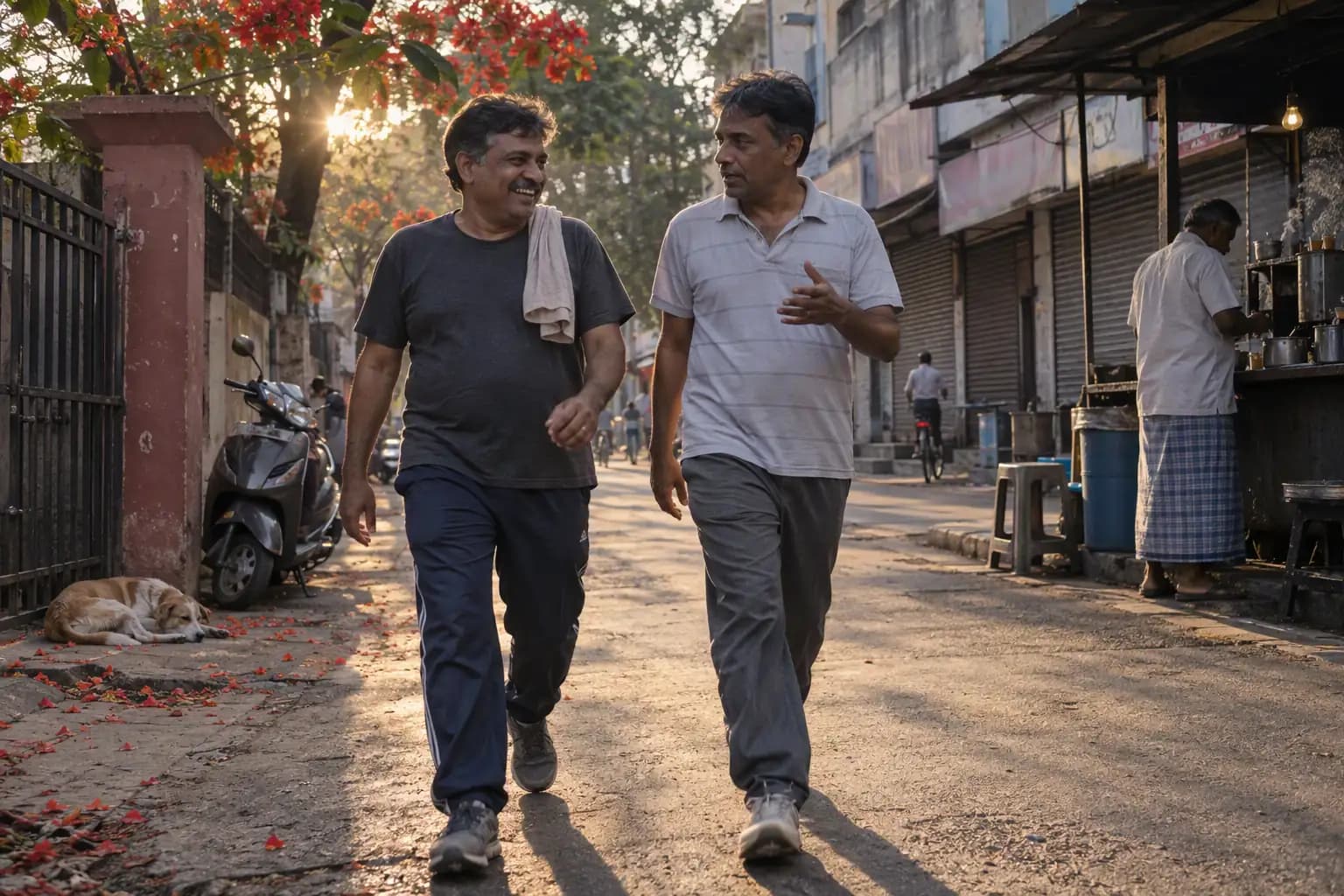
Arvind's week is built around his office hours. He does a 25-minute strength session on Monday, Wednesday and Friday before breakfast: squats, push-ups, lunges and rows with a backpack full of old ledgers. On Tuesday, Thursday and Saturday he walks for 40 minutes along Besant Nagar beach while it is still cool. Sunday is a rest day, or a long walk if the family is up for it.
The rest happens in between. He climbs the stairs to his fourth-floor office instead of waiting for the lift, takes client calls on his feet, and parks at the far end of the lot.
| Day | Do | |
|---|---|---|
| Mon, Wed, Fri | 3 days | Strength, 25 min |
| Tue, Thu, Sat | 3 days | Walk, 40 min |
| Sun | 1 day | Rest or long walk |
- 22%visceral fat lost, CENTRAL trial
Sleep, alcohol and the office routine
Short sleep turns a diet against your muscle.
Read the full section
In one carefully controlled study, people on the same diet lost far less fat and far more muscle when they slept five and a half hours.
Arlet Nedeltcheva's study at the University of Chicago kept volunteers on the same reduced-calorie diet for two weeks, once with 8.5 hours in bed and once with 5.5. With short sleep, fat loss fell from 1.4 kg to 0.6 kg, loss of fat-free mass rose from 1.5 kg to 2.4 kg, and they were hungrier. A six-year study by Jean-Philippe Chaput found that men and women sleeping six hours or less gained more visceral fat.
Alcohol is the other leak. A few pegs of whisky with soda on a Saturday, and the chakna that comes with them, can undo a careful week. Arvind did not stop drinking; he moved from three pegs on Friday and Saturday to two on Saturday only, with roasted chana instead of fried cashews.
The office brings its own traps: the 11 am biscuit tin, the client lunch, the samosa at the 4 pm meeting. Keeping a fruit and a box of chana in the drawer works better than willpower.
Weight and testosterone in men
Obesity can lower testosterone in men, and losing weight tends to raise it again.
Sources: [14]
Read the full section
That is one reason men often say they feel better well before they reach their target.
Giovanni Corona's meta-analysis in Florence pooled 24 studies of men losing weight through a low-calorie diet or bariatric surgery. Both raised testosterone, and the more weight a man lost, the more it rose. Younger men, men without diabetes and men with more weight to lose saw the largest changes.
Low energy, a lower sex drive and losing muscle easily can all come with low testosterone. They also come with poor sleep, stress and too much alcohol, so it is worth a blood test before assuming anything. A morning testosterone level, read alongside sugar and thyroid, gives a doctor the picture.
Arvind's testosterone came back at the low end of normal. His doctor told him to recheck it after six months of weight loss, and not to buy any of the boosters advertised to him on YouTube.
- GainBelly fat rises
Testosterone falls.
- ThenMuscle drops
Energy dips.
- LoseFat comes off
Testosterone rises.
Blood tests a man should do before starting
Plenty of men with a 100 cm waist feel perfectly well and have blood results that say otherwise.
Read the full section
Testing first tells you how urgent the job is, and gives you numbers to beat.
The useful set is short: HbA1c and fasting sugar, a lipid profile, liver enzymes, kidney function and TSH, with a morning testosterone if energy or sex drive have dropped. Fatty liver is so common with a big belly that the liver tests are rarely a waste.
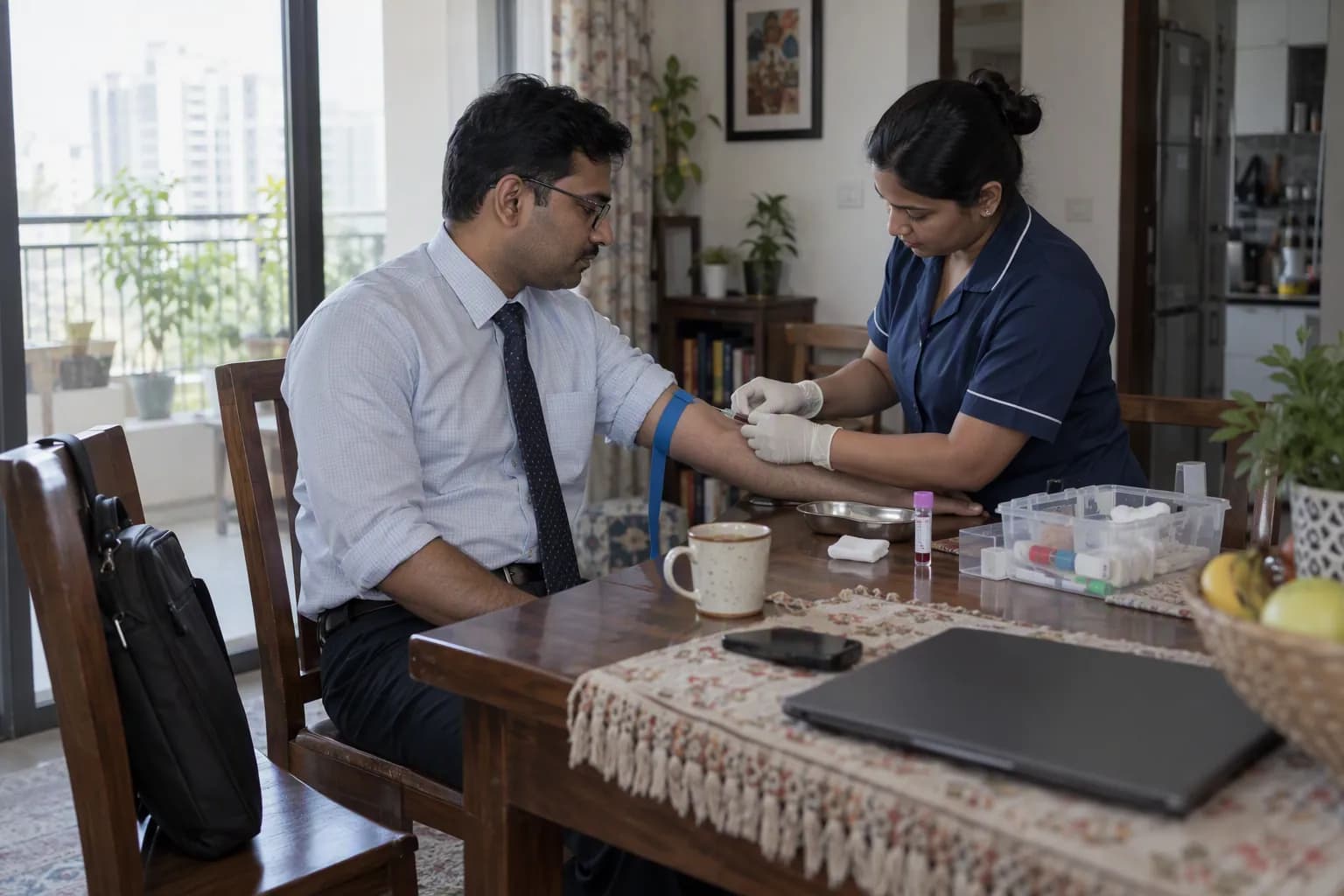
Arvind had put his off for three years. When he finally did it, his HbA1c was in the prediabetes range, his triglycerides were high and his liver enzymes were raised. He had been told to lose weight for a decade, and it was those three numbers, printed beside his father's history, that finally made him take it seriously.
That is where Metaboliq begins too, and the aim we set with members is "Lose up to 20% of your body weight — and keep your muscle". Results vary; your doctor decides what is right for you. Men tend to get the first half and forget the second, so the doctor and coach plan protein and strength work from week one. It starts with a home blood test that a doctor reads with you.
45+ markers, one home blood test
- HbA1c
- Thyroid test
- Fasting insulin
- HOMA-IR
- Fasting blood sugar
- Lipid profile
- Liver function test
- Kidney function test
Every source, in full (14)
[1] Misra A, et al. Consensus statement for diagnosis of obesity, abdominal obesity and the metabolic syndrome for Asian Indians and recommendations for physical activity, medical and surgical management
Journal of the Association of Physicians of India, 2009. Set the Indian adult bands: BMI 18.0-22.9 normal, 23.0-24.9 overweight and 25 or more obesity, with abdominal obesity at a waist of 90 cm or more in men and 80 cm or more in women.
Read the source[2] Anjana RM, et al. Metabolic non-communicable disease health report of India: the ICMR-INDIAB national cross-sectional study (ICMR-INDIAB-17)
The Lancet Diabetes & Endocrinology, 2023. Across 113,043 adults in 31 states and union territories, generalised obesity was 28.6%, abdominal obesity 39.5%, hypertension 35.5%, diabetes 11.4%, prediabetes 15.3% and dyslipidaemia 81.2% of those tested.
Read the source[3] Unnikrishnan AG, et al. Prevalence of hypothyroidism in adults: an epidemiological study in eight cities of India
Indian Journal of Endocrinology and Metabolism, 2013. Of 5,360 adults tested in eight Indian cities, 10.95% had hypothyroidism (15.86% of women, 5.02% of men), and 3.47% had it undetected until the study's blood test.
Read the source[4] Johnstone AM, et al. Factors influencing variation in basal metabolic rate include fat-free mass, fat mass, age, and circulating thyroxine but not sex, circulating leptin, or triiodothyronine
American Journal of Clinical Nutrition, 2005. In 150 adults, fat-free mass explained 63% of the differences in basal metabolic rate between people, fat mass 6% and age 2%; sex made no significant difference once body make-up was counted, and 26% stayed unexplained.
Read the source[5] Wang Z, et al. Specific metabolic rates of major organs and tissues across adulthood: evaluation by mechanistic model of resting energy expenditure
American Journal of Clinical Nutrition, 2010. Uses resting rates of about 13 kcal per kilo a day for skeletal muscle and 4.5 for fat tissue, against 200 for the liver, 240 for the brain and 440 for the heart and kidneys.
Read the source[6] Wycherley TP, et al. Effects of energy-restricted high-protein, low-fat compared with standard-protein, low-fat diets: a meta-analysis of randomized controlled trials
American Journal of Clinical Nutrition, 2012. In energy-restricted trials, higher-protein diets produced slightly greater fat loss and better preservation of fat-free mass than standard-protein diets.
Read the source[7] Longvah T, Ananthan R, Bhaskarachary K, Venkaiah K. Indian Food Composition Tables 2017
National Institute of Nutrition (ICMR), Hyderabad, 2017. Table 1, Proximate Principles and Dietary Fibre: energy, protein, fat, available carbohydrate and dietary fibre per 100 g edible portion. Every food figure in this page's charts is computed from it for the serving shown.
Read the source[8] Hunter GR, et al. Resistance training conserves fat-free mass and resting energy expenditure following weight loss
Obesity, 2008. In 94 women losing about 12 kg, those who did resistance training kept their fat-free mass (46.9 to 47.2 kg), resting energy expenditure and strength; those doing aerobic training (45.4 to 44.4 kg) or no exercise (47.9 to 46.4 kg) lost fat-free mass and resting energy use.
Read the source[9] Vispute SS, et al. The effect of abdominal exercise on abdominal fat
Journal of Strength and Conditioning Research, 2011. Six weeks of abdominal exercises improved abdominal muscular endurance but did not reduce abdominal fat, waist circumference or body fat compared with a control group.
Read the source[10] Vissers D, et al. The effect of exercise on visceral adipose tissue in overweight adults: a systematic review and meta-analysis
PLoS One, 2013. Across fifteen trials without calorie restriction, exercise reduced visceral fat, with moderate or high intensity aerobic training showing the greatest effect.
Read the source[11] Gepner Y, et al. Effect of distinct lifestyle interventions on mobilization of fat storage pools: CENTRAL magnetic resonance imaging randomized controlled trial
Circulation, 2018. In 278 sedentary adults over 18 months, moderate weight loss brought visceral fat down 22% and liver fat 29%; added exercise reduced visceral fat further with either diet, and the Mediterranean low-carbohydrate diet beat low-fat for liver and heart fat.
Read the source[12] Nedeltcheva AV, et al. Insufficient sleep undermines dietary efforts to reduce adiposity
Annals of Internal Medicine, 2010. On the same reduced-calorie diet for 14 days, 5.5 hours of sleep instead of 8.5 cut the share of weight lost as fat by 55% (0.6 kg of fat against 1.4 kg), raised the loss of fat-free mass by 60% (2.4 kg against 1.5 kg) and increased hunger.
Read the source[13] Chaput JP, et al. Change in sleep duration and visceral fat accumulation over 6 years in adults
Obesity, 2014. Adults sleeping six hours or less gained more visceral fat over six years than those sleeping seven to eight hours, and moving from short to adequate sleep was associated with less gain.
Read the source[14] Corona G, et al. Body weight loss reverts obesity-associated hypogonadotropic hypogonadism: a systematic review and meta-analysis
European Journal of Endocrinology, 2013. Across 24 studies of men, both a low-calorie diet and bariatric surgery raised testosterone, and the amount of weight lost was the best predictor of how far testosterone rose.
Read the source