 metaboliq
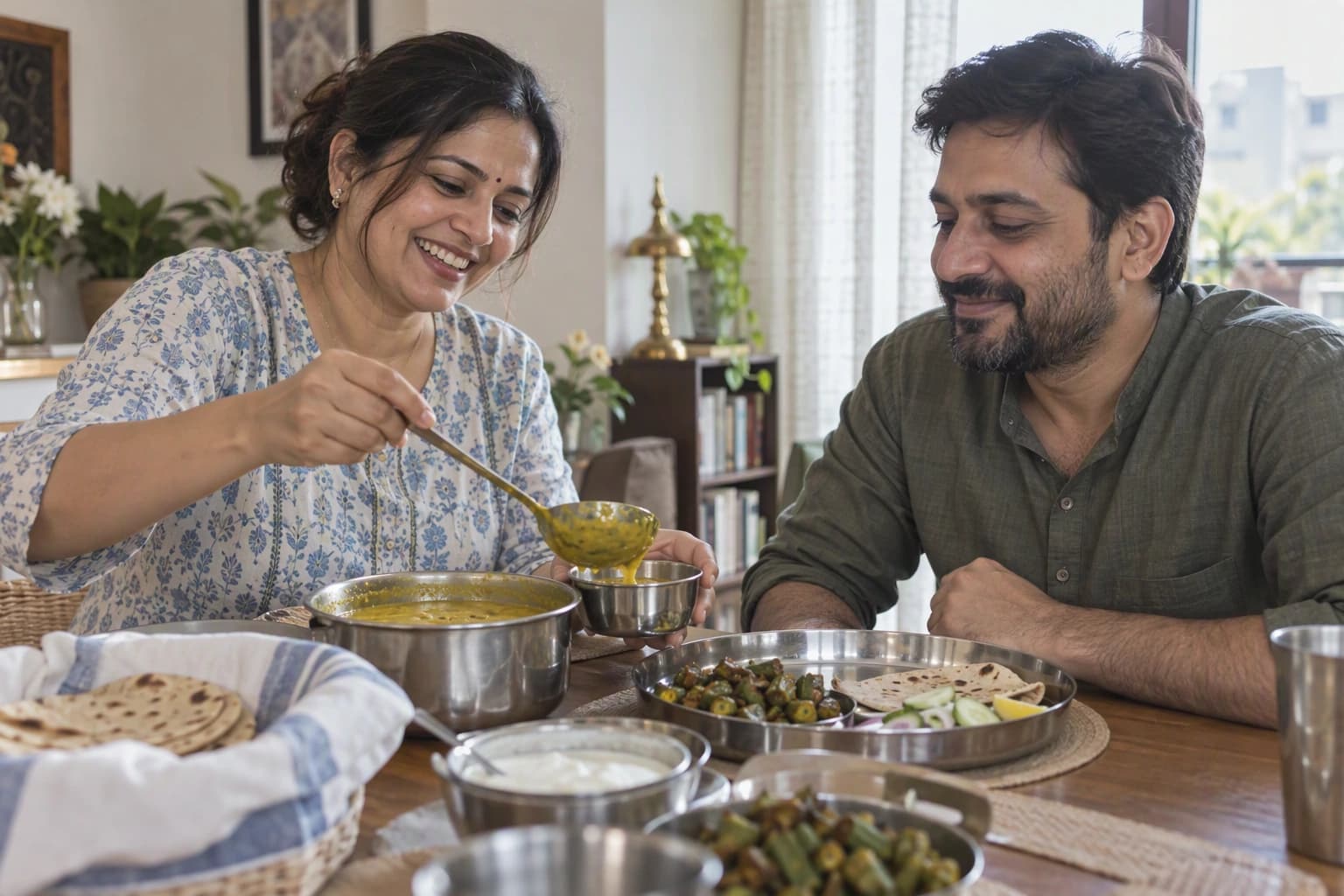
The plate: what an Indian weight-loss meal looks like
ICMR-NIN's Dietary Guidelines for Indians (2024) draw the day as a plate: vegetables and greens as the largest share, then whole grains and millets, then pulses, eggs, meat or fish, with milk or curd and a few nuts and seeds. For weight loss, the same plate works with two changes: the grain is measured rather than served until full, and a protein food sits at every meal, not only at dinner.
In a katori-and-roti kitchen that means one or two medium rotis or one small katori of rice; a full katori of dal, or paneer, eggs, chicken or fish; and sabzi and salad filling the rest. Oil is counted by the teaspoon: each one is about 44 kcal, and a restaurant gravy can hide several. Cereals and pulses together, in the 3:1 ratio the guidelines describe, give vegetarian protein a better mix of amino acids.
Protein: the part that keeps the muscle
The RDA for a healthy Indian adult is 0.83 g of protein per kg a day: about 58 g for a 70 kg adult. When calories are cut, a meta-analysis of trials found that higher-protein diets kept more lean mass and lost slightly more fat than standard-protein ones. Most Indian plates are heavy on grain and light on protein, so the fix is usually adding, not cutting: a second katori of dal, a bowl of curd, an egg, a piece of paneer or a handful of roasted chana.
Our Indian food pages give the protein of each everyday food for a real serving, and the protein calculator works out a daily figure for your weight.
Indian diet chart for weight loss: two worked days
These are worked examples of the plate, not a prescription: your own calories depend on your size, age and activity, which the energy-needs tool works out. Every item is weighed, grains and dals raw, and every figure is added up from its IFCT 2017 row; tap a food to see its page. Neither day goes below 1,500 kcal: our energy tool prints no daily figure under 1,200 kcal for women or 1,500 kcal for men.
A vegetarian day
Dal, besan, paneer and milk carry the protein; no meat, no eggs.
| Meal | Energy | Protein |
|---|---|---|
| Breakfast: Besan chilla with onion, tomato and spinach, and a glass of milk besan (chana dal flour), 40 g (132 kcal); onion, 30 g (14 kcal); tomato, 30 g (6 kcal); spinach, 30 g (7 kcal); 1 teaspoon oil or ghee (44 kcal); 1 glass cow's milk, 200 g (146 kcal) | 349 kcal | 16.5 g |
| Mid-morning: A guava 1 medium guava, 150 g (48 kcal) | 48 kcal | 2.2 g |
| Lunch: Three rotis, moong dal, bhindi sabzi and a cucumber salad 3 medium rotis (atta), 90 g (288 kcal); moong dal, raw weight, 40 g (130 kcal); bhindi, 120 g (32 kcal); cucumber, 100 g (20 kcal); 1 teaspoon oil or ghee (44 kcal) | 515 kcal | 22.3 g |
| Evening: Kala chana chaat with onion and tomato, and a banana 1 medium banana, 100 g (105 kcal); kala chana, dry weight, 30 g (86 kcal); onion, 20 g (10 kcal); tomato, 30 g (6 kcal) | 207 kcal | 7.4 g |
| Dinner: Paneer bhurji, a jowar roti and lauki sabzi paneer, 75 g (229 kcal); 1 jowar roti, 30 g (100 kcal); lauki, 150 g (17 kcal); tomato, 30 g (6 kcal); 1 teaspoon oil or ghee (44 kcal) | 396 kcal | 18.2 g |
| The day | 1515 kcal | 66.6 g |
59.2 g of fibre across the day. 3 teaspoons of oil or ghee are counted, at 44 kcal each; every extra teaspoon adds the same again.
A day with eggs, chicken and fish
Animal protein at three meals, with dal and vegetables still on the plate.
| Meal | Energy | Protein |
|---|---|---|
| Breakfast: A two-egg omelette with onion and tomato, a cup of papaya and a glass of milk 2 eggs, 100 g (135 kcal); onion, 30 g (14 kcal); tomato, 30 g (6 kcal); 1 teaspoon oil or ghee (44 kcal); 1 cup papaya, 150 g (36 kcal); 1 glass cow's milk, 200 g (146 kcal) | 382 kcal | 21.1 g |
| Lunch: Rice, chicken curry, cauliflower sabzi and salad rice, raw weight (1 small katori cooked), 40 g (142 kcal); chicken breast, raw weight, 120 g (202 kcal); cauliflower, 120 g (28 kcal); cucumber, 100 g (20 kcal); 1 teaspoon oil or ghee (44 kcal); 1 teaspoon oil or ghee (44 kcal) | 480 kcal | 32.6 g |
| Evening: An apple and a small handful of peanuts 1 medium apple, 150 g (93 kcal); peanuts, 25 g (130 kcal) | 223 kcal | 6.3 g |
| Dinner: Fish curry, two rotis, masoor dal and spinach rohu, raw weight, 100 g (102 kcal); 2 medium rotis (atta), 60 g (192 kcal); masoor dal, raw weight, 25 g (81 kcal); spinach, 100 g (24 kcal); 1 teaspoon oil or ghee (44 kcal) | 443 kcal | 34.3 g |
| The day | 1527 kcal | 94.4 g |
31.5 g of fibre across the day. 4 teaspoons of oil or ghee are counted, at 44 kcal each; every extra teaspoon adds the same again.
A PCOS diet for weight loss
There is no special PCOS diet. The 2023 international PCOS guideline found that no one eating pattern beats another, and puts healthy eating and activity first. What helps in practice is the same plate as above, built a little more firmly: protein at every meal (dal, paneer, eggs, chicken or fish), whole grains and millets in a measured katori, and refined sugar and maida kept rare.
Insulin resistance is common in PCOS, including at a normal weight, so the order of the plate matters too: vegetables and protein before the roti or rice. Weight change in PCOS can be slow; the guideline asks for a plan a woman can keep, not a crash diet.
A thyroid diet for weight loss
An underactive thyroid does not need a separate diet once it is treated: the plate above works. Two things are worth knowing. Use iodised salt, as the ICMR-NIN guidelines advise, and keep the total to about a teaspoon a day. And if you take thyroid hormone replacement, take it the way your doctor told you, apart from soya and from a high-fibre breakfast, since both can reduce how much is absorbed.
Cabbage, cauliflower and other crucifers are often called thyroid foods to avoid. Cooked, in normal amounts, they are part of a balanced Indian plate for most people with treated hypothyroidism.
A diet for prediabetes and type 2 diabetes
For blood sugar, the grain is the part to measure. The American Diabetes Association's standards say there is no single ideal split of carbohydrate, protein and fat; they ask for vegetables, pulses and whole grains, and less refined carbohydrate and added sugar. On an Indian plate that means one measured katori of rice or one or two rotis, a full katori of dal or a protein dish, and half the plate as sabzi and salad.
Eat the vegetables and protein first and the grain last: in a small trial, that order alone lowered the rise in blood sugar after the meal. Whole fruit, counted, is fine; juice and sweets are where sugar climbs fastest. If you take anything for your sugar, your doctor sets your carbohydrate targets, because a sudden change in the plate can change what you need.
Everyday Indian foods, by the numbers
Each food below has its own page with its IFCT 2017 figures for a real serving, how it fits a plate that loses fat and keeps muscle, and how to cook it lighter.
Dals, chana, rajma and soya
Rice, atta, millets and breakfast grains
White rice, Brown rice, Wheat atta, Jowar, Ragi, Barley, Quinoa, Suji (rava), Poha, Sweet corn
Vegetables and roots
Potato, Sweet potato, Onion, Beetroot, Carrot, Bhindi, Bottle gourd, Moringa leaves
Fruit
Banana, Grapes, Guava, Litchi, Mango, Avocado, Jackfruit, Amla, Dates, Muskmelon, Chikoo, Pear, Watermelon, Papaya, Apple, Pomegranate