metaboliq

How much protein a day for weight loss
Start from your own weight, not from a number on a tub.
Read the full answer
India's RDA of 0.83 g per kg comes from nitrogen-balance studies of healthy adults who were eating enough to hold their weight. It is the amount that covers almost everyone at maintenance, and for a 70 kg adult it works out to about 58 g.
Eating less changes the picture. When calories fall, the body is more willing to break down muscle for fuel, and the trials that protected muscle best fed more protein than the RDA. Reviews of that work land on roughly 1.2 to 1.6 g per kg a day. A large analysis of strength-training trials found no further gain in lean mass once total intake passed about 1.6 g per kg, which makes a sensible upper end for most people.
For a 60 kg woman that range is about 72 to 96 g a day; for an 80 kg man, about 96 to 128 g. Most Indian homes eat closer to the RDA than to this, with most of the plate given to rice or roti, so the change is usually one more protein food a meal rather than a new way of eating.
- 58 gRDA for a 70 kg adult
- 84–112 gwhile losing, same adult
| RDA, 0.83 g/kg | While losing, 1.2–1.6 g/kg | |
|---|---|---|
| 50 kg | 42 g | 60–80 g |
| 60 kg | 50 g | 72–96 g |
| 70 kg | 58 g | 84–112 g |
| 80 kg | 66 g | 96–128 g |
| 90 kg | 75 g | 108–144 g |
Why a high protein diet helps you lose fat, not muscle
Here is the part of dieting the bathroom scale never shows you: some of the kilos that come off are muscle.
Read the full answer
Researchers in Australia pooled 24 trials in which two groups ate exactly the same calories and only the protein differed. After roughly three months, the higher-protein groups had lost 0.79 kg more in total and 0.87 kg more fat, and had held on to 0.43 kg more lean tissue. Small numbers. Look at what they tell you, though: extra protein did not so much make people lose more weight as change what that weight was made of.
Add training and the gap widens. A Canadian group put forty young men on about 40% fewer calories than they needed for four weeks, with six training sessions a week. Those eating 2.4 g of protein per kg actually put on 1.2 kg of lean mass while dropping 4.8 kg of fat. The 1.2 g group gained 0.1 kg and lost 3.5 kg. Few of us will ever train like those volunteers, but two or three sessions of squats, push-ups or weights a week push in the same direction.
| Difference | |
|---|---|
| Weight lost | 0.79 kg more |
| Fat lost | 0.87 kg more |
| Lean mass kept | 0.43 kg more |
Why protein keeps hunger quieter
Swap your usual poha for a besan chilla and a glass of milk for one week, and notice when you start thinking about lunch.
Read the full answer
A study in Seattle ran a stricter version of that experiment. Nineteen adults ate their usual diet for two weeks, then the same calories with protein raised from 15% to 30% for two more. After that they could eat as much as they wanted of the higher-protein food for twelve weeks. Nobody asked them to cut back. They ate about 440 fewer calories each day anyway, and came out 4.9 kg lighter, 3.7 kg of it fat.
Some of this comes down to digestion. Your body spends energy breaking food down; protein costs more to process than carbohydrate, and fat costs almost nothing. The calories involved are small. What matters more is that the same process seems tied to feeling full, and fullness is the difference between a smaller plate you can live with and one you abandon by Wednesday.
- 15% → 30%of calories from protein
- 4.9 kglost in 12 weeks
| Protein | Eating | |
|---|---|---|
| Weeks 1–2 | 15% of calories | Usual amount |
| Weeks 3–4 | 30% of calories | Same calories |
| Weeks 5–16 | 30% of calories | About 440 fewer each day |
High-protein Indian foods, veg and non-veg
Indian kitchens are better stocked for protein than the gym crowd gives them credit for.
Read the full answer
Rank everyday foods by protein per 100 kcal, using IFCT 2017, and soya beans come out far ahead on the vegetarian side. Masoor and moong dal come next, then kala chana and paneer, which sit close together. On the non-vegetarian side rohu beats chicken breast, and both beat eggs. Atta and rice carry some protein too, but you would need a stack of rotis to get anywhere with them, which is the very habit this page is trying to break.
Two foods need a little care. Peanuts are rich in protein but richer still in fat, so a small handful works as a snack and not as the protein of a meal. Paneer has the same issue to a smaller degree; weigh it once so you know what 75 g looks like. Milk is the quiet helper. One glass slips easily into a day, and two take a fair bite out of a vegetarian's gap. The table lists each food at the serving its own page uses.
| Food, one serving | kcal | Protein |
|---|---|---|
| Chicken breast 100 g | 168 | 21.8 g |
| Rohu fish 100 g | 102 | 19.7 g |
| Soya bean 30 g | 113 | 11.3 g |
| Paneer 50 g | 153 | 9.4 g |
| Egg 50 g | 74 | 6.7 g |
| Moong dal 30 g | 98 | 7.2 g |
| Kala chana 30 g | 86 | 5.6 g |
| Rajma 30 g | 90 | 6 g |
| Milk 200 g | 146 | 6.5 g |
| Peanuts 30 g | 156 | 7.1 g |
A high-protein vegetarian day, worked out
This vegetarian day reaches about 85.5 g of protein in about 1,691 kcal, with no eggs, no meat and no powder.
Read the full answer
Breakfast is a besan chilla stuffed with a little paneer, with a glass of milk. Mid-morning is a fistful of roasted kala chana and a guava. Lunch is two rotis with rajma cooked with a handful of soya beans, which lifts the protein without changing the taste much. The evening snack is simply another glass of milk, and dinner is palak paneer with a small katori of moong dal and a jowar roti.
Notice what is not there: no special flour, no imported food, nothing a family kitchen does not already stock. The work is in the spread. Each meal carries a protein food, so no single meal has to carry the day. Every item is weighed, grains and dals raw, and added up from its IFCT 2017 row; tap "every item" in the table to see the grams.
| Meal | kcal | Protein |
|---|---|---|
| Breakfast Besan chilla stuffed with paneer, and a glass of milk | 423 | 21.1 g |
| Mid-morning Roasted kala chana and a guava | 134 | 7.8 g |
| Lunch Two rotis, rajma cooked with a handful of soya beans, and cucumber | 432 | 20.7 g |
| Evening A glass of milk | 146 | 6.5 g |
| Dinner Palak paneer, moong dal and a jowar roti | 556 | 29.5 g |
| The day | 1691 | 85.5 g |
Every item, weighed
- Breakfast: besan (chana dal flour), 40 g (132 kcal); paneer, 30 g (92 kcal); onion, 20 g (10 kcal); 1 teaspoon oil or ghee (44 kcal); 1 glass cow's milk, 200 g (146 kcal)
- Mid-morning: kala chana, dry weight, 30 g (86 kcal); guava, 150 g (48 kcal)
- Lunch: 2 medium rotis (atta), 60 g (192 kcal); rajma, dry weight, 40 g (120 kcal); soya bean, dry weight, 15 g (57 kcal); cucumber, 100 g (20 kcal); 1 teaspoon oil or ghee (44 kcal)
- Evening: 1 glass cow's milk, 200 g (146 kcal)
- Dinner: paneer, 80 g (244 kcal); moong dal, raw weight, 30 g (98 kcal); 1 jowar roti, 40 g (134 kcal); spinach (palak), 150 g (36 kcal); 1 teaspoon oil or ghee (44 kcal)
56.4 g of fibre across the day; 3 teaspoons of oil or ghee counted. Grains and dals weighed raw; every figure from its IFCT 2017 row.
A high-protein day with eggs, chicken and fish
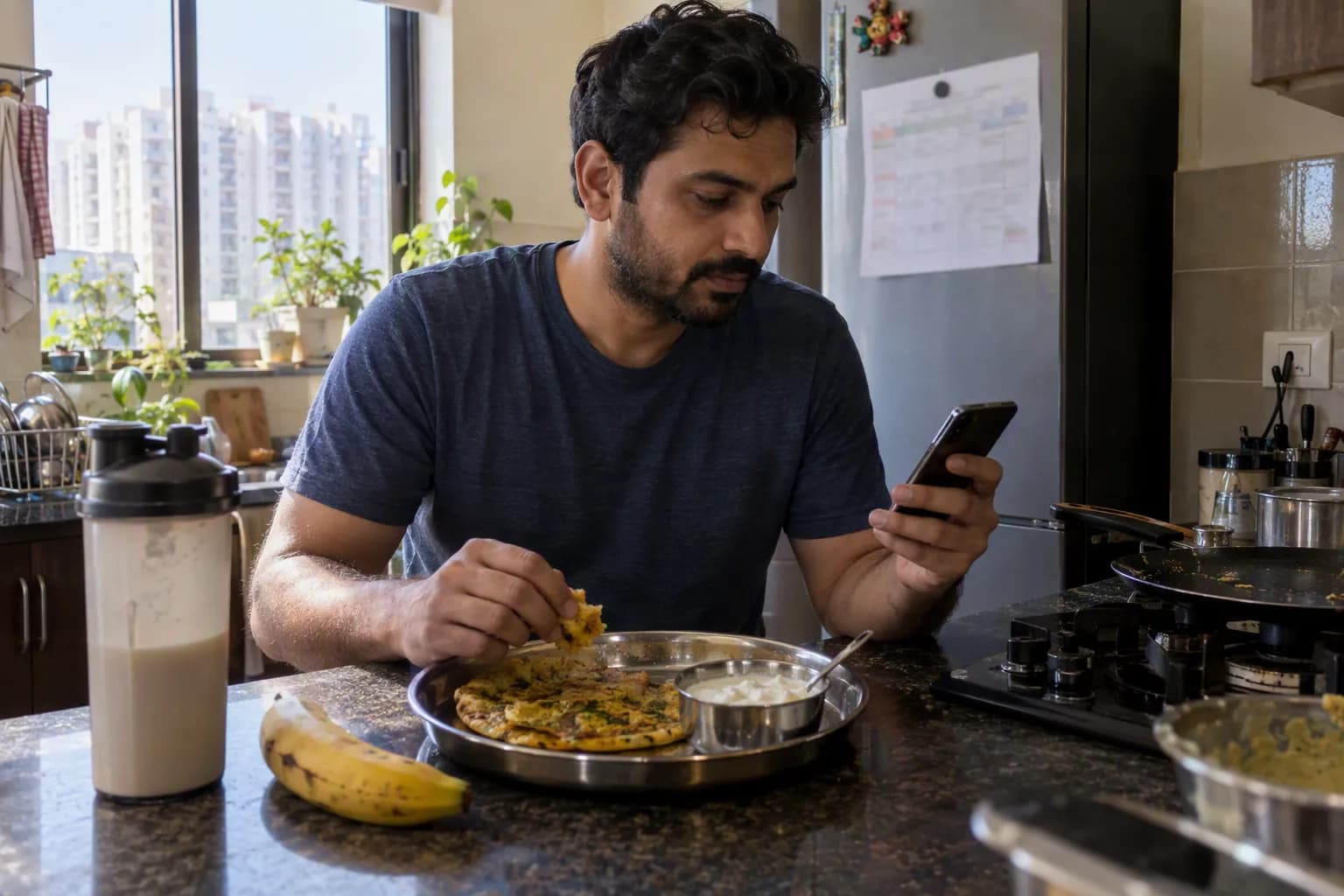
Add eggs, chicken and fish and the same calories carry more protein: this day lands at about 110.6 g in about 1,719 kcal.
Read the full answer
It starts with two boiled eggs plus two extra whites, a roti and a glass of milk. An apple mid-morning. Lunch is chicken curry with a small katori of rice, some masoor dal and gobhi. A glass of milk and a little roasted chana in the evening, then rohu curry for dinner with two rotis, palak and a spoonful or two of moong dal. We kept dal at both main meals on purpose: meat brings no fibre, and dal does.
The other thing this day does is spread the protein out. In a small study at the University of Texas, eight adults ate the same daily protein two ways, either evenly, about 30 g at each meal, or mostly at dinner. Spread evenly, their muscles built protein 25% faster over 24 hours. Plenty of Indian homes eat a light breakfast and a heavy dinner, so moving an egg or a katori of dal to the morning is the easiest fix on this page.
| Meal | kcal | Protein |
|---|---|---|
| Breakfast Two boiled eggs and two egg whites, a roti, and a glass of milk | 476 | 30.8 g |
| Mid-morning An apple | 93 | 0.4 g |
| Lunch Chicken curry, rice, masoor dal and gobhi | 498 | 34.4 g |
| Evening A glass of milk and a little roasted chana | 203 | 10.3 g |
| Dinner Rohu curry, two rotis, palak and moong dal | 449 | 34.6 g |
| The day | 1719 | 110.6 g |
Every item, weighed
- Breakfast: 2 boiled eggs, 100 g (148 kcal); 2 boiled egg whites, 60 g (32 kcal); 1 medium roti (atta), 30 g (96 kcal); onion, 20 g (10 kcal); 1 teaspoon oil or ghee (44 kcal); 1 glass cow's milk, 200 g (146 kcal)
- Mid-morning: apple, 150 g (93 kcal)
- Lunch: chicken breast, raw weight, 100 g (168 kcal); rice, raw weight, 50 g (178 kcal); masoor dal, raw weight, 25 g (81 kcal); cauliflower (gobhi), 120 g (28 kcal); 1 teaspoon oil or ghee (44 kcal)
- Evening: 1 glass cow's milk, 200 g (146 kcal); kala chana, dry weight, 20 g (57 kcal)
- Dinner: rohu, raw weight, 100 g (102 kcal); 2 medium rotis (atta), 60 g (192 kcal); spinach (palak), 120 g (29 kcal); moong dal, raw weight, 25 g (82 kcal); 1 teaspoon oil or ghee (44 kcal)
33.3 g of fibre across the day; 3 teaspoons of oil or ghee counted. Grains and dals weighed raw; every figure from its IFCT 2017 row.

Protein shakes for weight loss: do you need one?
You can lose weight without ever opening a tub of protein powder, and most people do.
Read the full answer
The strongest evidence for powders comes from gyms, not weight-loss clinics. A review of 49 trials in people doing regular strength training found that added protein gave a bit more strength and about 0.30 kg more lean mass. The benefit stopped once total protein, food plus powder, passed about 1.6 g per kg a day. Past that line, a shake is an expensive snack.
There are times it earns its place: a morning with no time to cook, a vegetarian who also avoids dairy, someone lifting four or five days a week who cannot eat enough dal to keep up. If you do buy one, count the scoop as part of a meal, pick one without added sugar, and let real food do most of the work.
Sources: [4]
| Result | |
|---|---|
| Strength (one-rep max) | 2.49 kg more |
| Lean mass | 0.30 kg more |
| No further gain above | 1.62 g per kg a day |
Is a high protein diet safe for your kidneys?
Start eating more dal and paneer and someone in the family will ask about your kidneys. For healthy kidneys, the trials are reassuring.
Read the full answer
Researchers at McMaster University pooled 28 trials, 1,358 adults in all, none with kidney disease. Some ate a high-protein diet, meaning at least 1.5 g per kg or 100 g a day; the rest ate normal amounts. Measured by how well the kidneys filtered blood, the two groups changed in the same way.
Damaged kidneys are a different matter. A review by kidney specialists warns that a lot of protein can push a struggling kidney downhill faster, and plant protein looked easier on the kidney than animal protein in the studies they read. Kidney trouble also tends to stay quiet for a long time. So check first: a creatinine and eGFR from one blood test settle it, and if the numbers are off, your doctor sets the protein, not this page.
| Healthy kidneys | Kidney disease | |
|---|---|---|
| 1.5 g/kg or more | No change in filtration (28 trials) | May speed decline |
| Plant protein | Fine | Looked gentler |
| Check first | Creatinine, eGFR | Ask your doctor |
Keeping your muscle while the weight comes off
Picture two people who both drop 8 kg.
Read the full answer
One kept her muscle and still carries the gas cylinder up two flights of stairs; the other lost a chunk of it and finds those stairs harder than before.
Reviews of this keep asking for the same two things: enough protein, and some kind of resistance work. Dieting alone takes muscle along with the fat. Protein at the levels on this page, plus weights, resistance bands or bodyweight moves two or three times a week, keeps more of it and keeps you stronger.
When we wrote down what our own programme is for, it came out as one line: "Lose up to 20% of your body weight — and keep your muscle". Results vary; your doctor decides what is right for you. The first step is a home blood test, kidney function included, which a registered doctor reads with you. Your protein number then comes from your body and your results, not from a chart on the internet.
- FirstCheck the kidneys
Creatinine and eGFR before raising protein.
- Every mealA protein food
Dal, paneer, eggs, chicken or fish.
- 2–3 times a weekStrength work
Weights or bodyweight exercise.
- MonthlyMeasure, not just weigh
Waist and strength, not only the scale.

Every source, in full (14)
[1] Recommended Dietary Allowances and Estimated Average Requirements for Indians
ICMR-NIN Expert Group, 2020. Protein for healthy Indian adults: 0.83 g per kg of body weight a day.
Read the source[2] Rand WM, Pellett PL, Young VR. Meta-analysis of nitrogen balance studies for estimating protein requirements in healthy adults
The American Journal of Clinical Nutrition, 2003. Across 19 nitrogen-balance studies (235 adults), the recommended allowance that covers nearly everyone came to 132 mg of nitrogen per kg a day, the 0.83 g of protein per kg that India's RDA uses; it is a floor for healthy adults at a stable weight.
Read the source[3] Leidy HJ et al. The role of protein in weight loss and maintenance
The American Journal of Clinical Nutrition, 2015. A review: higher-protein, calorie-reduced diets gave more fat loss and kept more lean mass in controlled trials; longer trials were mixed, and sticking to the diet explained most of the difference.
Read the source[4] Morton RW et al. A systematic review, meta-analysis and meta-regression of the effect of protein supplementation on resistance training-induced gains in muscle mass and strength in healthy adults
British Journal of Sports Medicine, 2018. Across 49 trials (1,863 adults) of strength training, extra protein added strength and muscle, with no further gain in lean mass beyond a total intake of about 1.6 g per kg a day.
Read the source[5] Wycherley TP et al. Effects of energy-restricted high-protein, low-fat compared with standard-protein, low-fat diets: a meta-analysis
The American Journal of Clinical Nutrition, 2012. In 24 trials (1,063 adults, about 12 weeks), a higher-protein diet at the same calories lost 0.79 kg more weight and 0.87 kg more fat, and kept 0.43 kg more lean mass, than a standard-protein diet.
Read the source[6] Longland TM et al. Higher compared with lower dietary protein during an energy deficit combined with intense exercise promotes greater lean mass gain and fat mass loss
The American Journal of Clinical Nutrition, 2016. Forty young men ate about 40% under their needs for four weeks while training six days a week; on 2.4 g of protein per kg they gained 1.2 kg of lean mass and lost 4.8 kg of fat, against 0.1 kg and 3.5 kg on 1.2 g per kg.
Read the source[7] Cava E, Yeat NC, Mittendorfer B. Preserving healthy muscle during weight loss
Advances in Nutrition, 2017. Diet-induced weight loss takes some muscle with it; a high protein intake and both endurance and resistance exercise help keep muscle mass, and resistance exercise also improves strength.
Read the source[8] Weigle DS et al. A high-protein diet induces sustained reductions in appetite, ad libitum caloric intake, and body weight despite compensatory changes in diurnal plasma leptin and ghrelin concentrations
The American Journal of Clinical Nutrition, 2005. When 19 adults moved from 15% to 30% of calories from protein and could eat as much as they liked, they ate about 440 fewer calories each day and lost 4.9 kg over 12 weeks, 3.7 kg of it fat.
Read the source[9] Westerterp KR. Diet induced thermogenesis
Nutrition & Metabolism, 2004. Digesting food uses 5 to 15% of a day's energy on a mixed diet; protein costs the most to process, fat the least, and protein's cost is tied to how full it keeps you.
Read the source[10] Longvah T, Ananthan R, Bhaskarachary K, Venkaiah K. Indian Food Composition Tables 2017
National Institute of Nutrition (ICMR), Hyderabad, 2017. The energy, protein and fibre per 100 g of every food in the day plans and tables on this page, measured across India's regions.
Read the source[11] Dietary Guidelines for Indians
ICMR-National Institute of Nutrition, 2024. The Indian plate for the day: vegetables and greens as the largest share, whole grains and millets, pulses, eggs, meat or fish, milk or curd, nuts and seeds; cereals and pulses in a 3:1 ratio; slow, steady weight reduction.
Read the source[12] Mamerow MM et al. Dietary protein distribution positively influences 24-h muscle protein synthesis in healthy adults
The Journal of Nutrition, 2014. In eight adults, the same daily protein split evenly (about 30 g at each of three meals) built muscle protein 25% faster over 24 hours than when most of it came at dinner.
Read the source[13] Devries MC et al. Changes in kidney function do not differ between healthy adults consuming higher- compared with lower- or normal-protein diets
The Journal of Nutrition, 2018. Across 28 trials (1,358 adults without kidney disease), higher-protein intakes (1.5 g per kg or more, or 100 g a day) did not change kidney filtration differently from normal intakes.
Read the source[14] Ko GJ et al. The effects of high-protein diets on kidney health and longevity
Journal of the American Society of Nephrology, 2020. A review warning that high-protein diets may worsen kidney function in people with kidney disease, and possibly some without; plant protein looked kinder to the kidney than animal protein in observational studies.
Read the source