metaboliq

How to lose weight naturally at home: what actually works
Ask around any Indian family and you will collect a dozen tips, from jeera water to skipping dinner.
Read the full section
The things with real evidence are fewer and duller: a small, steady calorie gap kept for months, enough protein, and daily movement.
Kevin Hall's modelling at the US National Institutes of Health explains why patience is the hard part. The body answers a change in eating slowly, with a half-time of about a year, so a habit you keep goes on working long after the first fortnight's excitement fades. Crash diets get the opposite result, a fast early drop followed by a routine nobody can live with.
The most convincing Indian evidence comes from Chennai. In the Indian Diabetes Prevention Programme, people whose sugar ran high after a glucose drink were given plain advice on food and walking, nothing more. Over three years 39.3% of them developed diabetes, against 55.0% of those who got no programme, and roughly six people had to follow the advice for one case to be prevented. That was ordinary food and walking, done at home.
Protein is the piece most home plans leave out. Reviews of tightly controlled feeding trials find more fat lost, better appetite control and more muscle kept when a reduced-calorie diet is higher in protein.
- 6People advised, one case prevented

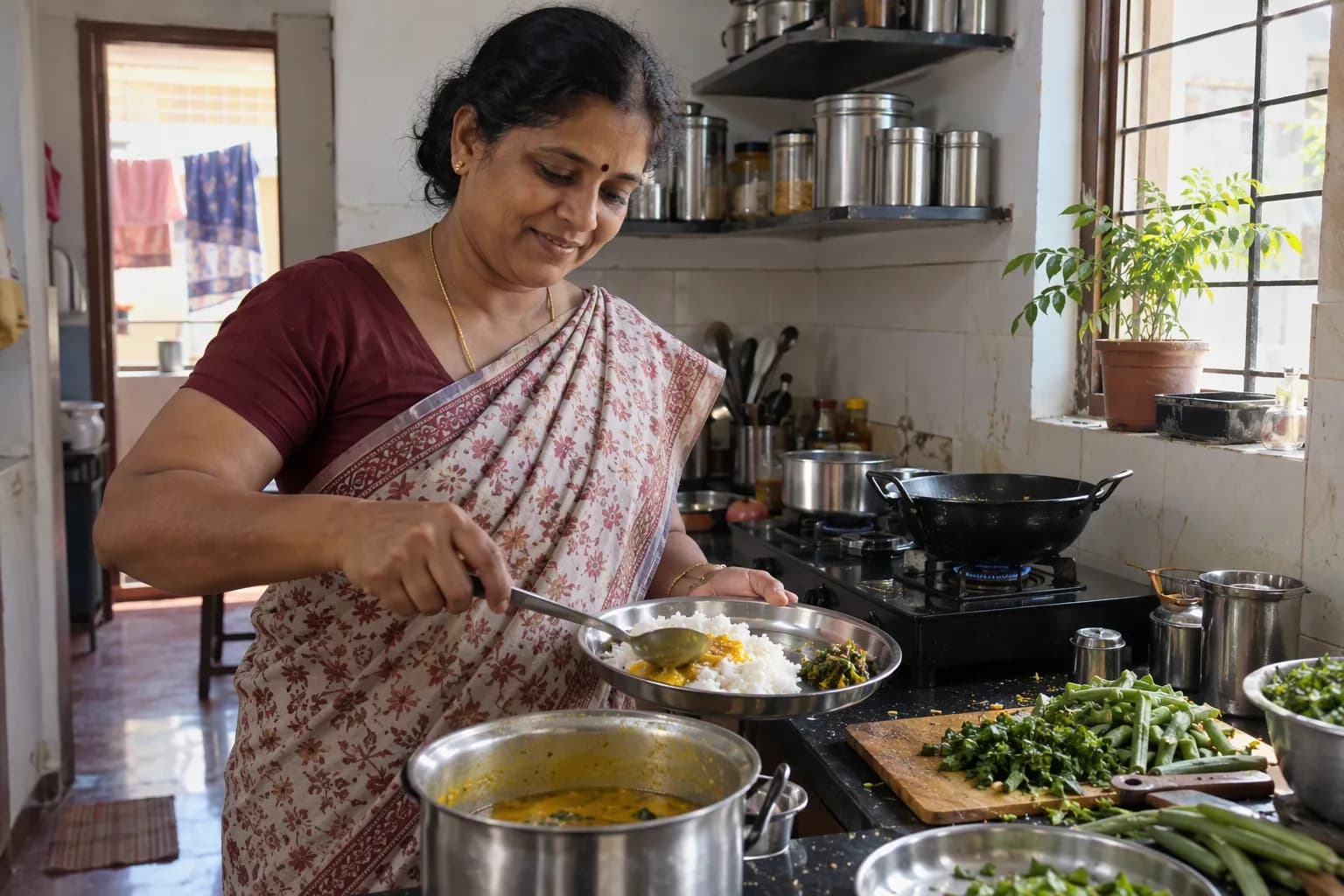
An Indian plate for weight loss at home
Nothing on this plate needs a special shop.
Read the full section
Half of it is sabzi or salad, a quarter is dal, paneer, eggs, chicken or fish, and the last quarter is rice or rotis, which is close to what ICMR-NIN recommends for every Indian adult.
NIN's plate puts vegetables and greens as the biggest share, then whole grains and pulses, with milk or curd and a handful of nuts, and asks for added sugar under 5% of the day's energy. The bars here show why dal and paneer earn their place: per 100 g, dry moong dal carries about twice the protein of wheat atta, and paneer is close behind.
The bigger leak in most homes is packaged food. In a tightly controlled NIH trial, the same 20 adults ate about 508 kcal a day more on an ultra-processed diet than on an unprocessed one, with the meals matched for sugar, fat and fibre, and gained weight within two weeks. Biscuits with chai, namkeen at five o'clock, a packet of chips during a match: this is where an Indian home quietly loses its calorie gap.
Poha with peanuts and a boiled egg, dal-chawal with a big bowl of sabzi, roti with paneer bhurji and curd. These are ordinary meals that happen to be built the right way round.
- 508Extra kcal a day, ultra-processed
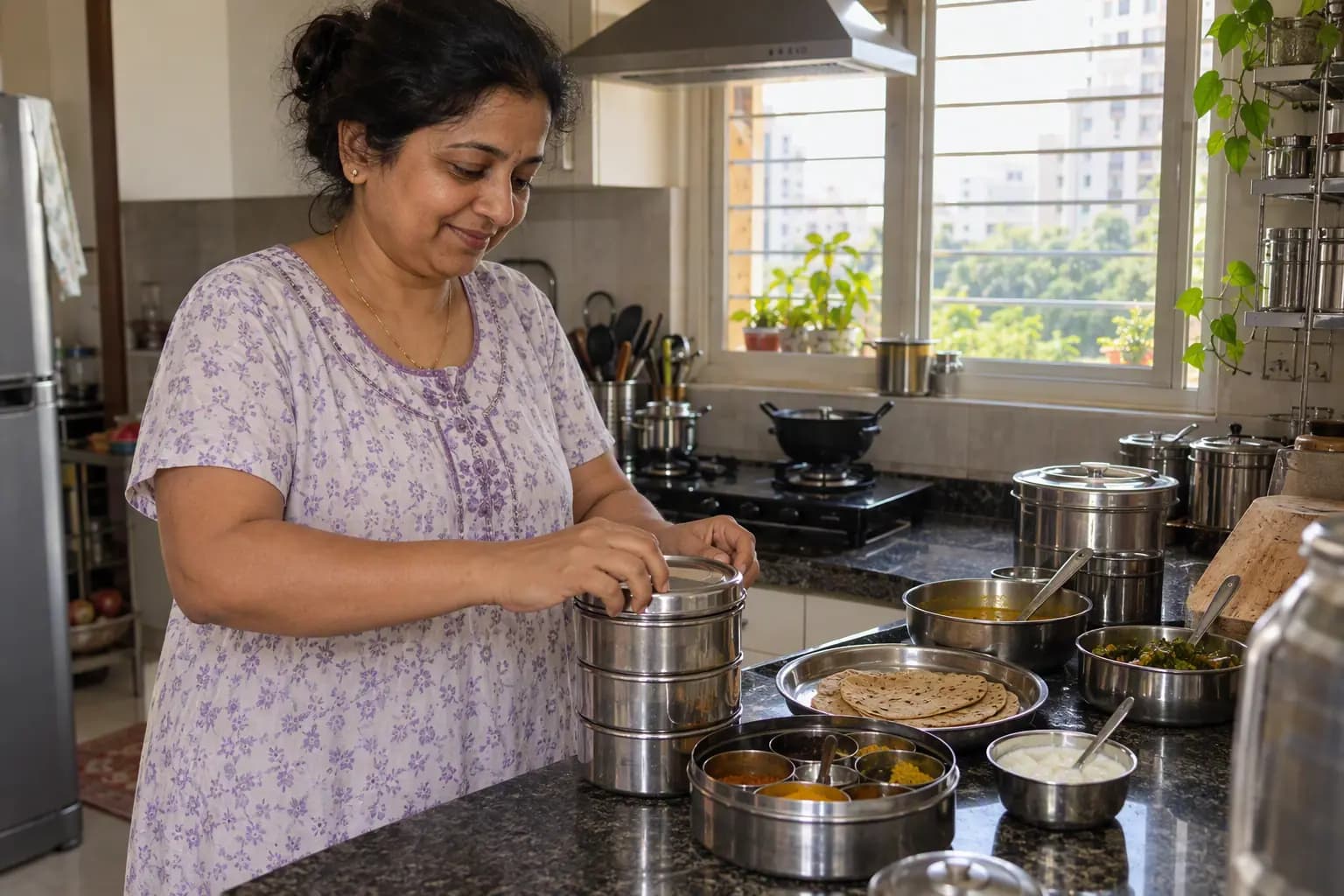
Home remedies for weight loss: jeera water, lemon, green tea and vinegar
Most kitchen remedies have little evidence.
Read the full section
Green tea made no meaningful difference to weight in trials outside Japan, vinegar's one positive trial was run by a vinegar maker, and jeera's best study added it to a diet.
Green tea is the best studied. A Cochrane review pooled six trials outside Japan and found an average difference of 0.04 kg after about twelve weeks, effectively nothing, with waist size moving by 0.2 cm. Japanese trials showed more, but varied too much to combine. Drink it if you like it, without sugar.
Apple cider vinegar rests mostly on a 2009 Japanese trial in which a drink containing 15 or 30 ml of vinegar a day went with lower weight and belly fat over twelve weeks. It was small, and it was run by Mizkan, which makes vinegar. Neat vinegar can also hurt the throat and teeth.
Jeera has one encouraging study. Iranian women on a weight-loss diet who took 3 g of cumin powder a day, stirred into curd at two meals, lost more weight and waist than women eating plain curd. The cumin helped alongside a diet, not instead of one. Warm lemon water with honey has no trial behind it, and a spoon of honey adds calories. Ajwain and methi water have none worth citing either.
| Best trial found | |
|---|---|
| Green tea | 0.04 kg difference, 6 trials |
| Vinegar, 15-30 ml | Some loss, 1 trial, maker-run |
| Cumin, 3 g in curd | Helped with a diet, 1 trial |
| Lemon and honey | No trial found |
- 0.04 kgGreen tea, outside Japan
Ayurvedic weight loss: what the evidence says, and one real risk
Ayurveda's daily routine, with early, regular meals and walking after food, fits the evidence well.
Read the full section
The powders and syrups sold online are another matter: one in five tested carried lead, mercury or arsenic.
In 2008 a Boston team led by Robert Saper bought 193 Ayurvedic products online, made in both the US and India, and tested them for metals. 20.7% contained lead, mercury or arsenic, and the Indian-made ones were no different from the American (19.5%). Rasa shastra preparations, which add metals on purpose, were worst at 40.6%. Every product with metals in it exceeded at least one limit for a safe daily intake.
That does not condemn Ayurveda. It does mean that a weight-loss churan bought from an advert, with no batch testing, is a gamble with your liver and kidneys, and not one any trial suggests will pay off. If you want to use an Ayurvedic product, buy from a company that publishes heavy-metal test results, and tell your doctor what you take.
The habits are the useful part. Eating your largest meal at lunch, an early light dinner, a walk after meals and a fixed wake-up time cost nothing, and each fits what the sleep and activity research shows.
- 1 in 5Products tested had metals
Exercise for weight loss at home, without equipment
Most home plans are all diet and no exercise, and that costs muscle.
Read the full section
A brisk walk of 30 to 45 minutes most days, plus two short strength sessions a week, is enough to protect it.
The WHO's 2020 guidelines ask adults for 150 to 300 minutes of moderate activity a week, and muscle-strengthening work on at least two days. ICMR-NIN's version is simpler: a 30 to 45 minute brisk walk, plus yoga. Terrace walks, a few rounds of the society compound or the stairs of your building all count, and nobody needs a gym membership to start.
For strength at home you need a wall, a chair and the floor. Chair squats, wall or knee push-ups, glute bridges, lunges holding the kitchen counter and a plank on the yoga mat, two or three rounds of each. A filled water bottle or a five-kilo bag of atta makes a decent weight once these get easy.
Muscle is why this matters. Reviews of weight loss find that diet alone takes muscle along with fat, and that protein plus resistance exercise is the best-supported way to keep it. When we designed Metaboliq's doctor-led plan, which starts with a home blood test and a doctor's review, that was the brief: lose up to 20% of your body weight — and keep your muscle.
| Minutes | What | |
|---|---|---|
| Mon, Wed, Fri | 30-45 | Brisk walk or stairs |
| Tue, Sat | 20-25 | Squats, push-ups, bridges, plank |
| Thu | 30 | Yoga or a long walk |
| Sun | 0-30 | Rest or an easy walk |
- 2Strength days a week, at least

Sleep: the free weight loss tool most people skip
Dinner at ten, then an hour of reels in bed: it is a very Indian evening, and it may be costing you more than the food.
Read the full section
In a 2022 trial, adults who slept about 1.2 hours more each night ate about 270 kcal a day less, without being told to diet.
Esra Tasali's team in Chicago worked with overweight adults who usually slept under six and a half hours. A single counselling session on sleep habits, mostly about screens and bedtimes, got them an extra 1.2 hours a night. They ate about 270 kcal a day less than the control group, measured objectively rather than by food diary, and lost weight, with no change in the energy they burned.
ICMR-NIN asks for six to eight hours of sleep and says plainly that good sleep helps prevent the unhealthy eating that leads to weight gain. Anyone who has raided the fridge at midnight after a short night will recognise the pattern.
Moving dinner an hour earlier is the hardest change in a joint family and the most useful one. Charging the phone outside the bedroom comes a close second.
| Result | |
|---|---|
| Extra sleep | 1.2 hours a night |
| Calories eaten | 270 kcal a day less |
| Energy burned | No change |
| People | 80 adults, BMI 25-29.9 |
- 270Fewer kcal a day

Track it at home: the scale, the tape and your waist
People who weighed themselves every day lost 6.1 kg more over six months than those who weighed on most days.
Read the full section
A measuring tape around the waist tells you even more than the scale does.
Steinberg's trial was small, but it matches what the US National Weight Control Registry has seen for years. Its members had lost an average of 31.3 kg and were still keeping off 23.1 kg a decade later, and those who stopped weighing themselves were among the ones who put weight back.
The daily number jumps around, which puts people off. A salty dinner of chole and papad can add a kilo of water overnight, and it is gone two days later. Weigh at the same time each morning, after the toilet and before tea, and watch the weekly trend.
For Indians the waist is the more telling number. The national consensus treats a waist of 90 cm or more in men and 80 cm or more in women as abdominal obesity, whatever the scale says. Measure at the navel, breathing out normally, once a fortnight.
| Abdominal obesity from | |
|---|---|
| Men | 90 cm |
| Women | 80 cm |
- 6.1 kgMore lost, weighing daily
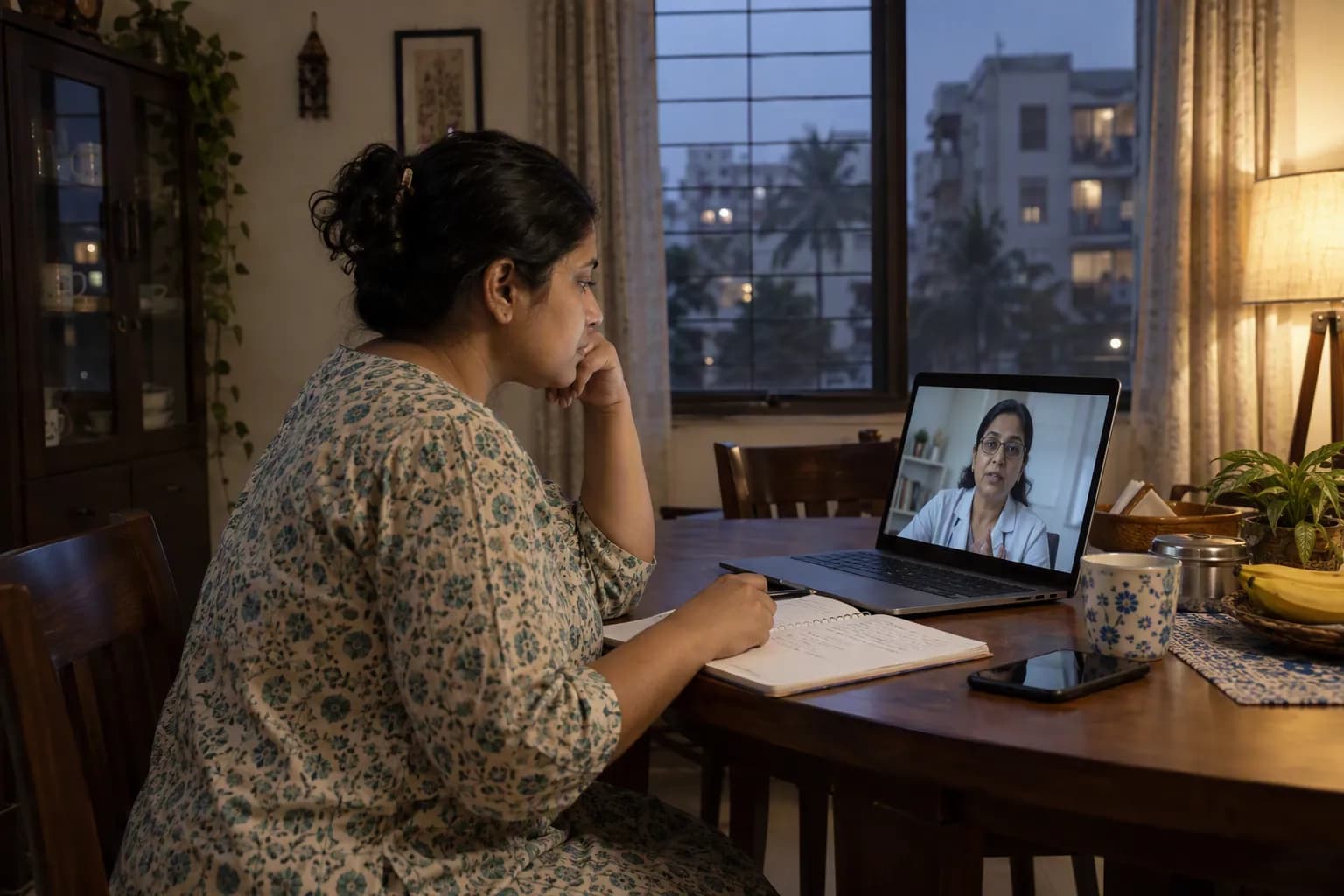
When home weight loss stalls, and when to see a doctor
Almost everyone who loses weight at home hits a wall somewhere around the third month.
Read the full section
Usually it is the body adapting, and sometimes it is something medical that a blood test would pick up.
As weight comes off, the body burns a little less and appetite creeps up to meet it, which is why a plan that worked in March can stop working by June. An underactive thyroid, insulin resistance or PCOS can also hold weight in place however disciplined you are, and the Indian lines are lower than many people realise: overweight from a BMI of 23, obesity from 25.
- 23Indian BMI line for overweight

Every source, in full (16)
[1] Hall KD, et al. Quantification of the effect of energy imbalance on bodyweight
The Lancet, 2011. Bodyweight responds slowly to a change in daily energy intake, with a half-time of about a year, so a steady change in eating keeps working for months; heavier people lose more for the same change.
Read the source[2] Ramachandran A, et al. The Indian Diabetes Prevention Programme shows that lifestyle modification and metformin prevent type 2 diabetes in Asian Indian subjects with impaired glucose tolerance
Diabetologia, 2006. In Indians with impaired glucose tolerance, lifestyle change cut the three-year rate of diabetes from 55.0% to 39.3%, a 28.5% relative reduction; about six people needed the programme to prevent one case.
Read the source[3] Leidy HJ, et al. The role of protein in weight loss and maintenance
American Journal of Clinical Nutrition, 2015. Meta-analyses of controlled feeding studies show more weight and fat loss, and better preservation of lean mass, on higher-protein reduced-calorie diets than on lower-protein ones, with better appetite control.
Read the source[4] ICMR-National Institute of Nutrition. Dietary Guidelines for Indians
ICMR-NIN, Hyderabad, 2024. Notes the tendency of women to gain weight after childbirth from less activity and extra calories; advises slow, steady weight reduction, 6-8 hours of sleep, a 30-45 minute brisk walk, fresh fruit rather than juice, buttermilk, coconut or lemon water over soft drinks, and added sugar under 5% of energy.
Read the source[5] Longvah T, Ananthan R, Bhaskarachary K, Venkaiah K. Indian Food Composition Tables 2017
National Institute of Nutrition (ICMR), Hyderabad, 2017. Table 1, Proximate Principles and Dietary Fibre: energy, protein, fat and carbohydrate per 100 g edible portion, the mean of the regions sampled. Every per-100 g food figure on this page comes from it.
Read the source[6] Hall KD, et al. Ultra-processed diets cause excess calorie intake and weight gain: an inpatient randomized controlled trial
Cell Metabolism, 2019. In 20 adults eating as much as they wanted, an ultra-processed diet led to about 508 kcal a day more intake than an unprocessed diet matched for calories, sugar, fat and fibre on the plate, and to weight gain of about 0.9 kg in two weeks.
Read the source[7] Jurgens TM, et al. Green tea for weight loss and weight maintenance in overweight or obese adults
Cochrane Database of Systematic Reviews, 2012. Pooled trials outside Japan found green tea preparations made no meaningful difference to weight (0.04 kg) or waist (0.2 cm) over about 12 weeks; Japanese trials varied too widely to pool.
Read the source[8] Kondo T, et al. Vinegar intake reduces body weight, body fat mass, and serum triglyceride levels in obese Japanese subjects
Bioscience, Biotechnology, and Biochemistry, 2009. A 12-week trial in obese Japanese adults, run by a vinegar maker: 15 or 30 ml of vinegar a day in a drink went with lower weight, visceral fat area, waist and triglycerides than a placebo drink.
Read the source[9] Zare R, et al. Effect of cumin powder on body composition and lipid profile in overweight and obese women
Complementary Therapies in Clinical Practice, 2014. In 88 overweight women on the same weight-loss counselling, 3 g of cumin powder a day in curd for three months went with more loss of weight, waist and fat mass, and better cholesterol, than curd alone.
Read the source[10] Saper RB, et al. Lead, mercury, and arsenic in US- and Indian-manufactured Ayurvedic medicines sold via the Internet
JAMA, 2008. Of 193 Ayurvedic products bought online, 20.7% contained lead, mercury or arsenic (19.5% of those made in India); rasa shastra products 40.6%. Every metal-containing product exceeded at least one daily intake limit.
Read the source[11] Bull FC, et al. World Health Organization 2020 guidelines on physical activity and sedentary behaviour
British Journal of Sports Medicine, 2020. Adults should do 150 to 300 minutes of moderate activity a week, or 75 to 150 minutes of vigorous activity, plus muscle-strengthening work; the guidance now includes women after childbirth.
Read the source[12] Cava E, Yeat NC, Mittendorfer B. Preserving healthy muscle during weight loss
Advances in Nutrition, 2017. Weight loss removes some muscle along with fat; adequate protein and exercise, resistance exercise in particular, are the best-supported ways to limit the loss and keep strength.
Read the source[13] Tasali E, et al. Effect of sleep extension on objectively assessed energy intake among adults with overweight in real-life settings
JAMA Internal Medicine, 2022. Adults with overweight who usually slept under 6.5 hours were helped to sleep about 1.2 hours more a night; they ate about 270 kcal a day less than controls and lost weight, with no change in energy spent.
Read the source[14] Steinberg DM, et al. Weighing every day matters: daily weighing improves weight loss and adoption of weight control behaviors
Journal of the Academy of Nutrition and Dietetics, 2015. Over six months, people who weighed themselves every day lost 6.1 kg more than those who weighed on most days, and took up more weight-control habits.
Read the source[15] Thomas JG, et al. Weight-loss maintenance for 10 years in the National Weight Control Registry
American Journal of Preventive Medicine, 2014. Registry members who had lost a mean 31.3 kg still kept off 23.1 kg after 10 years; falling activity, less self-weighing and less dietary restraint went with regain.
Read the source[16] Misra A, et al. Consensus statement for diagnosis of obesity, abdominal obesity and the metabolic syndrome for Asian Indians and recommendations for physical activity, medical and surgical management
Journal of the Association of Physicians of India, 2009. Set the Indian adult bands: BMI 18.0-22.9 normal, 23.0-24.9 overweight and 25 or more obesity, with abdominal obesity at a waist of 90 cm or more in men and 80 cm or more in women.
Read the source