Skip to content
metaboliq

Bhindi for weight loss: the sabzi, minus the oil

  • 27 kcal in 100 g, about one katori of sabzi.
  • 2.1 g protein per serving, from IFCT 2017.
  • Half-plate vegetable on a plate built to lose fat and keep muscle.
Book my health assessment

Takes 2 minutes to book. A doctor makes every decision with you.

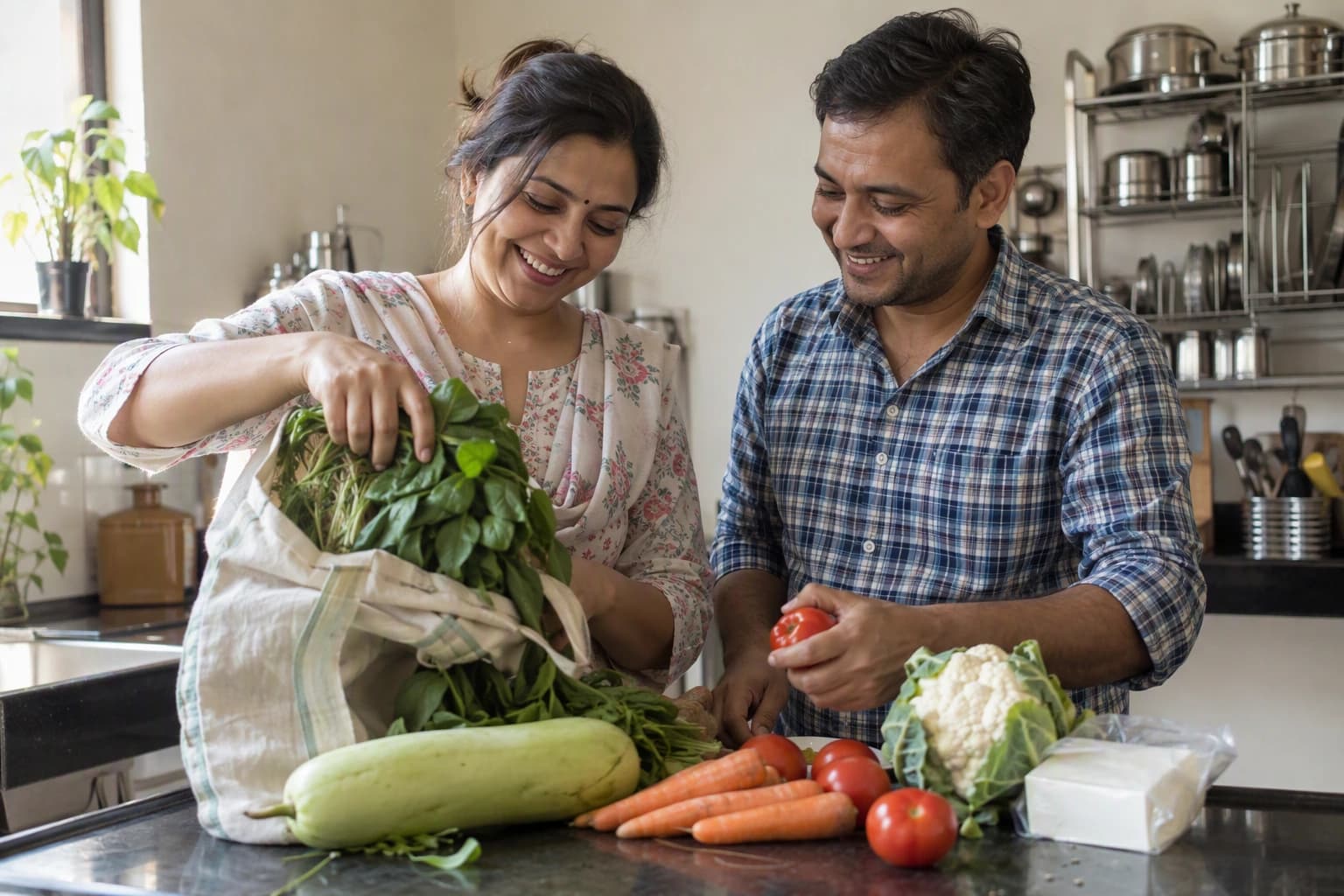
A couple laugh while unpacking fresh vegetables from a cloth bag in their kitchen

Bhindi is a very good vegetable for weight loss. A katori (100 g) gives 27 kcal with 4.1 g of fibre and 2.1 g of protein. The vegetable is light; a bhindi fry that soaks up oil is not, so cook it dry.

Bhindi nutrition, per serving and per 100 g

Bhindi: IFCT 2017 figures
NutrientPer servingPer 100 g
Energy27 kcal27 kcal
Protein2.1 g2.1 g
Carbohydrate (available)3.6 g3.6 g
Dietary fibre4.1 g4.1 g
Fat0.2 g0.2 g

Serving: 100 g, about one katori of sabzi. IFCT 2017 food code D056, "Ladies finger (Abelmoschus esculentus)", the mean of 6 regions sampled. IFCT does not report glycaemic index, so this page prints none.

The verdict on bhindi

Half-plate vegetable

Fill half the plate: 50 kcal or fewer in every 100 g.

  • 7.7 g of protein for every 100 kcal.
  • One serving gives 2.1 g of the roughly 58 g of protein a day ICMR-NIN's RDA sets for a 70 kg adult.
  • 4.1 g of fibre in a serving.

How bhindi fits a plan that loses fat and keeps muscle

IFCT 2017 lists lady finger at 27 kcal and 4.1 g of fibre per 100 g. Its protein per calorie, 7.7 g per 100 kcal, is high for a vegetable, though the amount per katori is small.

Bhindi works as the half-plate vegetable: a full katori beside dal and a measured roti. Wash and dry it well before cutting, and it cooks crisp in a teaspoon of oil without the sliminess that tempts people to add more.

Bhindi in an Indian kitchen

Wash bhindi whole and dry it completely before cutting; wet bhindi turns slimy in the pan. Cook it uncovered on a high flame with a teaspoon of oil, onion and amchur, and it crisps without deep-frying. Bharwan bhindi stuffed with a dry masala of besan, coriander and spices cooks well on a tawa. Bhindi in a curd-based kadhi or a sambar is another light way to eat it. Kurkuri bhindi from a restaurant is battered and fried.

Pair it, or swap it

Bhindi with dal and roti, or bhindi do pyaza with a katori of curd, makes a balanced vegetarian plate.

Worth knowing

Kurkuri bhindi is deep-fried and coated, and a bhindi fry can hold several teaspoons of oil, about 44 kcal each.

Bhindi against similar foods

Per 100 g, IFCT 2017
FoodEnergyProteinFibre
Bhindi27 kcal2.1 g4.1 g
Bottle gourd11 kcal0.5 g2.1 g
Spinach24 kcal2.1 g2.4 g
Ridge gourd13 kcal0.9 g1.8 g

Bhindi: questions people ask

Is bhindi good for weight loss?

Yes. A katori gives about 27 kcal and 4.1 g of fibre per IFCT 2017, before oil.

How do I cook bhindi with less oil?

Dry the pods fully before cutting, cook on high heat in a non-stick pan with one teaspoon of oil, and add salt at the end.

Is bhindi good for diabetes?

It is a low-calorie, high-fibre vegetable. Ask your doctor how vegetables fit your plan if you have diabetes.

Sources

  1. [1] Longvah T, Ananthan R, Bhaskarachary K, Venkaiah K. Indian Food Composition Tables 2017

    National Institute of Nutrition (ICMR), Hyderabad, 2017. Table 1, Proximate Principles and Dietary Fibre: energy, protein, fat, available carbohydrate and dietary fibre per 100 g edible portion, the mean of the regions sampled. Every figure on this page comes from it.

    Read the source
  2. [2] ICMR-National Institute of Nutrition. Dietary Guidelines for Indians

    ICMR-NIN, Hyderabad, 2024. Recommends combining cereals with pulses in a 3:1 ratio for protein quality, meeting vegetarian protein needs from pulses, beans and milk, keeping added sugar under 5% of energy and salt to 5 g a day, and slow, steady weight reduction.

    Read the source
  3. [3] ICMR-NIN Expert Group on Nutrient Requirements for Indians. Recommended Dietary Allowances and Estimated Average Requirements

    ICMR-NIN, Hyderabad (brief note), 2020. Sets the protein RDA for healthy Indian adults at 0.83 g per kg of body weight a day, and 1 g per kg for people on a cereal-based diet with lower-quality protein.

    Read the source
  4. [4] Wycherley TP, et al. Effects of energy-restricted high-protein, low-fat compared with standard-protein, low-fat diets: a meta-analysis of randomized controlled trials

    American Journal of Clinical Nutrition, 2012. In energy-restricted trials, higher-protein diets produced slightly greater fat loss and better preservation of fat-free mass than standard-protein diets.

    Read the source
  5. [5] Shukla AP, et al. Food Order Has a Significant Impact on Postprandial Glucose and Insulin Levels

    Diabetes Care, 2015. Eating vegetables and protein before carbohydrate in the same meal produced lower post-meal glucose and insulin than the reverse order, in a small crossover study.

    Read the source

Your plate, planned by a doctor and a dietitian.

The right portions depend on your blood sugar, thyroid, lipids and kidneys, which only a blood panel read by a doctor shows.

Book my health assessment

Then the home test, ₹999.

Takes 2 minutes to book. A doctor makes every decision with you.

Book my health assessment

Takes 2 minutes to book. A doctor makes every decision with you.