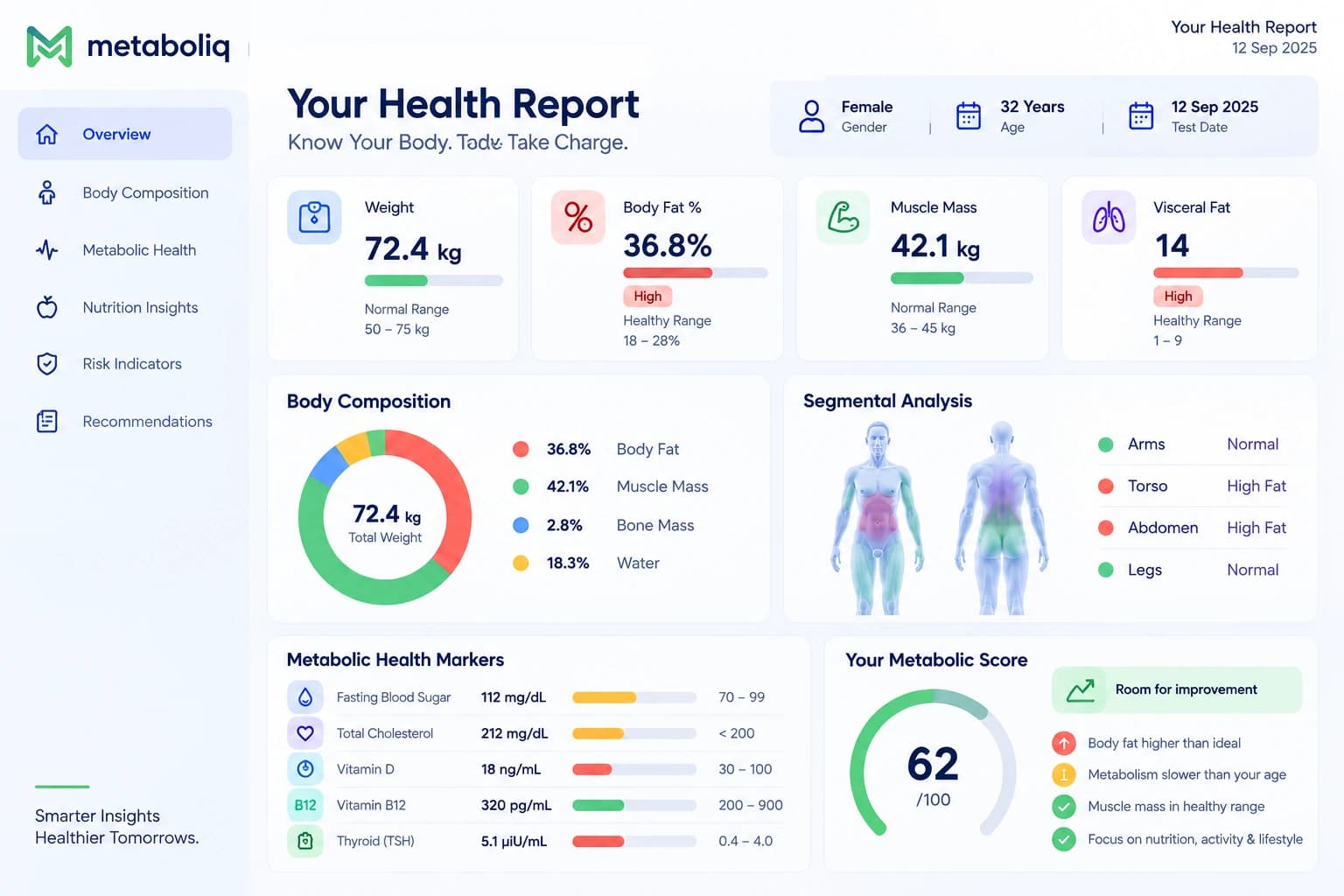
metaboliq

What PCOS is, and whether PCOD is different
Polycystic ovary syndrome is a hormone condition in which the ovaries make more male-type hormone than usual and often release an egg irregularly.
Read the full section
Doctors call it a syndrome because no single test or symptom proves it.
The working definition comes from a 2003 meeting in Rotterdam of the European and American fertility societies. They agreed that PCOS combines ovarian dysfunction, signs of androgen excess and polycystic ovaries, that it can show as irregular periods, androgen signs and weight gain, and that it raises the long-term risk of type 2 diabetes and heart disease. The 2023 international guideline, led by Helena Teede, kept that frame: two of the three features, once other causes are ruled out.
In Indian clinics and on Instagram, PCOD and PCOS are used almost interchangeably, and you will hear doctors say both. The international guidelines describe one condition, PCOS, with a range of severity. What matters is which features you have, because that decides what to test and what to treat.
It is common. A national study led by Dr Mohd Ashraf Ganie tested 8,993 women aged 18 to 40 in five zones of India. By the strict NIH definition 7.2% had PCOS, and by the broader Rotterdam definition 19.6%.
Irregular periods: the symptom most women notice first
For most women the first sign is the calendar.
Sources: [2]
Read the full section
Periods that come every six or seven weeks, skip months, or arrive with no pattern at all are the classic PCOS picture.
The 2023 guideline treats a cycle as irregular, once a girl is past the first years after her first period, when it is shorter than 21 days, longer than 35 days, or there are fewer than eight periods a year. Some women have a cycle that looks regular but do not release an egg each month, which only a blood test or scan picks up.
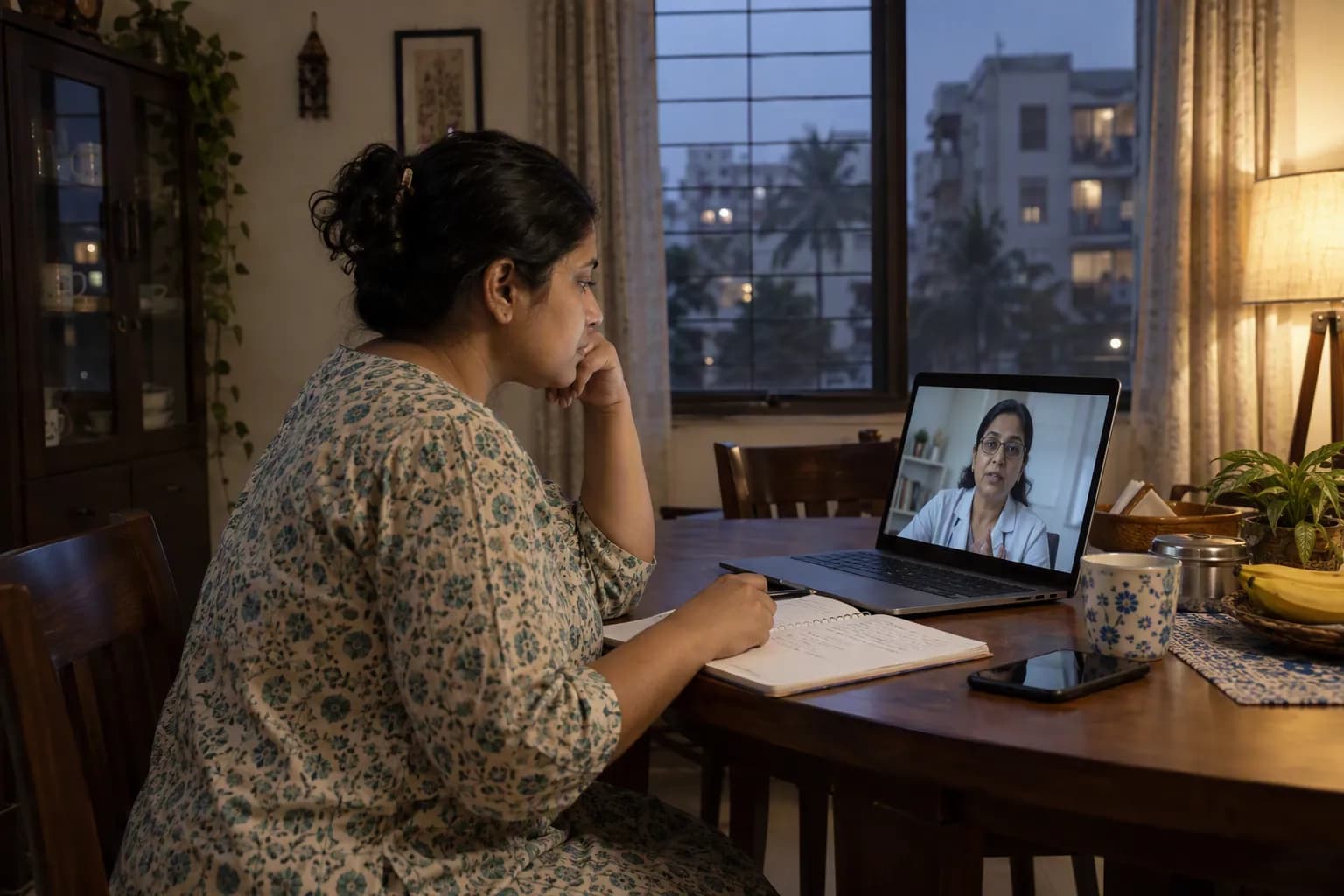
Ananya, 24, an analyst at an IT firm in Pune, is a composite of the readers who write to us. Her periods were regular in college. Since she started her first job, with night calls and food from the office canteen, they have stretched to 45 or 50 days, and twice she has gone three months without one. Her mother told her it was stress and would settle after marriage.
It is worth seeing a doctor sooner than that. Long gaps between periods let the lining of the womb build up, which is one reason doctors like to see at least a few periods a year, and they are the most common reason a woman with PCOS is told she has it.

Acne, facial hair and thinning hair
Androgens are the hormones men have more of, and women make them too. In PCOS they run higher, and the skin and hair show it first.
Read the full section
The usual signs are coarse dark hair on the chin, upper lip, chest or lower belly, acne along the jaw that carries on into the twenties and thirties, and thinning hair at the crown or a widening parting. Many Indian women pluck, thread or wax for years without mentioning it to a doctor, because it feels cosmetic. It is a symptom, and doctors score it on a standard chart.
A blood test for testosterone helps, but it can be normal even when the skin says otherwise, because labs measure it differently and the levels vary. That is why the guideline accepts clinical signs alone for this feature.
Among the Indian women in Dr Ganie's study, the commonest type of PCOS was phenotype C: androgen excess with polycystic ovaries and regular periods. So a woman whose periods arrive on time can still have PCOS, and acne or chin hair is enough reason to ask.

Weight gain and belly fat in PCOS
Weight gain is one of the PCOS symptoms women find hardest, partly because it settles around the waist and partly because it seems to arrive with very little change in eating.
Read the full section
In the Indian study, 43.2% of the women with PCOS had obesity, 32.9% had fatty liver and 24.9% met the definition of metabolic syndrome. Abnormal cholesterol results were almost universal, in 91.9%. These are young women, with a mean age of about 29.
The weight and the PCOS feed each other. Extra fat, especially around the middle, worsens insulin resistance; higher insulin pushes the ovaries to make more androgen; and the androgen makes it easier to store fat at the waist. Ananya's waist has gone from 74 cm to 84 cm in two years, past the 80 cm line Indian doctors use for women, and she has gained eight kilos.
Breaking that loop is the most useful thing most women with PCOS can do, and how the weight comes off matters. Muscle is where the body uses most of its sugar, so a crash diet that strips muscle can leave insulin resistance worse than before. At Metaboliq the aim we set with members is "Lose up to 20% of your body weight — and keep your muscle". Results vary; your doctor decides what is right for you. For a woman like Ananya it starts with a home blood test, insulin and thyroid included, that a doctor reads with her.

Insulin resistance, the PCOS symptom you cannot see
Insulin resistance means the body has to pump out more insulin than usual to keep blood sugar normal.
Read the full section
It sits under most cases of PCOS, and the woman who has it usually cannot tell.
Samantha Cassar and her colleagues in Melbourne gathered 28 studies that used the clamp test, the most exact way of measuring insulin sensitivity, in women with and without PCOS. Women with PCOS were 27% less sensitive to insulin, and that was true after allowing for weight. A higher BMI took sensitivity down a further 15%.
So Ananya's slim college friend, also diagnosed with PCOD, is not off the hook. Her insulin resistance is milder, but it is there. Ananya, with eight extra kilos round her waist, has more of it.
Sometimes the skin gives it away. Acanthosis nigricans, a dark, velvety patch at the back of the neck or in the armpits, is caused by high insulin, and many women spend months scrubbing it with lemon and besan before a doctor names it. The 4 pm craving for something sweet and the heavy sleepiness after a rice lunch are common complaints too, though on their own they prove nothing.
The blood test is what settles it. Fasting insulin and glucose, HbA1c, and sometimes a two-hour glucose tolerance test show how hard Ananya's body is working to keep her sugar in range.

What causes PCOS?
Nobody has found a single cause, and it helps to say that plainly, because many women are made to feel they caused it.
Read the full section
PCOS runs strongly in families. It comes from genes interacting with insulin, androgens and weight, and the genes come first.
If your mother, sister or aunt has PCOS, type 2 diabetes or very irregular periods, your own chances go up. Some women seem to be born with ovaries that make more androgen and muscles and liver that respond less well to insulin. Weight gain, sitting all day and poor sleep then bring the tendency out, or make it worse.
Ananya's family fits the pattern once someone asks the right questions. Her mother was found to have diabetes at 46. An older cousin in Nashik was told she had PCOD only after four years of trying to conceive. Until a doctor drew the family tree, nobody had linked the two.
The blame often lands in the wrong place. Cold drinks, a brand of sanitary pad or long hours of study do not cause PCOS. Stress and short sleep do disturb periods and worsen insulin resistance, so they are worth fixing, but they act on a tendency that was already there.

How PCOS is diagnosed
A doctor diagnoses PCOS from your story, an examination and blood tests, sometimes with an ultrasound.
Sources: [2]
Read the full section
The work is partly in ruling out other conditions that look the same.
Expect questions about your periods since they began, your skin and hair, your weight over the years and diabetes in the family. The doctor will measure your weight, waist and blood pressure and look for acne, hair growth and dark skin patches.
Blood tests usually include testosterone, and often TSH for the thyroid and prolactin, because an underactive thyroid or a raised prolactin can cause irregular periods too. HbA1c, fasting glucose and a lipid profile check the metabolic side. The 2023 guideline says that if a woman has both irregular periods and androgen signs, an ultrasound is not needed to diagnose PCOS, and that in girls within eight years of their first period an ultrasound should not be used for it, because many young ovaries look polycystic.
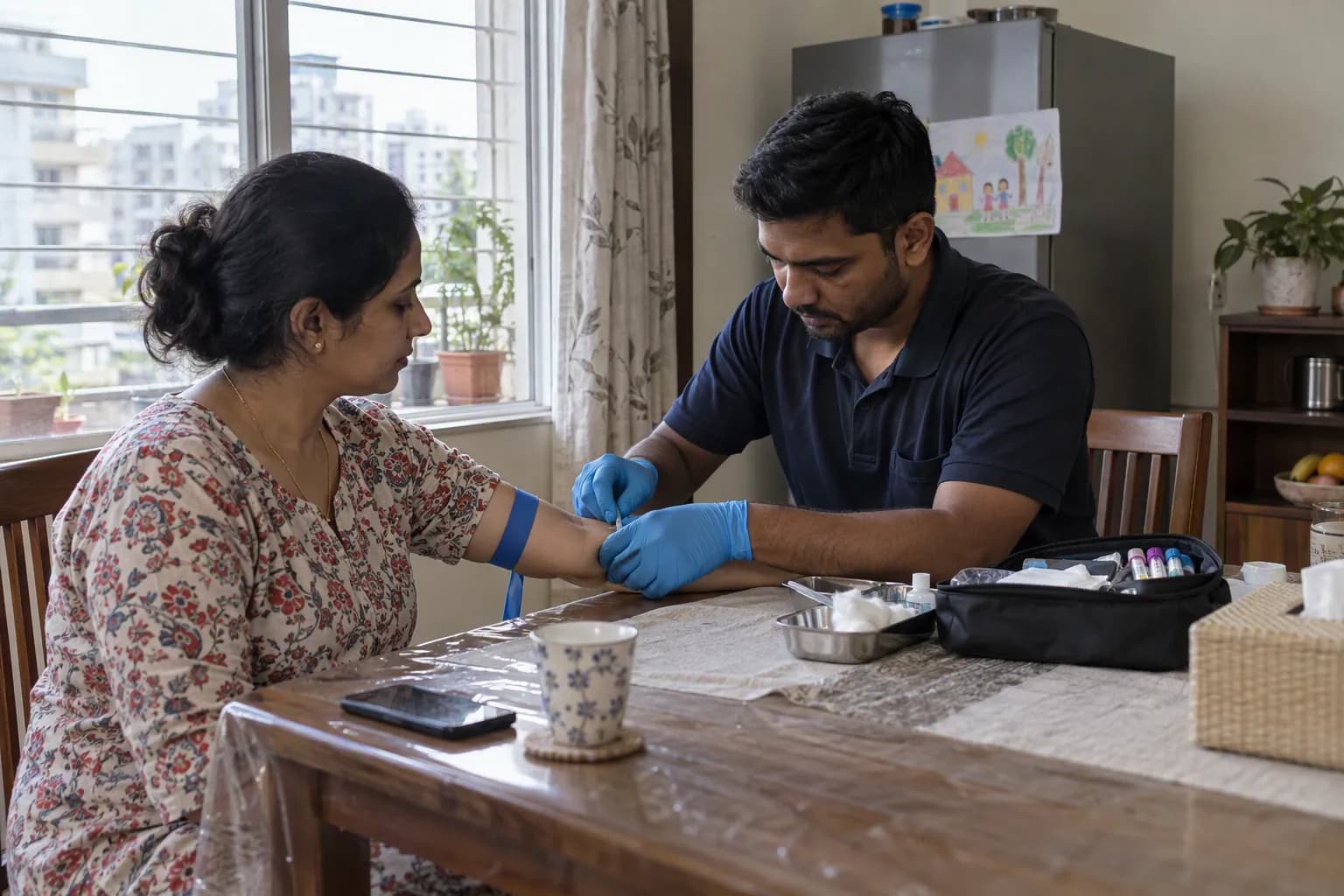
For unmarried women, the scan can be done through the abdomen. Ananya's diagnosis took one consultation and one morning of blood tests.
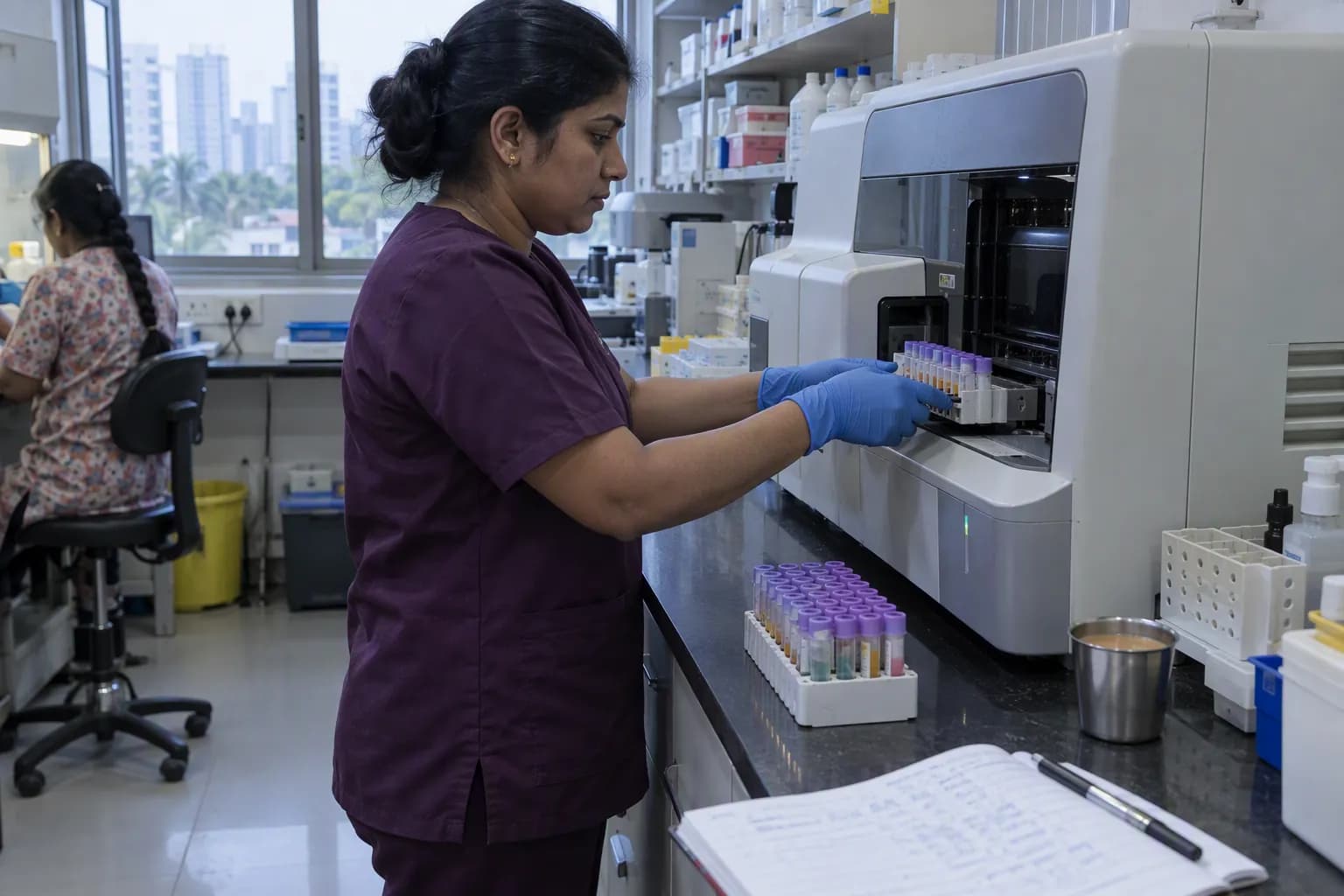
45+ markers, one home blood test
- HbA1c
- Thyroid test
- Fasting insulin
- HOMA-IR
- Fasting blood sugar
- Lipid profile
- Liver function test
- Kidney function test
- 2 of 3features needed to diagnose
Why PCOS symptoms matter later, and what helps first
PCOS rarely stays a period problem.
Read the full section
Left alone, it tends to show up years later as type 2 diabetes, high cholesterol or fatty liver, which is why a diagnosis should start regular blood checks.
The Rotterdam group named diabetes and heart disease as the long-term risks, and India's numbers suggest they start young: the women in Dr Ganie's study were 29 on average, and almost all of those with PCOS already had an abnormal cholesterol result. The 2023 guideline asks doctors to check sugar in every woman with PCOS, whatever she weighs, when she is diagnosed and every one to three years after that.
The first step for almost everyone is lifestyle aimed at insulin, with weight loss where it is needed. It need not be large. In the St Mary's Hospital study by Kiddy and Franks, women who lost more than 5% of their weight saw testosterone and insulin come down, and most of those with irregular periods became more regular or conceived. For Ananya, at 68 kg, that is about three and a half kilos, a target she can picture.
Her mother's advice was to wait for marriage. The better plan is to start now, while the changes are small and easy to reverse, and the treatment page sets out what that looks like week by week.
- FirstBlood tests
Sugar, insulin, lipids.
- ThenPlate
Protein, less refined grain.
- ThenMove
Walks and strength work.
- YearlyRecheck
Sugar and lipids.
- 5%loss that helps many women

Every source, in full (6)
[1] Rotterdam ESHRE/ASRM-Sponsored PCOS Consensus Workshop Group. Revised 2003 consensus on diagnostic criteria and long-term health risks related to polycystic ovary syndrome
Fertility and Sterility, 2004. PCOS is a syndrome of ovarian dysfunction with androgen excess and polycystic ovaries, and no single feature is enough for diagnosis; it may show as irregular periods, signs of androgen excess and obesity, and raises the risk of type 2 diabetes and cardiovascular events.
Read the source[2] Teede HJ, et al. Recommendations from the 2023 International Evidence-based Guideline for the Assessment and Management of Polycystic Ovary Syndrome
Journal of Clinical Endocrinology & Metabolism, 2023. The international PCOS guideline, 254 recommendations and practice points, covering diagnosis, metabolic risk, weight and lifestyle care for women with PCOS.
Read the source[3] Ganie MA, et al. Prevalence, phenotypes, and comorbidities of polycystic ovary syndrome among Indian women
JAMA Network Open, 2024. Among 8,993 women aged 18 to 40 across five zones of India, PCOS prevalence was 7.2% by the NIH criteria and 19.6% by the Rotterdam criteria; of the women with PCOS, 43.2% had obesity, 91.9% dyslipidaemia, 32.9% fatty liver and 24.9% metabolic syndrome.
Read the source[4] Misra A, et al. Consensus statement for diagnosis of obesity, abdominal obesity and the metabolic syndrome for Asian Indians and recommendations for physical activity, medical and surgical management
Journal of the Association of Physicians of India, 2009. Set the Indian adult bands: BMI 18.0-22.9 normal, 23.0-24.9 overweight and 25 or more obesity, with abdominal obesity at a waist of 90 cm or more in men and 80 cm or more in women.
Read the source[5] Cassar S, et al. Insulin resistance in polycystic ovary syndrome: a systematic review and meta-analysis of euglycaemic-hyperinsulinaemic clamp studies
Human Reproduction, 2016. Across 28 clamp studies, insulin sensitivity was 27% lower in women with PCOS than in controls, independent of BMI, and a higher BMI lowered it by a further 15%.
Read the source[6] Kiddy DS, et al. Improvement in endocrine and ovarian function during dietary treatment of obese women with polycystic ovary syndrome
Clinical Endocrinology, 1992. Of 24 women with PCOS on a six-to-seven-month diet, the 13 who lost more than 5% of their weight saw free testosterone and fasting insulin fall; nine of the 11 with period problems among them conceived or became more regular, and hirsutism fell in 40%.
Read the source