metaboliq

When menopause arrives for Indian women
Menopause is the point twelve months after the last period.
Sources: [1]
Read the full section
The years leading up to it, perimenopause, often start in the early forties, with periods that change and sleep that gets lighter.
A survey by the Indian Menopause Society across 21 of its chapters found the average age of menopause in Indian women was 46.2 years, compared with about 51 in Western women. It differed between rural and urban women and varied with income, marital status and the number of children.
That earlier age matters for weight. Much of the advice online comes from studies of American and European women in their early fifties. An Indian woman may meet the same changes at 42, while she is still running a household, a job and teenage children, often with ageing parents to care for as well.
Meena, 49, an officer at a public sector bank in Kolkata, is a composite of the women who write to us. Her periods became irregular at 44 and stopped at 47. In those three years she gained six kilos, her saris began to feel tight at the waist rather than the hips, and she started waking at 3 am most nights.

Why weight goes to the belly at menopause
Meena's weight went up six kilos between 44 and 47, which she could have lived with. What bothered her was where it went.
Read the full section
Her hips stayed much the same while her blouses stopped closing at the waist.
That pattern is what the research shows. As oestrogen falls, fat that used to settle on the hips and thighs moves to the abdomen, including the deeper visceral fat around the organs. In SWAN, a large American study that has followed women through menopause with yearly body scans, Gail Greendale's team found fat building up at twice the previous rate from the start of the transition, while lean mass began to drop. Both continued until roughly two years after the final period.
Jennifer Lovejoy's group at the Pennington Center scanned women yearly for four years and saw a clear rise in visceral fat only in those who reached menopause during the study. Their energy use during sleep fell at the same time.
The International Menopause Society sums it up fairly. Menopause on its own does not explain weight gain, but the hormonal change goes with more body fat and more of it around the waist, which is exactly where it does the most harm.
- BeforeSteady
Slow, even gain.
- TransitionFat gain doubles
Muscle starts to fall.
- +2 yearsSettles
New, slower pace.
- 2×faster fat gain in transition

Is menopause slowing your metabolism?
Probably not by much.
Read the full section
When Herman Pontzer's team at Duke University pooled energy measurements on 6,421 people aged from eight days to 95 years, metabolism adjusted for body size stayed level from about 20 to 60.
So Meena's body at 49 is burning energy at much the same rate per kilo of tissue as it did at 30. What has changed is the tissue. A kilo of muscle burns about 13 kcal a day at rest and a kilo of fat about 4.5, so swapping one for the other nudges the resting rate down a little, though not enough to explain six kilos.
The rest is life at 45. Meena used to walk to the bus stop and back, about two kilometres, until the bank moved her to a branch she reaches by car. Hot flushes wake her at 3 am, and a tired woman eats more the next day. The evening walk on the Lake Road stopped when her knees started to hurt. None of these are metabolism, and all of them can be changed, which is the useful part of knowing it.

Strength training is the best answer to menopause weight gain
If every woman at menopause took up one habit, it should be lifting something heavy two or three times a week.
Read the full section
It protects muscle, bone and blood sugar at exactly the age all three start to slip.
Gary Hunter's trial at the University of Alabama put 94 women on the same diet until each had lost about 12 kg. The women who did resistance training finished with their fat-free mass intact, in fact slightly up, from 46.9 to 47.2 kg, and their resting energy use unchanged. Those who did aerobic exercise lost about a kilo of fat-free mass, and those who did nothing lost a kilo and a half.
Plenty of Indian women in their forties have never touched a dumbbell and feel self-conscious about starting. Meena did. She began on her bedroom floor three evenings a week with chair squats, push-ups against the wall, lunges holding the kitchen counter and rows with a band looped round the door handle, two sets of each. Four months later she joined the women's morning batch at a gym near Gariahat, mostly because she wanted heavier weights.
Walking still matters for the heart and the waist, so she kept her evening walk. The weights are what stop the muscle loss SWAN measured.
| Start | End | |
|---|---|---|
| Weights | 46.9 kg | 47.2 kg |
| Aerobic only | 45.4 kg | 44.4 kg |
| No exercise | 47.9 kg | 46.4 kg |
A menopause diet, and a 5-day plan to start with
The best menopause diet is a higher-protein version of what you already cook, with a little less rice, roti and sugar.
Read the full section
Protein at every meal matters more now than at any time since your twenties.
Protein keeps you full and, with strength training, helps protect the muscle menopause starts to take, as Heather Leidy's review and Thomas Wycherley's meta-analysis of weight-loss trials both found. Dairy brings protein and calcium together, which suits bones at this age.
Here is a five-day plan to use as a template. Monday: besan chilla and curd, lunch of dal, sabzi and two rotis, dinner of paneer bhurji with one roti. Tuesday: two boiled eggs and a fruit, rajma with a small katori of rice, then fish curry with sabzi. Wednesday: moong dal dosa with chutney, chole with one roti, then dalia khichdi with curd. Thursday: poha cooked with peanuts and sprouts, fish or egg curry with rice, then a vegetable soup and paneer tikka. Friday: ragi porridge with milk, dal and sabzi with two rotis, then chicken or soya chunks with vegetables.
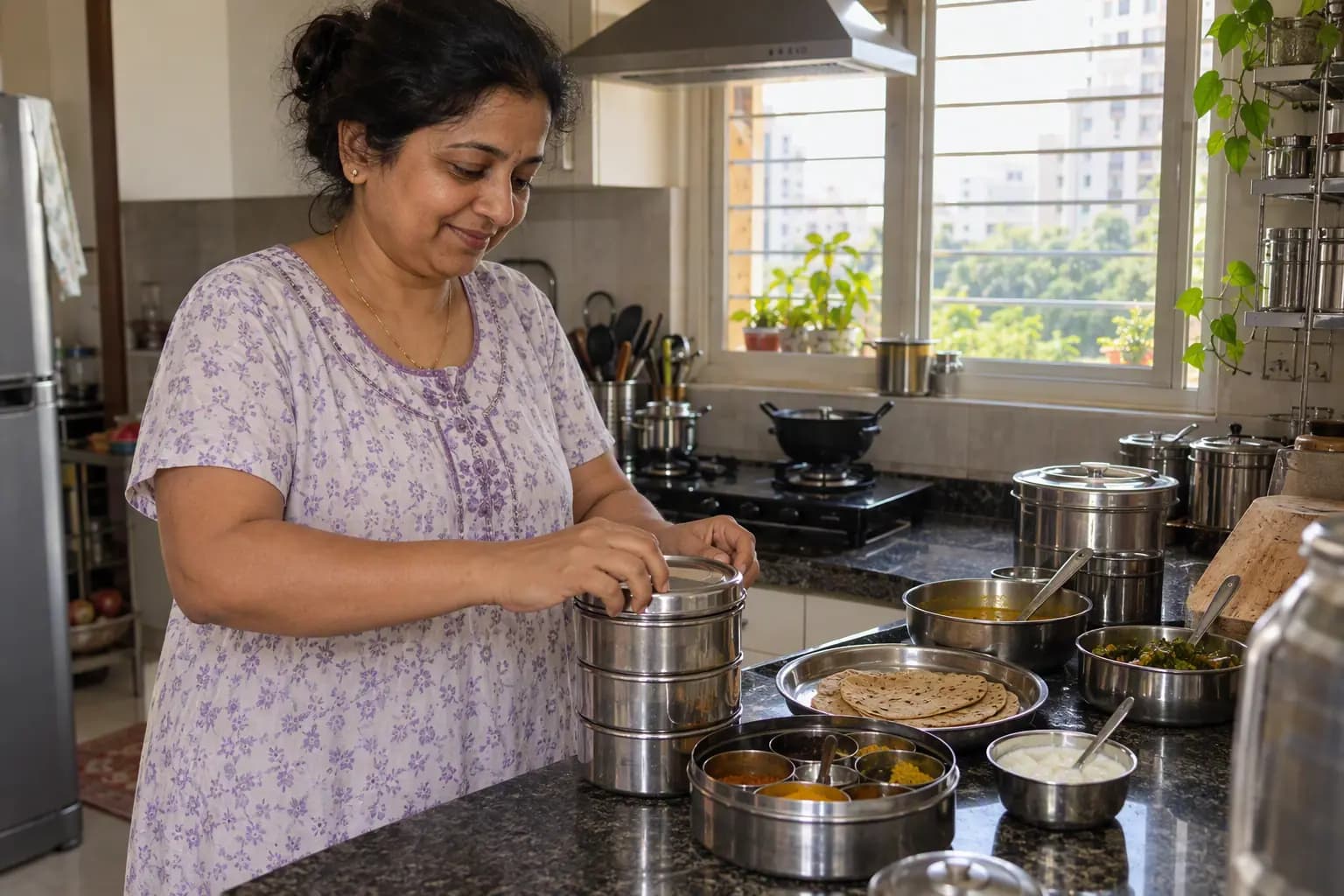
Keep sweets for festivals, cut the sugar in chai by half, and drink water or buttermilk instead of juice. Meena's biggest change was her evening: the 6 pm tea with biscuits became tea with a bowl of sprouts, and the 10 pm dinner moved to 8.
| Day | Main meal | |
|---|---|---|
| Mon | Day 1 | Dal, sabzi, 2 rotis |
| Tue | Day 2 | Rajma, small rice |
| Wed | Day 3 | Chole, 1 roti |
| Thu | Day 4 | Fish or egg curry |
| Fri | Day 5 | Chicken or soya |
Hot flushes, broken sleep and late-night eating
Night sweats and 3 am waking are among the most common menopause complaints, and they work quietly against weight.
Read the full section
Short sleep raises hunger and moves more fat to the belly.
In Arlet Nedeltcheva's controlled study, people on the same diet lost 1.4 kg of fat with 8.5 hours in bed and only 0.6 kg with 5.5 hours, while losing more muscle and feeling hungrier. Jean-Philippe Chaput's six-year study found that adults sleeping six hours or less gained more visceral fat than those sleeping seven to eight.
Some fixes are practical. A cooler bedroom, a cotton nightie, a fan aimed at the bed and an earlier, lighter dinner all help. Cutting tea after 4 pm and keeping the phone out of the bedroom help more than most women expect. When hot flushes wreck sleep night after night, it is worth discussing treatment options with a gynaecologist, because good sleep makes everything else on this page easier.
Meena now eats by 8, walks for 15 minutes after dinner and keeps the bedroom fan on high. She still wakes some nights, but less often, and the 11 pm kitchen visits have stopped.

Belly fat after menopause, and the tests to do at 45
The new belly fat is more than a matter of how clothes fit.
Read the full section
It brings rises in blood sugar, cholesterol and blood pressure that often appear in the same few years.
Indian doctors use 80 cm as the waist line for women, set by a consensus panel led by Dr Anoop Misra. Many women cross it in perimenopause without any change on the scale. An underactive thyroid is also common in Indian women, found in 15.9% of women in a study across eight cities, and its tiredness and weight gain are easy to blame on menopause.
A sensible check at 45 includes HbA1c and fasting sugar, a lipid profile, TSH, liver and kidney function, and blood pressure. Meena's showed a raised TSH and an HbA1c at the top of normal, which changed the conversation with her doctor.
Metaboliq is a doctor-led weight programme, and the aim we set with members is "Lose up to 20% of your body weight — and keep your muscle". Results vary; your doctor decides what is right for you. At menopause the muscle half of that line carries the most weight, and the plan is built around strength and protein. It starts with a home blood test that a doctor reads with you.
45+ markers, one home blood test
- HbA1c
- Thyroid test
- Fasting insulin
- HOMA-IR
- Fasting blood sugar
- Lipid profile
- Liver function test
- Kidney function test
- 80 cmwaist line for Indian women

Every source, in full (14)
[1] Ahuja M. Age of menopause and determinants of menopause age: a PAN India survey by IMS
Journal of Mid-life Health, 2016. An Indian Menopause Society survey across 21 chapters found the average age of menopause in Indian women was 46.2 years, against about 51 in Western women.
Read the source[2] Greendale GA, et al. Changes in body composition and weight during the menopause transition
JCI Insight, 2019. In the SWAN cohort, the rate of fat gain doubled and lean mass began to decline at the start of the menopause transition, continuing until about two years after the final period, while weight rose steadily.
Read the source[3] Lovejoy JC, et al. Increased visceral fat and decreased energy expenditure during the menopausal transition
International Journal of Obesity, 2008. Over four years, only women who became postmenopausal showed a significant rise in visceral fat, alongside falls in sleeping energy expenditure and fat oxidation.
Read the source[4] Davis SR, et al. Understanding weight gain at menopause
Climacteric, 2012. The International Menopause Society's review: weight gain itself cannot be blamed on the menopause transition, but the hormonal change is associated with more total body fat and more abdominal fat.
Read the source[5] Pontzer H, et al. Daily energy expenditure through the human life course
Science, 2021. In 6,421 people measured by doubly labelled water from 8 days to 95 years of age, size-adjusted energy use peaks about 50% above adult values at around one year, declines to adult levels by about 20, stays stable from 20 to 60, even in pregnancy, then declines.
Read the source[6] Wang Z, et al. Specific metabolic rates of major organs and tissues across adulthood: evaluation by mechanistic model of resting energy expenditure
American Journal of Clinical Nutrition, 2010. Uses resting rates of about 13 kcal per kilo a day for skeletal muscle and 4.5 for fat tissue, against 200 for the liver, 240 for the brain and 440 for the heart and kidneys.
Read the source[7] Hunter GR, et al. Resistance training conserves fat-free mass and resting energy expenditure following weight loss
Obesity, 2008. In 94 women losing about 12 kg, those who did resistance training kept their fat-free mass (46.9 to 47.2 kg), resting energy expenditure and strength; those doing aerobic training (45.4 to 44.4 kg) or no exercise (47.9 to 46.4 kg) lost fat-free mass and resting energy use.
Read the source[8] Leidy HJ, et al. The role of protein in weight loss and maintenance
American Journal of Clinical Nutrition, 2015. Reviews the evidence that higher-protein meals increase reported fullness and reduce later intake compared with meals matched for energy but lower in protein.
Read the source[9] Wycherley TP, et al. Effects of energy-restricted high-protein, low-fat compared with standard-protein, low-fat diets: a meta-analysis of randomized controlled trials
American Journal of Clinical Nutrition, 2012. In energy-restricted trials, higher-protein diets produced slightly greater fat loss and better preservation of fat-free mass than standard-protein diets.
Read the source[10] Longvah T, Ananthan R, Bhaskarachary K, Venkaiah K. Indian Food Composition Tables 2017
National Institute of Nutrition (ICMR), Hyderabad, 2017. Table 1, Proximate Principles and Dietary Fibre: energy, protein, fat, available carbohydrate and dietary fibre per 100 g edible portion. Every food figure in this page's charts is computed from it for the serving shown.
Read the source[11] Nedeltcheva AV, et al. Insufficient sleep undermines dietary efforts to reduce adiposity
Annals of Internal Medicine, 2010. On the same reduced-calorie diet for 14 days, 5.5 hours of sleep instead of 8.5 cut the share of weight lost as fat by 55% (0.6 kg of fat against 1.4 kg), raised the loss of fat-free mass by 60% (2.4 kg against 1.5 kg) and increased hunger.
Read the source[12] Chaput JP, et al. Change in sleep duration and visceral fat accumulation over 6 years in adults
Obesity, 2014. Adults sleeping six hours or less gained more visceral fat over six years than those sleeping seven to eight hours, and moving from short to adequate sleep was associated with less gain.
Read the source[13] Misra A, et al. Consensus statement for diagnosis of obesity, abdominal obesity and the metabolic syndrome for Asian Indians and recommendations for physical activity, medical and surgical management
Journal of the Association of Physicians of India, 2009. Set the Indian adult bands: BMI 18.0-22.9 normal, 23.0-24.9 overweight and 25 or more obesity, with abdominal obesity at a waist of 90 cm or more in men and 80 cm or more in women.
Read the source[14] Unnikrishnan AG, et al. Prevalence of hypothyroidism in adults: an epidemiological study in eight cities of India
Indian Journal of Endocrinology and Metabolism, 2013. Of 5,360 adults tested in eight Indian cities, 10.95% had hypothyroidism (15.86% of women, 5.02% of men), and 3.47% had it undetected until the study's blood test.
Read the source