 metaboliq
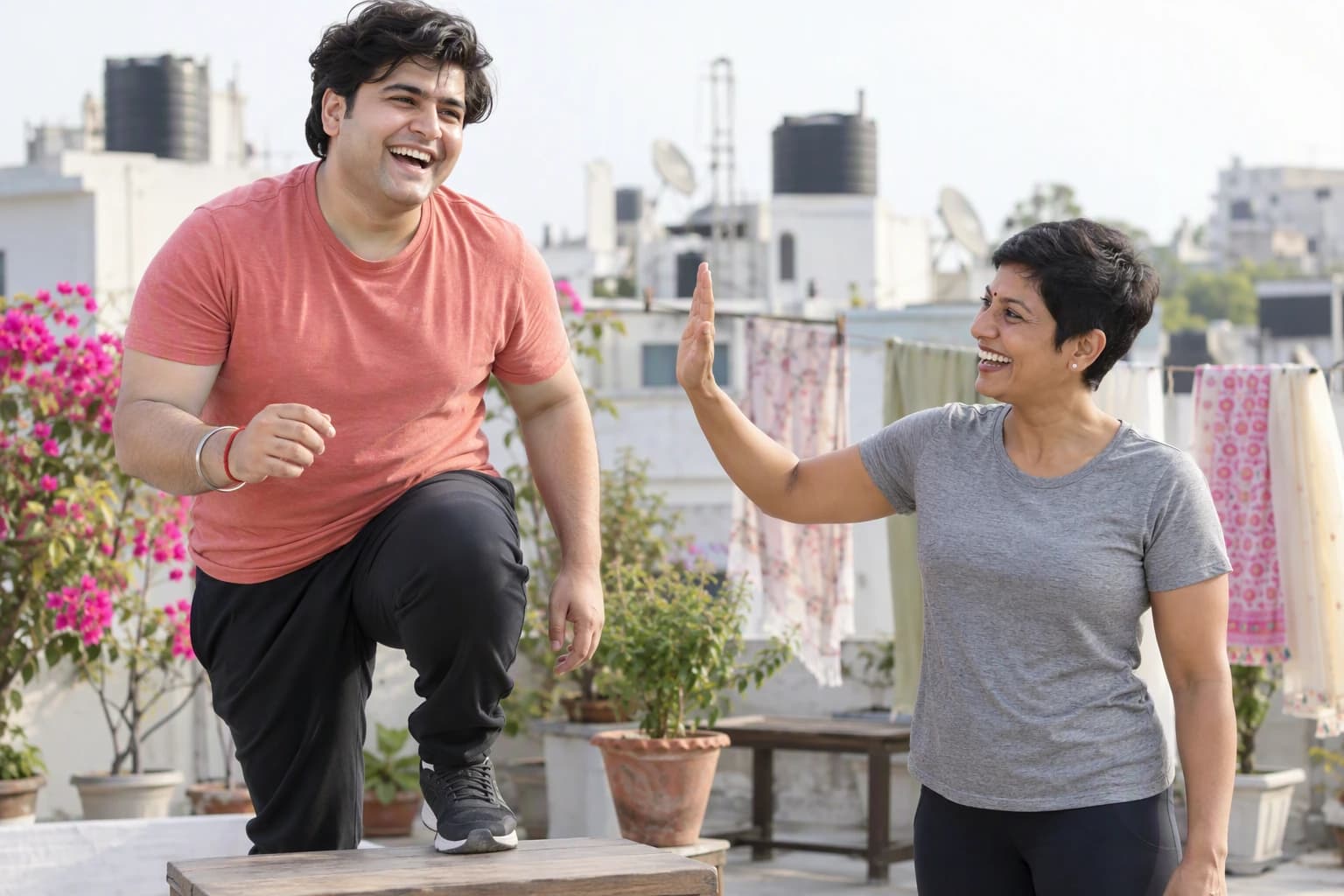
At 6:15, before the tiffins and the school bus, there is usually a 30-minute gap in an Indian home, and that is enough. Use 15 of those minutes for brisk movement: marching on the spot, step-ups on the bottom stair, or fast laps of the terrace. Use ten for chair squats, wall push-ups and glute bridges, and the rest to warm up and stretch. Five mornings like that make 150 minutes a week, the World Health Organization's minimum for adults.
On its own this will move the scale slowly, because food does most of that work. What the routine adds is muscle kept while the fat goes, and kept muscle is what stops the weight from drifting back. Build towards 250 minutes a week over the next two or three months for clearer results.
Is morning exercise better for weight loss in women?
There is some evidence it may help with belly fat, though the studies are small. In 2022 Paul Arciero's team at Skidmore College randomised 30 women, already used to exercising, to train either between 6 and 8 am or between 6:30 and 8:30 pm for 12 weeks. Both groups did the same mix of strength, intervals, stretching and endurance work.
The morning group lost more total fat and more abdominal fat, and their blood pressure fell further. The evening group gained more upper-body strength and power. The women were in their early forties, of normal weight on average and already fit, so the results may not carry over exactly to beginners.
For most women the practical answer is simpler. The best time is the one you will keep. Mornings often win in an Indian household because the day has not yet filled up with work calls, school runs, cooking and visitors. A 6:30 am slot before the house wakes up is easier to protect than an evening that keeps getting eaten.
If mornings are impossible, evening exercise still counts. Over months, how much you do across the week is likely to matter more than the hour on the clock.
Sources: [1]
How much exercise do women need to lose weight?
The WHO's 2020 guidelines, written up by Fiona Bull and colleagues, ask every adult for 150–300 minutes a week of moderate activity, or 75–150 minutes of vigorous activity. They add strength work on at least two days.
For losing weight, more is better. Joseph Donnelly's position stand for the ACSM found that 150–250 minutes a week on its own brings only a modest drop. Past about 250 minutes a week, losses became large enough to matter clinically. Combine even the lower amount with eating a little less and results improve.
For a beginner that translates into 30 minutes on five mornings, or 150 minutes. Over two or three months, stretch the sessions to 40–45 minutes or add a 20-minute walk after dinner, and you are past 250.
Moderate means you can talk but could not sing. Vigorous means only a few words between breaths. Fast walking, stairs, skipping, a dance workout video in the living room and garba practice all qualify.
Should women do cardio or strength training at home?
Kavita, 38, works from home in Lucknow and has two children in school. When she decided to lose weight she downloaded three workout apps, and each one told her something different. Some said cardio, some said only weights. The research says she needs both, and that they do different jobs.
The clearest test is STRRIDE AT/RT at Duke University. For eight months, 119 inactive adults with overweight did aerobic exercise, resistance training, or both. The aerobic groups lost more weight and fat. The resistance groups were the ones who gained lean mass. Doing both needed twice the time and did not take off much more fat than aerobic work alone.
The deep belly fat around the organs behaves the same way. A 2012 meta-analysis of 35 trials found aerobic exercise shrank it, while resistance training alone made no clear difference. And in a 2023 analysis of 101 trials in postmenopausal women, aerobic and mixed training did more for fat, while strength and mixed training did more for muscle.
So Kavita's mornings start with 15 minutes of brisk movement every day, and on three of them she adds nine minutes of strength. Fat comes off mainly through the walking and her food; the squats are there so that what she loses is fat, not muscle.
What is a good 30-minute morning workout at home for beginners?
Minutes 0–4, warm-up. March on the spot, swing your arms, roll your shoulders, and finish with ten slow sit-to-stands from a dining chair.
Minutes 4–18, brisk movement. Indoors, alternate one minute of fast marching with one minute of step-ups on the bottom stair or a sturdy low step, seven times. With a terrace or a quiet corridor, a fast walk works just as well. Aim to breathe harder while still being able to talk.
Minutes 18–27, strength, two rounds with a minute's rest between. Ten chair squats, sitting back until your bottom brushes the seat. Eight wall push-ups, hands at shoulder height. Ten glute bridges, lying on your back with knees bent and lifting your hips until your body is straight from knee to shoulder. Six reverse lunges each side, one hand on the wall. A 20-second plank on your knees and forearms.
Minutes 27–30, stretch your calves, thighs, hips and chest. If lunges hurt your knees, swap them for side steps. If getting down to the floor is hard, do the bridges and plank against the bed or a wall instead. A small 2021 study found that even an 11-minute bodyweight routine three times a week lifted fitness in inactive adults within six weeks, so short sessions count.
Sources: [7]
What does a weekly plan look like?
Monday, Wednesday and Friday: the full 30-minute routine above, with the strength rounds. Tuesday and Thursday: 30 minutes of brisk walking or stairs, no strength. Saturday: a longer walk, a yoga class or dancing. Sunday: rest, or an easy family walk.
Each fortnight, make one thing harder. Add a round to the strength work, two more reps to each move, or five more minutes of walking. When ten chair squats feel easy, try them without touching the chair. When wall push-ups get easy, move to the kitchen counter, then to your knees on the floor.
Women who carry a 2 kg water bottle or a backpack with books during squats and lunges add load without buying anything. Two filled 1-litre bottles make a fair pair of light dumbbells for rows and shoulder presses.
Kavita, the Lucknow mother from earlier, is a useful illustration. She starts with the Tuesday and Thursday walks only, adds the strength days in week three, and sets her alarm 30 minutes earlier rather than hunting for time later in the day.
Sources: [2]
Why does strength training matter so much for women losing weight?
Diet alone takes muscle with the fat. Weinheimer's review of 52 studies in adults over 50 found that in 81% of diet-only groups, at least 15% of the weight lost was fat-free mass. Add exercise and only 39% of groups lost that much.
For women that matters twice over. They start with less muscle than men, and from the forties muscle drains faster, especially around menopause. Muscle burns energy around the clock, so losing some during a diet means needing less food afterwards, and the weight finds its way back.
This is the thinking behind Metaboliq's doctor-led plans, which aim for up to 20% of body weight lost with muscle kept. They start with a home blood test, and a doctor goes through the thyroid, sugar and insulin results before deciding how fast the weight should come off. Protein and two or three strength sessions a week are part of the plan from the first week, much like the mornings described here.
Squats need food behind them. A katori of dal, a bowl of curd, 100 grams of paneer or two eggs at each meal gives muscle what it needs to stay.
What do the first four weeks look like?
Week 1: three mornings of 15 minutes. Warm up, then 11 minutes of marching and step-ups. No strength yet. The only goal is getting out of bed at the same time on Monday, Wednesday and Friday.
Week 2: five mornings of 15–20 minutes. Add one round of the strength circuit on Monday and Friday. Expect stiff thighs on Tuesday; a slow walk helps more than rest.
Week 3: five mornings of 25 minutes, two strength rounds on Monday, Wednesday and Friday. Start counting steps on your phone so you know your baseline.
Week 4: the full 30-minute routine five days a week, plus one longer walk or a yoga class on Saturday. Measure your waist at the navel on the first and last day of the month and write both numbers down.
By the end of the month most beginners can do noticeably more squats and climb stairs with less puffing, even if the scale has barely moved. That is the base the next three months are built on.
Sources: [2]