 metaboliq
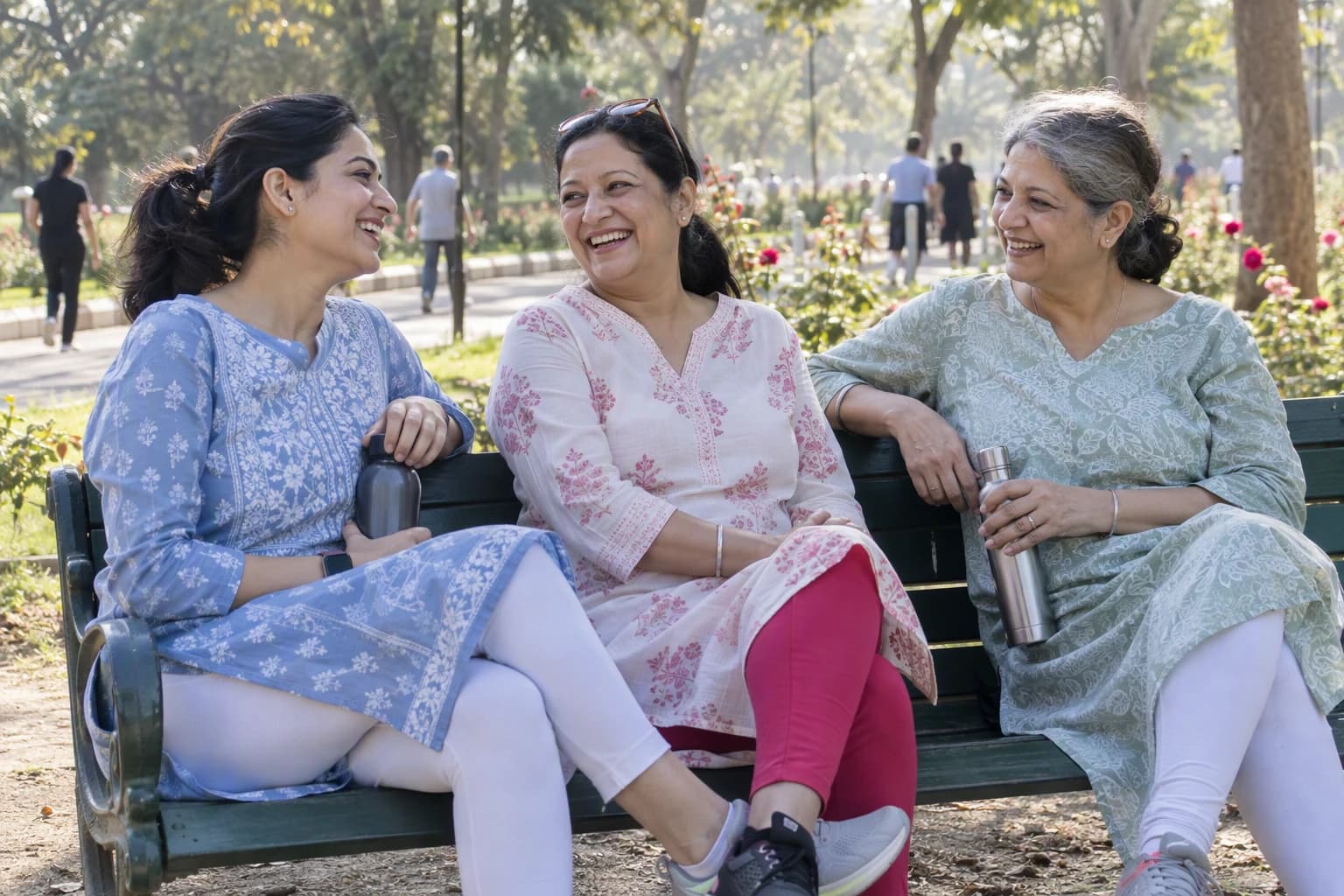
Most weight-loss advice handed to Indian women comes from a relative who lost weight once, on a diet that suited nobody else. It rarely asks whether you are 30 with PCOS, 42 with teenagers and a job, or 55 and past your last period. This page follows three such women, composites rather than real patients, who walk together most mornings in a Chandigarh park.
For women, weight comes off through a modest calorie gap, as it does for men, but hormones and muscle change how fast. PCOS slows it through insulin resistance. After the menopause, fat collects at the waist and muscle goes faster, so protein and strength training matter more each decade.
Is weight loss different for women?
The arithmetic is the same and most of the rest is not. A woman usually carries more fat and less muscle than a man of the same weight, so she burns less energy sitting at her desk and less on the stairs. Simone Lemieux's study found that at the same total body fat, women before menopause stored less fat around the organs than men did, and more on the hips and thighs.
That is why Sunita's husband lost his belly in two months of skipping rice while she lost far less on the same plan. He started with more muscle and more visceral fat, the kind that tends to shift first. Sunita's fat sits more on her hips, which is safer for her heart but slower to move. Comparing her progress with his was never a fair test, and it nearly made her give up in the first month.
Sources: [1]
How does PCOS change weight loss at 30?
It makes fat easier to store and slower to lose, mostly through insulin resistance. PCOS is common in India; Mohd Ashraf Ganie's large multicentre study found it in a substantial share of women of reproductive age, often with other metabolic problems alongside.
Priya's colleagues have told her she must go keto, or fast until 2 pm, to lose weight with PCOS. Lisa Moran's review found that weight loss improved PCOS features across many types of diet, with no single diet clearly ahead. So Priya picked one she can keep: a besan chilla with curd at 8.30, dal and sabzi with one roti from the office canteen, and paneer bhurji or eggs at dinner. Four kilos in, her periods have come on time twice in a row for the first time since college.
Does weight gained in pregnancy matter later?
It often stays, and the pregnancy can leave a lasting signal about sugar. Eleni Vounzoulaki's meta-analysis found that women who had diabetes during pregnancy carried almost ten times the risk of later type 2 diabetes compared with women who did not. Many women in India are told the condition went away after delivery and are never tested again.
Sunita had gestational diabetes with her second child, and kept about six of the kilos she gained in that pregnancy. Fourteen years on, nobody has checked her sugar. Her history makes a yearly HbA1c sensible, and it makes losing those kilos, especially from her middle, more than a matter of how her kurtas fit. Priya, who hopes to start a family in two years, has been told that reaching a healthier weight before pregnancy also lowers her own risk of diabetes in pregnancy.
Sources: [10]
Which blood tests are worth doing before a women's weight-loss plan?
Priya's doctor started with four. A TSH, because an underactive thyroid is common in Indian women and slows everything down. HbA1c and fasting insulin, because PCOS so often travels with insulin resistance; Ganie's multicentre study found metabolic problems alongside PCOS in many Indian women. And a lipid profile with liver function, to see what the extra weight was already doing. Her insulin came back high, which explained why the fat had been so stubborn.
Sunita's list was the same, but for her the HbA1c mattered most, because of the diabetes she had in her second pregnancy. Kamlesh's doctor added vitamin D and a haemoglobin, and found her vitamin D low enough to explain some of the aching she had blamed on age. Each result changed the plan a little. None of it shows up on a bathroom scale.
Why is weight loss harder in your forties?
Often because life changes more than metabolism does. Sunita's days start at 6 with tiffins for two teenagers, run through school counselling sessions, and end with homework, dinner and the washing. Exercise has slid off the list, and she eats the children's leftover parathas standing at the counter.
Muscle quietly declines through the forties without strength work, and the first signs of the menopause transition can start. Sunita's plan works around her family rather than against it. She walks with Priya and Kamlesh for 30 minutes before the household wakes and cooks one meal for everyone with more dal and sabzi. On Tuesday and Friday evenings she does a 15-minute strength routine while her son practises the keyboard. The leftover parathas now go into the fridge.
Sources: [8]
How do sleep and stress affect women's weight?
Short sleep raises appetite, especially for sweet and starchy food. Karine Spiegel's experiments found that restricting sleep shifted appetite hormones and increased hunger, most of all for calorie-dense food. Women in their forties often sleep worst, squeezed between teenagers, work and ageing parents, and hot flushes later add to it.
Sunita goes to bed after midnight on most school nights, once the kitchen is clean and her son's homework is checked, and her alarm rings at 5.45. Her worst snacking happens at 4 pm, after a day of difficult counselling sessions, when the staff room offers samosas and sweet tea. She now gets to bed by 11 on four nights a week and keeps a box of roasted chana in her desk drawer for 4 pm. Those two changes have done more than the diet chart her cousin forwarded.
Sources: [9]
What does the menopause do to weight?
Fat moves towards the middle and muscle starts to go faster. Gail Greendale's analysis of the SWAN study found that fat gain doubled in speed, and lean mass began to fall, as the menopause transition started. Jennifer Lovejoy followed women over four years and found that visceral fat rose significantly only in those who became postmenopausal.
Kamlesh weighs three kilos more than at 48, and her waist has grown by eight centimetres. Last spring she tried cutting lunch to one roti and a bowl of lauki, and by four o'clock she was too tired to walk to the market. Her doctor suggested she eat a proper lunch with dal and curd, add paneer at dinner, and join a strength class. Since July her waist has come down by three centimetres, and her afternoons are her own again.
How much protein do women need to lose weight?
More than most Indian women eat. Heather Leidy's review found that higher-protein meals keep people fuller and eating less later. For older adults, the PROT-AGE group led by Jürgen Bauer recommended at least 1.0, and ideally 1.2, grams per kilo of body weight a day, and more for those who exercise.
For Kamlesh, at 68 kilos, that is somewhere between 70 and 80 grams a day. Her usual day of tea with biscuits, rice and dal at lunch and two rotis with sabzi at night falls well short. Adding curd at breakfast and lunch, a besan chilla or two eggs in the morning, and paneer or chana at dinner closes most of the gap without any shakes. A glass of milk at bedtime finishes it.
Why should women lift weights?
Muscle and bone both thin with age, faster after the menopause, and lifting is the most reliable way to slow that down. Dennis Villareal's trial in older adults on a weight-loss programme found that adding resistance or combined training kept more lean mass than aerobic exercise alone, and improved everyday function most.
Kamlesh signed up for a seniors' strength class at her community centre in March. The instructor uses resistance bands and two-kilo dumbbells, and the oldest woman in the room is 71. In the first week Kamlesh could not rise from a low chair without using her hands. By September she lifts her two-year-old grandson onto her hip, and she carries the vegetable bags up three floors to her flat without stopping on the landing.
Sources: [7]
What does a weight-loss plan look like for each of them?
All three share one skeleton. Protein comes at every meal and rice or roti stays to a quarter of the plate. Tea has less sugar, packaged snacks mostly go, and there is a morning walk plus two strength sessions a week. The differences sit on top of that, and they come from each woman's body and week.
Priya keeps her meal times fixed, because a skipped lunch leaves her raiding the office sweets at six. Sunita writes the week's menu on a sheet on the fridge every Sunday, so the family eats one meal and she stops finishing the children's plates. Kamlesh adds curd, ragi and sesame for calcium, and booked the bone density scan her doctor suggested at 55.
Keeping muscle runs through all three plans, and it is the part most crash diets ignore. Metaboliq is a doctor-led weight programme built around it, and the aim we set with members is "Lose up to 20% of your body weight — and keep your muscle". Results vary; your doctor decides what is right for you. It starts with a home blood test that a doctor reads, because PCOS, thyroid and menopause each change what a sensible plan looks like.
Sources: [6]