 metaboliq
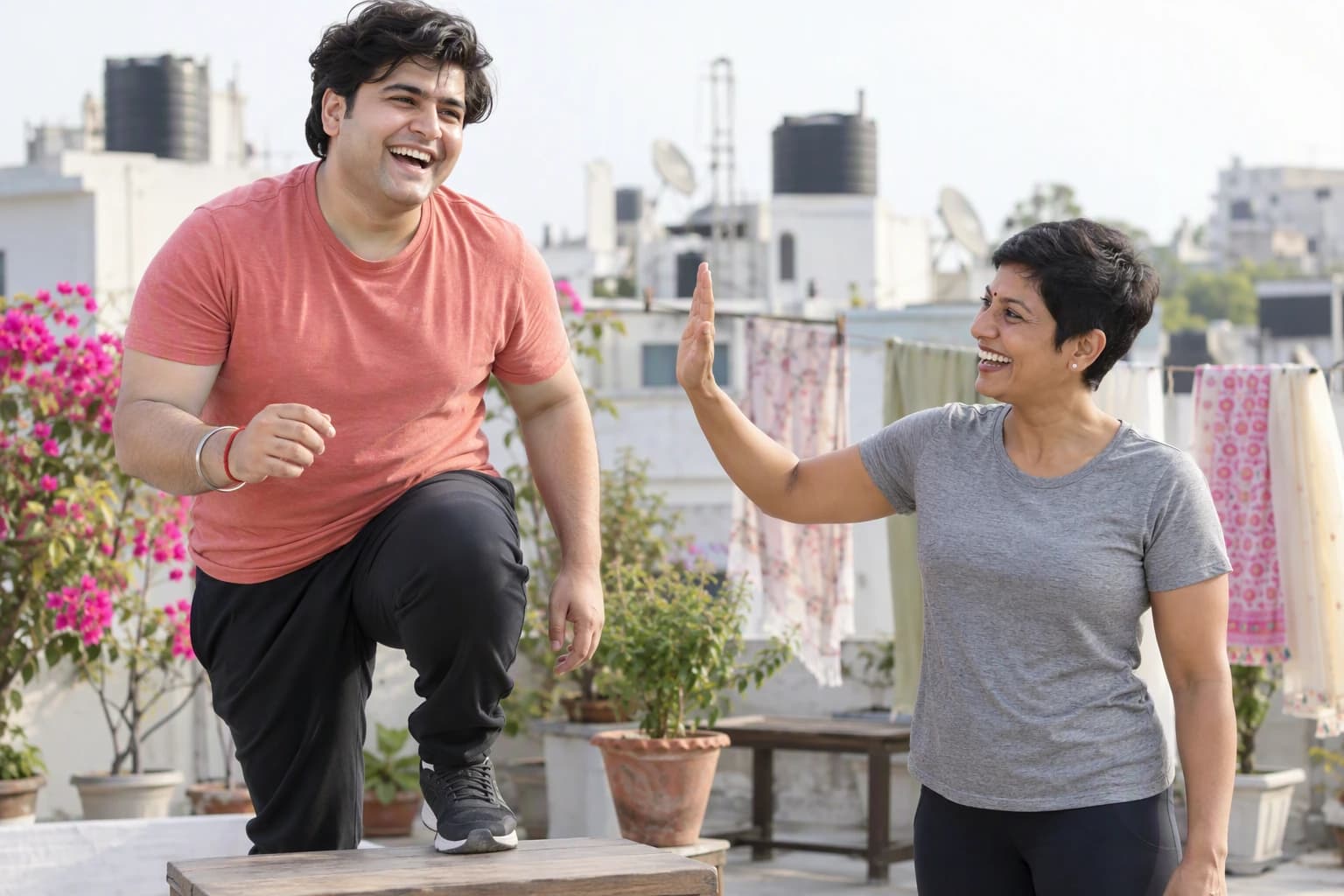
If a hundred leg raises a night have left your thighs firmer but the same size, the exercise is working as expected. Leg work builds the muscle; the fat over it shrinks only as your body fat falls overall. Trials that trained one leg or arm for three months found the fat loss spread evenly across the body. Thighs are usually the last place a woman slims. A modest calorie gap on ordinary Indian food, leg strength work and a brisk daily walk will get there in a few months.
Eat a little less than you burn, with protein at every meal, and do leg strength work two or three times a week. Walk briskly for 30–45 minutes on most days, after dinner if that is easiest. Measure your thighs once a month, because the change is slow and easy to miss in the mirror.
Can you lose fat from just your thighs?
Neha, an illustration rather than a real patient, is 27 and works in an office in Lucknow. For two months she has done 100 side leg raises every night in front of the television. Her thighs feel firmer, and the tape still reads 58 cm. She is not doing anything wrong; this is what the research predicts.
Ramírez-Campillo and colleagues had 11 young adults train only one leg, three times a week for 12 weeks. Each session was one long set of 960–1,200 light leg presses. They lost about 5% of their body fat. It came off the arms and trunk, and the trained leg lost no more than the resting one.
Kostek and colleagues tried the same idea with arms. They trained the non-dominant arm of 104 men and women for 12 weeks and scanned both arms by MRI. Fat loss was the same on both sides. Vispute and colleagues saw the same thing at the belly after six weeks of daily sit-ups.
Neha's leg raises built muscle, and that is useful. Where her fat came from was decided elsewhere, by her sex, age and genes.
Why does thigh fat stay the longest?
Look at Neha's family photos and the pattern is obvious: her mother, aunts and cousins all have slim shoulders and fuller hips and thighs. Before menopause, women store more fat below the waist and men store more on the belly. Karastergiou and colleagues reviewed why. Thigh fat cells in younger women can grow large and still respond normally to insulin, so the body keeps filling them.
They are also slow to empty. Manolopoulos and colleagues describe hip and thigh fat as a long-term store that soaks up spare fat after meals and releases it gradually. During a diet, the body tends to draw more readily on belly and organ fat, which turns over faster. So Neha should expect her kurtas to loosen at the waist a month or two before her jeans loosen at the thigh.
There is a health upside to this. People carrying more hip and thigh fat tend to have better cholesterol and blood sugar results than people of the same weight who carry it on the belly. After menopause, women start storing more at the waist, which is one reason to build leg and hip strength in the thirties and forties.
A small group of women face something different. In lipoedema, fat builds up evenly on both legs, often from hips to ankles, while the feet stay slim. The legs ache and bruise at a light knock, and Buso and colleagues report that dieting barely changes them.
Is spot reduction a complete myth?
Two recent trials found a small local effect, both at the belly. In Norway, Brobakken and colleagues had 16 overweight men run on a treadmill, with or without heavy abdominal work added. Total fat loss was about the same in both groups. The men who did the abdominal work lost about 700 g more fat from the trunk.
In Padua, Paoli and colleagues put 14 adults through eight weeks of circuits that mixed short cardio bursts with abdominal moves. Belly fat thickness fell more than in a group doing ordinary weights. Both trials were small and short, and neither measured women's thighs.
For Neha, that means leg training might draw a little extra fat from her thighs, at best. So she keeps leg sessions to about 30 minutes, three times a week, and adds load as she gets stronger. The hour she once spent on leg raises now goes on a brisk walk, which burns more fat across her whole body.
Which exercises help the thighs most?
Strength work changes how the thighs look as the fat comes off. Bigger, firmer muscle under a thinner layer of fat gives a leaner leg than a smaller muscle would. Neha's home session takes 30 minutes, three evenings a week, with three sets of each move.
She does 10–15 squats down to a chair, keeping her knees in line with her toes and her heels down. Then come 10 reverse lunges each side, 12 step-ups on the bottom stair and 15 glute bridges on a mat. She finishes with 15 side-lying leg raises each side, resting about a minute between rounds. When the last set feels easy, she holds a filled water bottle or slows each repetition to three seconds down. If a knee hurts, she makes the squat shallower rather than pushing through.
Walking does the larger share of the fat-burning work. The 2020 WHO guidelines advise adults to get 150–300 minutes of moderate activity a week, plus muscle strengthening on two or more days. For Neha that means a 30–45 minute brisk walk on most days, perhaps after dinner around the colony. Cycling and stair climbing count too, and they do not make thighs bulky at this level.
Sources: [8]
What should you eat to lose thigh fat?
No food targets the thighs, so the eating plan is one that brings total fat down while sparing muscle. Cava and colleagues reviewed how to do that: a moderate calorie cut, enough protein and regular resistance exercise. Crash diets take more muscle with them, and the legs end up smaller but softer.
Neha's changes are ordinary ones. Breakfast became besan chilla with curd instead of two parathas. Lunch is dal, sabzi, salad and two rotis, with a bowl of curd or a piece of paneer on the side. The evening samosa or biscuits were swapped for roasted chana or a fruit, and she drinks her chai with half the sugar.
Dinner is paneer, soya chunks or egg bhurji with vegetables and one or two rotis. She keeps rice for lunch on two or three days a week, one katori at a time. Fried snacks, sweets and sweet drinks still turn up at weddings and on Sundays, just less often than before.
Sources: [9]
How long does it take to slim your thighs?
Neha lost 3 kg in her first six weeks, and her waist dropped 4 cm before her thighs moved at all. By month three her thighs were 2 cm smaller at the spot she marks. That order, waist and face first and thighs later, is the usual one for women.
Losing around half a kilo a week is a realistic pace. She measures each thigh at the same spot once a month, standing, with the tape level. She also checks her weight in the same week of each menstrual cycle, because water before a period can add a kilo and hide progress.
If your BMI is already between 18.5 and 23, the healthy range for Indian adults, your thighs may simply be your shape, and strength work can change how they look without weight loss. For people living with obesity, the thighs change most when overall fat loss is large. With a doctor-led plan that begins with a home blood test and a doctor reading the results, some now lose up to 20% of their body weight and keep their muscle. Protein and leg training are what make that kept muscle show as firm, lean thighs.
Sources: [9]
How do you track thigh fat loss properly?
Neha keeps a small notebook by the bathroom scale. Three mornings a week she weighs herself after the toilet and before tea, and writes the number down. On Sunday she works out the average. Single readings swing by up to a kilo with salt, sleep and her cycle, so only the weekly average counts.
Once a month she takes three tape measurements: the waist at the navel, the hips at the widest point, and each thigh 15 cm above the top of the kneecap. She marks the spot with a pen the first time so she can find it again. She stands with her weight on both feet and keeps the tape flat, snug but not pressing.
She also takes a photo in the same clothes, in the same corner, under the same light. Photos catch a change in shape that the tape misses, especially at the back of the thigh. When Neha feels nothing has changed, the notebook usually shows that something has.
What does a thigh-focused week look like at home?
Monday, Wednesday and Friday are leg evenings, with the 30-minute circuit followed by a 15-minute walk after dinner. Tuesday, Thursday and Saturday are 40-minute brisk walks, split into two 20-minute halves on busy days. That adds up to roughly 165 minutes of walking, inside the WHO range. Sunday is rest, with some stretching.
Most of the food stays the same across the week, which keeps it easy to follow. Protein at each meal, vegetables at lunch and dinner, and grains in measured portions. One family dinner out a week is planned in, not treated as a slip.
If her weekly average and her tape measurements are both unchanged after four steady weeks, she looks first at portions, snacks and weekend meals. She trims the rice and roti a little and keeps the training the same.