 metaboliq
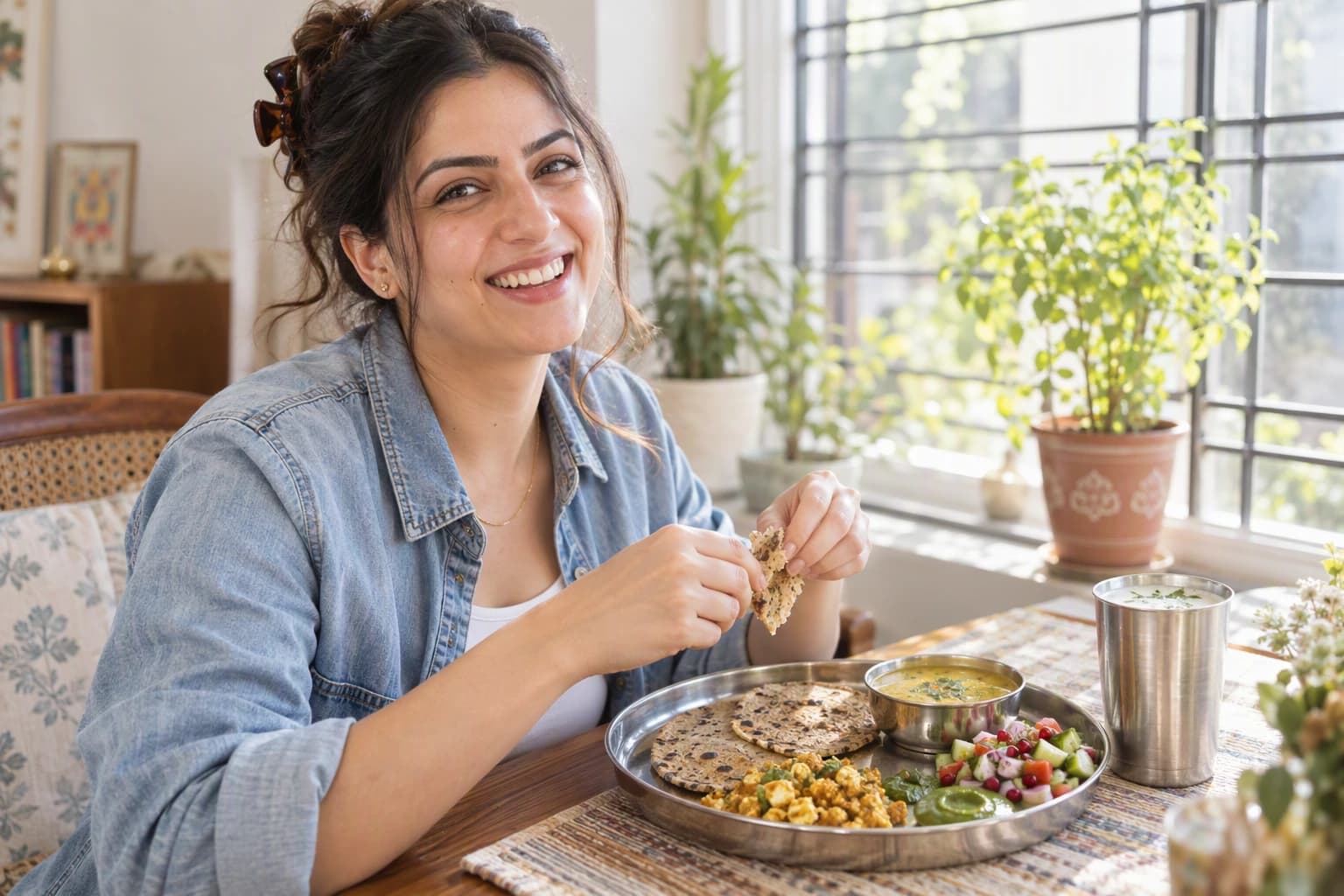
For most people a low-carb diet works by making it easier to eat less, especially if rice, rotis and sweets are where the extra calories come from. Year-long trials put its results close to a balanced diet with the same calorie cut, about a kilo apart on average. In an Indian kitchen it means one roti instead of three, a small katori of rice, chai without sugar, and more dal, paneer, eggs, curd and sabzi.
You do not need to go to zero, or to keto. Under about 130 g of carbohydrate a day is a level many people keep for months. Vegetables take half the plate, protein a quarter, and rice or roti the last quarter. Long studies favour plant fats and plant protein, so dal, chana, soya and nuts should do much of the work, with paneer and curd alongside.
What counts as a low-carb diet?
Researchers count in grams a day, and they do not all draw the line in the same place. Goldenberg and colleagues, reviewing low-carb diets for type 2 diabetes, called anything under 130 g a day low carb. Very low carb, where keto sits, was under about 10% of calories, which is roughly 50 g or less.
The Cochrane review by Naude and colleagues drew the line a little higher. For them, low carb meant between 50 and 150 g a day, or under 45% of energy. Very low carb was 50 g or under, and the balanced diets it was compared with took between 45% and 65% of energy from carbohydrate.
What about a diet with no carbs at all? On Indian food it is close to impossible, because dal, milk, curd, vegetables and fruit all contain some. Cutting every one of them would also cut the fibre, vitamins and protein a weight-loss diet relies on. Most people who search for a no-carb plan want fast results, and a low-carb plan that shrinks the grain gets them most of the way.
Does a low-carb diet lose more weight than other diets?
A little, at first, and not much by a year. The Cochrane review pooled 61 trials with 6,925 adults. Over three to eight months, people without diabetes on low-carb diets lost about 1 kg more than those on balanced-carbohydrate diets. Over one to two years the gap was about 0.9 kg. The authors judged this as little to no difference.
The DIETFITS trial by Gardner and colleagues at Stanford is the cleanest head-to-head. It randomised 609 adults to a healthy low-fat or a healthy low-carb diet for a year, both stressing whole foods and vegetables. The low-carb group lost 6.0 kg and the low-fat group 5.3 kg, a difference that could be chance.
DIETFITS also tested whether genes or insulin response could pick the right diet for each person. They could not. Neither a genotype pattern nor how much insulin people released after glucose predicted who did better on which plan.
Low carb, then, works about as well as other calorie-reduced diets, and its advantage is practical. For people who find rice and sweets hard to stop at one helping, a clear rule about carbohydrate can be easier to follow than counting every calorie.
Why do some people find low carb easier?
The early drop on the scale is encouraging, and part of it is water. Stored carbohydrate, called glycogen, holds water with it, so the first week of low carb often shows a kilo or two that is not fat. It comes back if carbohydrate returns.
There may be a small effect on energy use too, though this is debated. Ebbeling and colleagues kept 164 adults at a stable weight after they had lost about 12%, then fed them diets with 20%, 40% or 60% carbohydrate for 20 weeks. Those on 20% burned about 209 calories a day more than those on 60%. Hunger hormones were lower too.
Another tightly controlled study points the other way. Hall and colleagues at the US National Institutes of Health let 20 adults eat as much as they liked of a plant-based low-fat diet and an animal-based keto diet, two weeks each. On the low-fat plates they ate about 689 calories a day less.
The two studies tested different diets for different lengths of time, so they do not cancel each other out. What they share is the finding that people eat less on the plan that suits their appetite. If dropping rice stops the evening snacking, low carb fits. If you are still hungry by evening, a high-fibre, lower-fat Indian plate may suit you better.
How low should carbs go on an Indian diet?
Somewhere well below a usual Indian meal, and well above keto. A typical lunch of three rotis or a heaped plate of rice with dal and a little sabzi gets most of its energy from carbohydrate. Even a modest cut makes a large difference here.
Anjana and colleagues, working with data from 18,090 adults in the ICMR-INDIAB national study, modelled the diet that would best lower HbA1c in Indians. For remission of newly found diabetes, their answer was between 49% and 54% of energy from carbohydrate, with protein raised to about a fifth. For prevention the carbohydrate share was a little higher.
That is still a reduction for most Indian households, and it can be done without giving up rice or roti. A sensible starting point for weight loss is one or two rotis, or one small katori of rice, per meal. Fill the rest of the plate with vegetables and a protein food, and stop the sugar in chai and the biscuits with it.
People who want to go lower, towards 100 g a day or less, can do so by moving the grain to one meal and filling the others with eggs, paneer, sprouts and vegetables. Anyone on medicines that lower blood sugar should ask a doctor first, because a sharp carb cut can push sugar too low.
Sources: [6]
Which Indian foods are high in carbs, and which are low?
These figures are per serving, from the Indian Food Composition Tables 2017 as listed on our food pages. At the high end, a small katori of rice (40 g raw) carries about 31 g of carbohydrate, and a plate of poha about the same. A medium wheat roti has about 19 g, a jowar roti about 20 g, a medium potato about 22 g and a banana about 24 g.
In the middle sit the foods that also bring protein. A katori of moong dal has about 16 g of carbohydrate with 7 g of protein. One besan chilla has about 14 g, three quarters of a katori of boiled kala chana about 12 g, and a glass of milk about 10 g.
At the low end, 50 g of paneer has about 1 g and an egg almost none. A handful of peanuts has about 5 g, and a handful of soya beans about 3 g, with 11 g of protein. Two rotis, a small katori of rice, two katoris of dal and a glass of milk add up to about 110 g. That leaves room for vegetables and a piece of fruit under 130 g.
What does a low-carb Indian meal plan look like?
Here is a vegetarian day. Breakfast is two besan or moong dal chillas filled with paneer, with mint chutney and tea without sugar. Mid-morning, a bowl of curd and a few walnuts. Lunch is one jowar or wheat roti, a katori of dal, palak paneer and a big plate of cucumber and onion.
For the evening, roasted chana or a sprouts chaat with lemon. Dinner is soya chunk or paneer tikka with grilled vegetables and a bowl of lauki or tinda sabzi. Leaving rice out of dinner is the main carb cut on this day.
A day with eggs, chicken or fish might start with a two-egg omelette with onion, tomato and spinach, and a glass of milk. Lunch is a small katori of rice, chicken curry with less gravy, cabbage sabzi and salad. The evening snack is a boiled egg or a handful of peanuts.
Dinner is grilled fish or tandoori chicken, a katori of dal and sautéed beans. Across the week, rotate the protein so dal, paneer, eggs and fish each turn up a few times. Keep fruit to one or two pieces a day, eaten whole rather than as juice.
Sources: [6]
Which low-carb recipes suit Indian kitchens?
Cauliflower pulao: grate cauliflower into rice-sized bits and cook it for five minutes with jeera, peas, a few cashews and garam masala. It sits next to a rajma or chicken curry the way rice would, with a fraction of the carbohydrate.
Paneer bhurji: crumble paneer into onions, tomatoes and green chillies cooked in one teaspoon of oil, with haldi and kasuri methi. Eat it with a single roti or wrapped in a lettuce leaf.
Moong dal chilla: soak moong dal for two hours, grind with ginger and chilli, and cook thin on a tawa. Stuff with grated paneer or vegetables. Egg bhurji and masala omelettes work the same way for non-vegetarians.
Soya and sprouts: soya chunks soaked and cooked as a dry sabzi, or moong sprouts tossed with onion, tomato and lemon. Both bring protein and fibre. For dessert, a bowl of hung curd with cinnamon and a few berries replaces kheer on most nights.
Sources: [8]
Is a low-carb diet safe in the long run?
It depends a great deal on what replaces the carbohydrate. Seidelmann and colleagues followed 15,428 American adults for about 25 years and combined the results with seven other cohorts. Both very low and very high carbohydrate intakes went with higher death rates, with the lowest risk at 50% to 55% of energy.
The source of fat and protein changed the picture. Low-carb patterns built on meat went with higher mortality, while those built on vegetables, nuts, pulses and whole grains went with lower mortality. These are observational findings, but they fit Indian food well: dal, chana, soya, nuts and seeds over butter and red meat, with paneer and curd in sensible amounts.
Some people should check with a doctor before cutting carbohydrate hard. That includes anyone on medicines that lower blood sugar, people with kidney disease, women who are pregnant or breastfeeding, and anyone with a history of eating disorders. Some newer sugar-lowering medicines can, rarely, cause a dangerous build-up of ketones when carbohydrate is cut very low. If paneer, cheese and ghee become daily staples, a cholesterol check after a few months is sensible. A sudden switch can also bring headaches, constipation and tiredness in the first week, which usually settle with water, salt in normal amounts and enough vegetables.
Sources: [7]
How do you keep muscle on a low-carb diet?
Low carb nudges protein up almost by default, which helps. Leidy and colleagues reviewed the trials and found that higher-protein diets kept more lean mass while people lost weight. They suggested between 1.2 and 1.6 g of protein per kg a day. For a 70 kg woman, 1.2 g per kg is about 84 g. Two katoris of dal, 100 g of paneer, two eggs, a glass of milk and a handful of soya come to about 65 g, and rotis, rice and curd supply most of the rest.
Strength work matters as much. Weinheimer pooled 52 studies in adults over 50. In 81% of the diet-only groups, at least 15% of the weight lost was fat-free mass; with exercise added, the figure was 39%. Two sessions a week of squats, push-ups and rows, at home with a resistance band or in a gym, are enough to start.
If muscle goes, the daily burn drops with it, and the scale can stall on the same plate. At Metaboliq a doctor first reads a home blood test for sugar, insulin, thyroid and cholesterol, and the carbohydrate, protein and training are then worked out to fit. The aim is to lose up to 20% of body weight and keep your muscle while you do it.