metaboliq

Diabetes reversal, remission or cure: what the words mean
Remission is the word doctors use, and it has a definition: an HbA1c below 6.5% at least three months after stopping all diabetes treatment.
Sources: [1]
Read the full section
Reversal is a marketing word, and cure is not a claim any trial makes.
In 2021 an international expert group convened by the American Diabetes Association, led by Matthew Riddle, agreed the definition. The test is HbA1c, measured no sooner than three months after the last sugar-lowering treatment, because HbA1c reflects about three months of blood sugar. The group also asked that people in remission stay under active observation, since remission can end.
The word matters because the body has not forgotten its diabetes. The tendency stays. If the weight returns, or with age, sugar can climb back over the line. People in remission still need their eyes, kidneys and feet checked, and their blood pressure and cholesterol watched.
So when a programme promises to reverse diabetes in 21 days or 3 months, ask what it measures. A lower fasting sugar while you are still on treatment is control, which is good, but it is not remission.
- HbA1c below 6.5%
- Three months off all treatment
- Watched with regular HbA1c
- Eye, kidney and foot checks go on
- 6.5%HbA1c line for remission
What the DiRECT trial found
Almost half the people on a supervised weight-loss programme were in remission a year later.
Sources: [2]
Read the full section
The more weight they lost, the likelier it was: 86% of those who lost 15 kg or more.
DiRECT was run in 49 general practices in Scotland and the Tyneside area of England, led by Mike Lean and Roy Taylor. It took adults aged 20 to 65, diagnosed within the past six years, with a BMI of 27 to 45 and not on insulin. The programme group stopped their diabetes and blood-pressure treatment under supervision and lived on a formula diet of about 825 to 853 calories a day for three to five months, then reintroduced food over two to eight weeks, with support afterwards to keep the weight off.
At one year, 46% were in remission against 4% of the usual-care group. Remission tracked weight almost step for step: 7% for those who lost under 5 kg, 34% at 5 to 10 kg, 57% at 10 to 15 kg and 86% at 15 kg or more.
The formula diet is the part people remember, but the lesson is the weight. A formula diet is one way to lose 10 to 15 kg quickly under supervision. It is not the only way, and nobody should try 850 calories a day on their own while on diabetes treatment.

How long does diabetes remission last?
In DiRECT, 46% of the programme group were in remission at one year and 36% at two.
Read the full section
At five years it was 13% of those who stayed on in an extended programme. The people who kept at least 10 kg off held on to remission far better than the rest.
At two years, 64% of the participants who had kept off 10 kg or more were still in remission. Remission lasted about as long as the weight loss did, and faded as the kilos came back. The group that carried on into a lighter five-year extension was on average 6.1 kg below its starting weight at the end, and only about a quarter of those in remission at two years were still in remission at five.
Those years were not wasted. Over the whole five years, the original programme group spent more of its check-ups in remission, 27% against 4%, and had fewer than half the serious adverse events of the usual-care group.
For Prakash, the Pune bank officer we come to below, this changes the question he asks. He wants to know whether he can get off his treatment by Diwali. The better question is what weight he can hold at 50, because the trials show that is what keeps sugar down.
- 64%in remission, 10 kg kept off

Why weight loss can bring remission: liver and pancreas fat
Type 2 diabetes is driven in large part by fat inside the liver and pancreas.
Sources: [5]
Read the full section
Remove enough of it, and the liver listens to insulin again and the pancreas can make enough of it.
Roy Taylor at Newcastle University set out the idea in 2008, and DiRECT was built to test it. Years of surplus calories fill the liver with fat. A fatty liver ignores insulin and keeps releasing glucose, and the fat it exports collects in the pancreas, where it blunts the insulin-making cells. When people eat much less, liver fat falls within days and liver insulin resistance eases.
This also explains who does well. The insulin-making cells recover only if enough of them are still working, and they are lost steadily over the years of high sugar. That is why remission is far likelier within the first few years of diagnosis than after ten, and less likely once insulin is needed.
Indian bodies tend to carry more fat inside the abdomen and liver at a lower weight, so for many Indian adults a smaller loss may matter more than the number on the scale suggests. The waist and liver tests are worth tracking alongside weight.
- DaysLiver fat falls
Liver hears insulin.
- WeeksSugar output drops
Fasting sugar eases.
- MonthsPancreas recovers
If enough cells remain.
Who is most likely to reach remission?
People diagnosed in the last few years, not on insulin, who take 10 kg or more off and keep it off.
Read the full section
In longer-standing diabetes, remission is less common but still possible.
The DIADEM-I trial in Qatar tested a similar programme in 158 adults aged 18 to 50, diagnosed within three years, from the Middle East and north Africa. They lost about 12 kg at a year against 4 kg on usual care, and 61% were in remission against 12%. Young age and a short history are clearly on the side of remission.
Look AHEAD, a US trial of adults with type 2 diabetes of any duration, shows the other end. With an intensive lifestyle programme but no formula diet, 11.5% reached partial or complete remission in the first year and 7.3% at year four, against 2% of the comparison group. Only 3.5% stayed in remission continuously for all four years.
Prakash, 44, a bank officer in Pune, is a composite of the readers who write to us. He was diagnosed two years ago with an HbA1c of 7.6, weighs 88 kg and has a 102 cm waist. On paper, his chances of remission are good. Someone of 60, fifteen years after diagnosis and on insulin, can still gain a great deal from weight loss in sugar, blood pressure and fewer treatments, even if remission is less likely.
| Who | In remission | |
|---|---|---|
| DIADEM-I | Under 3 years, age 18-50 | 61% at 1 year |
| DiRECT | Under 6 years, age 20-65 | 46% at 1 year |
| Look AHEAD | Any duration | 11.5% at 1 year |

An Indian diet plan for type 2 diabetes remission
More protein, less refined grain.
Read the full section
An ICMR model built on 18,090 Indian adults matched remission of new diabetes to about half the calories from carbohydrate, a fifth from protein and a quarter from fat.
R M Anjana's team used the ICMR-INDIAB diet data to work out the mix of carbohydrate, protein and fat linked with an HbA1c below the diabetes line. For newly diagnosed diabetes it came to 49 to 54% carbohydrate, 19 to 20% protein and 21 to 26% fat, which is less carbohydrate and more protein than most Indian plates carry. A second INDIAB analysis found that swapping white rice for whole wheat or millet at the same quantity did not help.
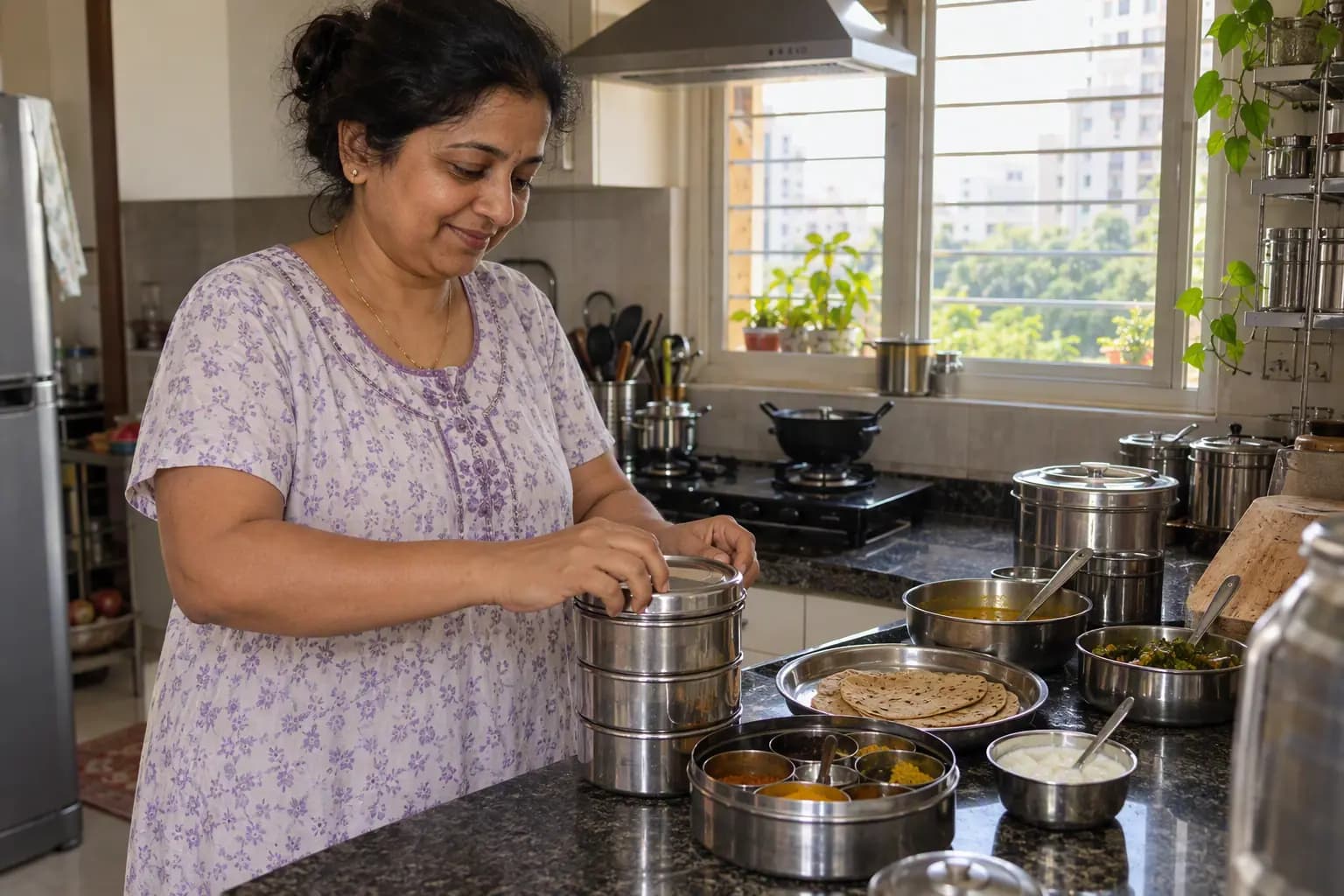
Prakash's version is Maharashtrian. Poha in the morning became a moong dal chilla or two eggs. At lunch he has two bhakris instead of four, with a full bowl of usal or dal, a vegetable and curd. In the evening, roasted chana replaces the vada pav at the station. Dinner is chicken or paneer with a vegetable and one chapati, by 8.30, and fruit is eaten whole after a meal rather than as juice.
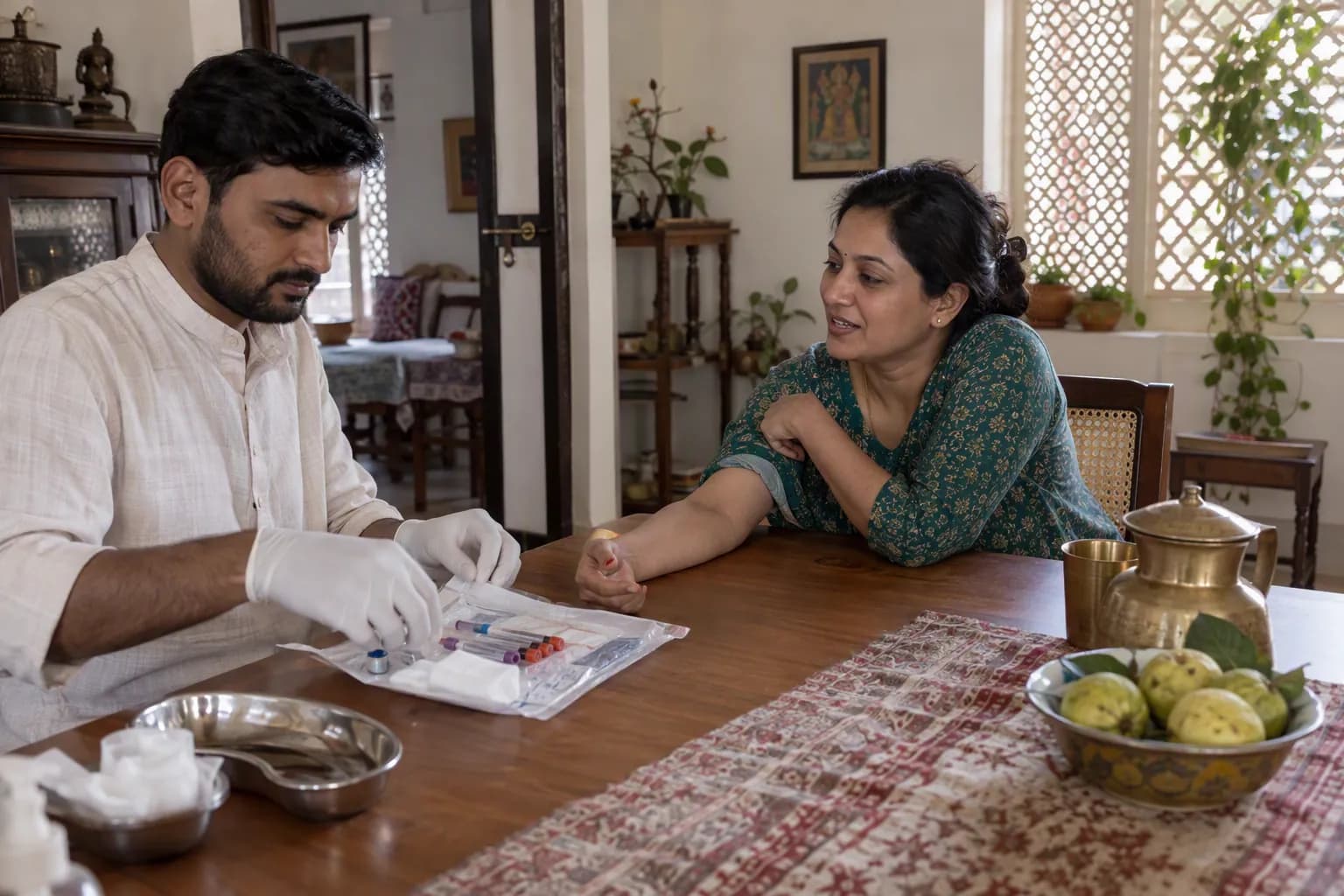
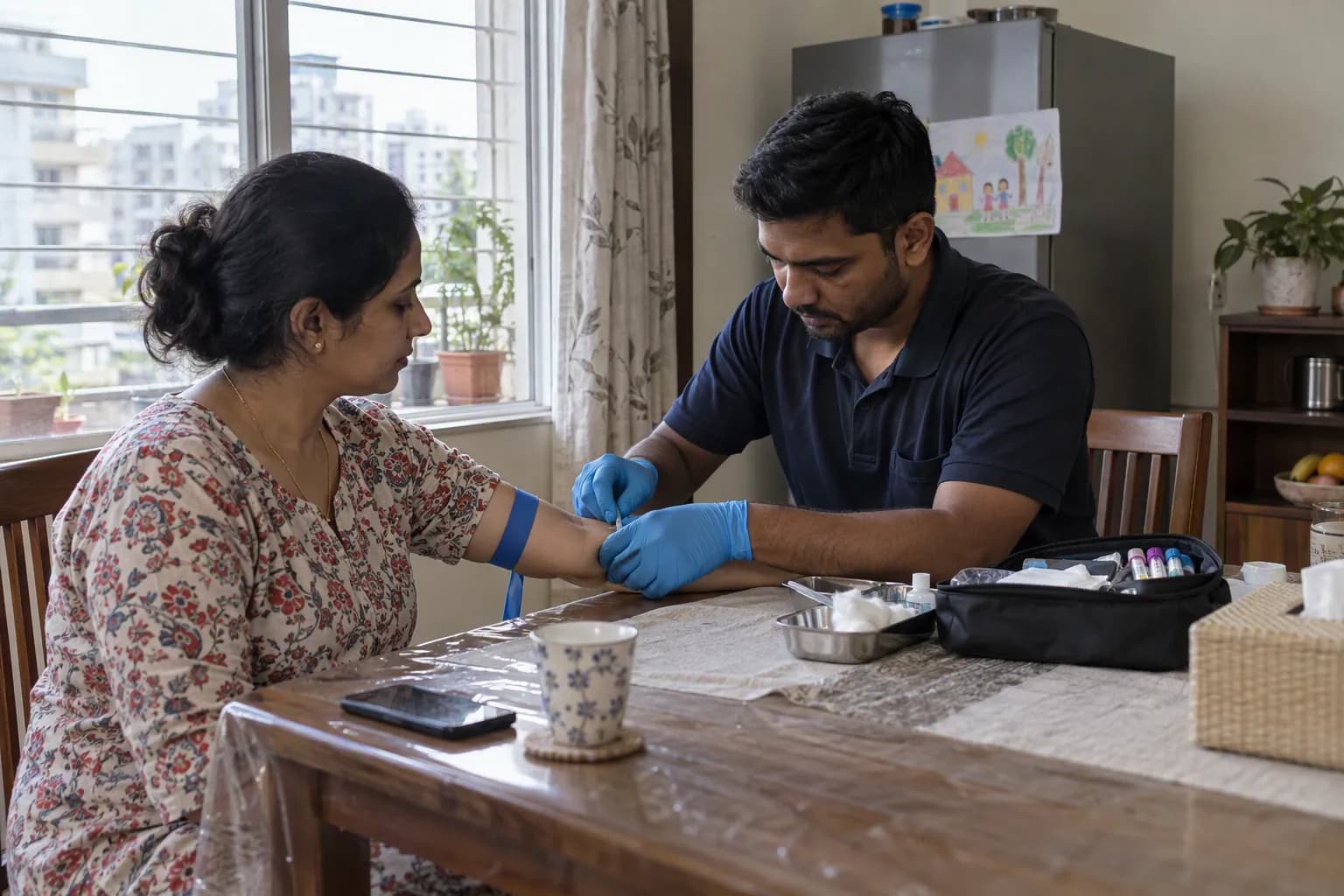
The remission trials turn on how much weight comes off and stays off, and a plate like this is how most people in India get there, over months rather than weeks. It is also why Metaboliq's doctors pair the plate with strength work: the aim they set with members is "Lose up to 20% of your body weight — and keep your muscle", and kept muscle is part of what holds sugar down. Results vary; your doctor decides what is right for you. Each plan starts with a home blood test, read with you by a doctor.
How to aim for remission safely, with a doctor
Nobody should stop diabetes treatment on their own.
Read the full section
As weight comes off, the same treatment can push sugar dangerously low, so a doctor lowers it step by step and repeats HbA1c every three months.
The American Diabetes Association sets an HbA1c goal below 7% for many adults and treats low blood sugar as a risk to plan for. In DiRECT, treatment was stopped on day one only because people were on a closely supervised formula diet. On an ordinary Indian plate, the safer path is for the doctor to step treatment down as home sugar readings fall.
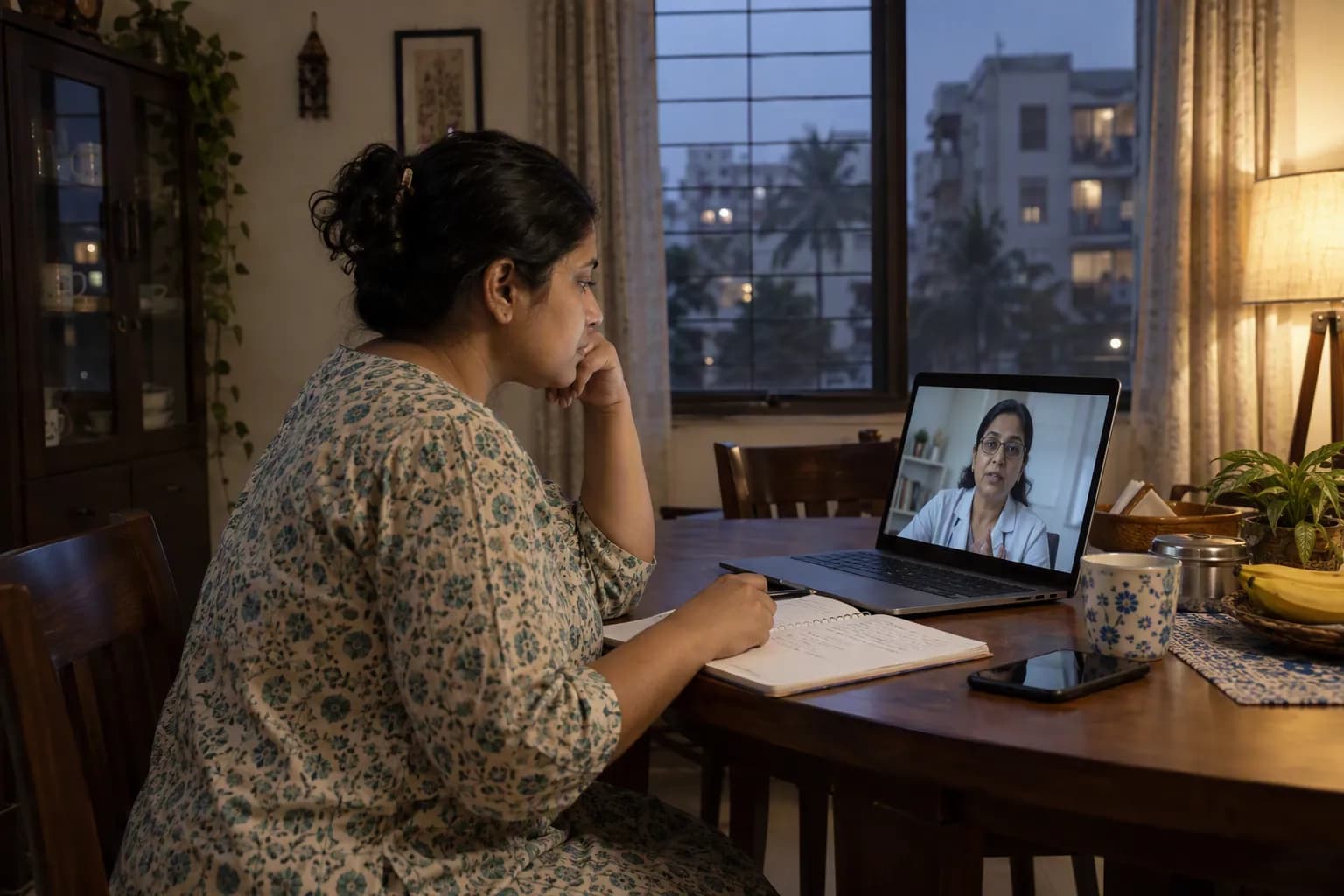
Prakash's doctor set out the order at their first call. A full blood panel first, including kidney and liver markers. Fasting and after-dinner sugar readings three times a week for the first two months. An HbA1c at three months, and a decision about his treatment at each review. If his HbA1c stays below 6.5% three months after the last treatment stops, that is remission, and his HbA1c keeps being checked after that.
He also has a rule for the bad weeks. If his fasting sugar goes above 130 on three mornings in a row, he calls the doctor rather than waiting for the next review.
- Week 0Blood panel
HbA1c, liver, kidney.
- Weeks 1-12Plan and step down
Treatment eased.
- Month 3+HbA1c again
Remission if under 6.5%.
- 3 monthsoff treatment before testing

Every source, in full (10)
[1] Riddle MC, et al. Consensus Report: Definition and Interpretation of Remission in Type 2 Diabetes
Diabetes Care, 2021. An international expert group convened by the American Diabetes Association proposed remission as the term, defined as an HbA1c below 6.5% measured at least three months after stopping glucose-lowering treatment, and asked for active observation of people in remission.
Read the source[2] Lean MEJ, et al. Primary care-led weight management for remission of type 2 diabetes (DiRECT): an open-label, cluster-randomised trial
The Lancet, 2018. At 12 months 46% of the weight-management group were in remission against 4% of controls; remission was reached by 7% of those who lost 0-5 kg, 34% at 5-10 kg, 57% at 10-15 kg and 86% at 15 kg or more.
Read the source[3] Lean MEJ, et al. Durability of a primary care-led weight-management intervention for remission of type 2 diabetes: 2-year results of the DiRECT open-label, cluster-randomised trial
The Lancet Diabetes & Endocrinology, 2019. At 24 months 36% of the intervention group and 3% of controls were in remission; of everyone who kept off at least 10 kg, 64% were in remission, and sustained remission tracked sustained weight loss.
Read the source[4] Lean ME, et al. 5-year follow-up of the randomised Diabetes Remission Clinical Trial (DiRECT) of continued support for weight loss maintenance in the UK: an extension study
The Lancet Diabetes & Endocrinology, 2024. At five years the extension group had lost 6.1 kg on average and 13% were in remission; of those in remission at two years, 26% still were at five; over the five years the original intervention group spent more visits in remission (27% against 4%) and had under half the serious adverse events of controls.
Read the source[5] Taylor R. Pathogenesis of type 2 diabetes: tracing the reverse route from cure to cause
Diabetologia, 2008. Fat in the liver makes it resist insulin and overproduce glucose, fatty acids blunt the beta cells, and with energy restriction liver fat falls within days and liver insulin sensitivity returns, while muscle insulin resistance persists.
Read the source[6] Taheri S, et al. Effect of intensive lifestyle intervention on bodyweight and glycaemia in early type 2 diabetes (DIADEM-I): an open-label, parallel-group, randomised controlled trial
The Lancet Diabetes & Endocrinology, 2020. In 158 adults aged 18-50 with diabetes of three years or less, from the Middle East and north Africa, treated in Qatar, a meal-replacement and lifestyle programme brought 11.98 kg off at 12 months against 3.98 kg, with 61% in remission against 12%.
Read the source[7] Gregg EW, et al. Association of an intensive lifestyle intervention with remission of type 2 diabetes
JAMA, 2012. In Look AHEAD, 11.5% of the intensive lifestyle group reached partial or complete remission in the first year and 7.3% at year four, against 2.0% of the education group; 3.5% of the intensive group stayed in continuous remission for all four years.
Read the source[8] Anjana RM, et al. Macronutrient recommendations for remission and prevention of diabetes in Asian Indians based on a data-driven optimization model: the ICMR-INDIAB national study
Diabetes Care, 2022. From 18,090 Indian adults, remission of newly diagnosed diabetes was modelled at carbohydrate 49-54% of energy, protein about a fifth and fat 21-26%: fewer carbohydrates and more protein than the usual Indian diet.
Read the source[9] Anjana RM, et al. Dietary profiles and associated metabolic risk factors in India from the ICMR-INDIAB survey-21
Nature Medicine, 2025. In 18,090 Indian adults, diets were high in low-quality carbohydrate (white rice, milled grains, added sugar) and low in protein; the highest carbohydrate intakes went with more abdominal obesity (odds ratio 1.15), swapping refined cereal for whole wheat or millet flour at the same quantity showed no benefit, and swapping carbohydrate for protein went with lower odds of diabetes.
Read the source[10] American Diabetes Association. 6. Glycemic Goals and Hypoglycemia: Standards of Care in Diabetes-2024
Diabetes Care, 2024. Sets an HbA1c goal below 7% for many non-pregnant adults, individualised up or down, and covers the risk of low blood sugar on glucose-lowering treatment.
Read the source