metaboliq
Liposuction, fat freezing and tummy tuck: what each one removes
All three work on the fat under the skin, the layer you can pinch between two fingers.
Read the full section
Liposuction sucks it out through thin tubes, fat freezing kills fat cells by cooling them, and a tummy tuck cuts away loose skin and tightens the muscle wall beneath.
Meera, 38, a teacher in Pune, is a composite of the women who ask us about this. After two caesareans she weighed 78 kg, and a cosmetic clinic quoted her for liposuction of the belly and flanks with a tummy tuck in the same sitting. She wanted to know what each part would actually do.
Liposuction is surgery under local or general anaesthesia, and the fat leaves the body the same day. The swelling takes weeks to settle and a compression garment stays on for a month or more. Fat freezing, sold as cryolipolysis or CoolSculpting, happens in a clinic chair: a cup clamps a roll of fat and cools it for about an hour, and the body clears the dead fat cells over the next two to three months. One cycle treats one roll, such as the lower belly or one flank.
A tummy tuck, or abdominoplasty, is a different operation. It removes skin and some fat below the navel and stitches together abdominal muscles stretched apart by pregnancy. None of the three reaches the fat packed around the liver, gut and heart, which is the fat Meera's blood report was about to show her.
| Takes out | Anaesthesia | |
|---|---|---|
| Liposuction | Fat, 1 area | Yes |
| Fat freezing | Fat, 1 roll | None |
| Tummy tuck | Skin and fat | Yes |

Does liposuction help with weight loss or blood sugar?
It takes weight off the scale, but the body does not register it as weight loss.
Read the full section
When 15 women had about a fifth of their body fat removed from the belly, their blood sugar control, cholesterol and blood pressure did not improve.
Samuel Klein's team at Washington University in St Louis ran the study that settled this. Fifteen women with abdominal obesity, seven of them with type 2 diabetes, had large-volume liposuction of the belly. The women with normal sugar lost 9.1 kg of fat and those with diabetes 10.5 kg, between 18 and 19% of all the fat in their bodies. The researchers measured insulin action in muscle, liver and fat before and 10 to 12 weeks after, along with inflammation markers and the usual heart risks.
Nothing important moved. Insulin worked no better, the inflammation markers were unchanged, and blood pressure, sugar and cholesterol stayed where they had been. The authors' conclusion was blunt: taking out fat tissue alone does not bring the metabolic benefits of weight loss.
The reason is where the fat sits. The fat that drives insulin resistance, fatty liver and diabetes is visceral fat, inside the abdomen and in the liver, and liposuction cannot reach it. It is also the fat that leaves first when you eat less and move more. In the CENTRAL trial, 18 months of moderate weight loss took visceral fat down by 22% and liver fat by 29%.
- 29%liver fat lost, CENTRAL trial

Fat freezing treatment: how much fat it really removes
The clinic offered Meera four sessions of fat freezing on her lower belly.
Read the full section
The studies say what she could expect: a treated roll of fat shrinks by roughly 10 to 28%, enough to see, and her blood report would not change at all.
Michael Ingargiola and colleagues pulled together the clinical studies of cryolipolysis published up to 2015. Measured with calipers, the treated fat layer thinned by 14.7 to 28.5%. Measured with ultrasound, it thinned by 10.3 to 25.5%. None of the studies found a change in cholesterol, triglycerides or liver tests afterwards. Most side effects were redness, swelling, numbness and soreness that faded within days or weeks.
One rare effect is worth knowing before you book. Doctors at Massachusetts General Hospital described paradoxical adipose hyperplasia, in which the treated area slowly grows a firm lump of fat a few months later instead of shrinking. They estimated it at about 1 in 20,000 treatment cycles, more often in men, and it did not go away by itself. The usual fix was liposuction.
The people most pleased with fat freezing tend to be near their goal weight, with one pocket of fat that diet and exercise have not touched, such as a pouch below the navel or the love handles. Meera, with a 92 cm waist and a prediabetic HbA1c, was not one of them.
Can fat come back after liposuction?
Yes, and it tends to come back somewhere else.
Sources: [5]
Read the full section
In a randomised trial, women who had fat suctioned from the thighs or hips had about the same body fat as untreated women a year later, and the new fat had settled on the belly.
Teri Hernandez and Robert Eckel at the University of Colorado randomised 32 women of normal weight to small-volume liposuction or no surgery, and asked everyone to keep eating and exercising as they had. Six weeks after surgery, body fat was down by about 2% in the liposuction group. By one year, the difference from the untreated group was no longer significant.
The treated thighs did stay slimmer. The fat had returned to the abdomen, the place most linked with diabetes and heart disease. The authors read it as the body defending its fat stores: take fat cells out of one place, and the fat cells left elsewhere fill up to make up the difference.
For anyone weighing liposuction, the practical message is about what happens after. Eating and activity decide whether the result lasts. Someone who keeps gaining weight after surgery puts it on in the places that were not treated, sometimes unevenly enough to need a second procedure.
- Week 0Lipo
Thighs and hips treated.
- Week 6Body fat down
About 2% lower.
- Year 1Fat back
Mostly on the belly.
What weight loss does that a procedure cannot
Losing weight starts with the fat inside the abdomen and the liver, which is why the blood numbers improve long before the waistline looks very different.
Read the full section
A loss of 5 to 10% is often enough to move sugar, triglycerides and blood pressure.
In Look AHEAD, a trial of 5,145 adults with type 2 diabetes, people who lost 5 to under 10% of their weight in the first year were about three and a half times as likely to bring HbA1c down by half a point as those whose weight stayed put. Their triglycerides, good cholesterol and blood pressure improved as well. Bigger losses did more.
Some problems need more. Donna Ryan's review found that blood sugar and triglycerides respond to small losses, while sleep apnoea and inflamed fatty liver usually need 10 to 15%. Large, lasting losses on that scale change survival: in the Swedish Obese Subjects study, people who kept off 14 to 25% of their weight after bariatric surgery had fewer deaths over about 11 years than matched people who did not lose weight.
Indian bodies make this more pressing. Indian adults reach high sugar and blood pressure at a smaller waist than Europeans, which is why the consensus line for abdominal obesity here is 90 cm for men and 80 cm for women. A flat stomach after liposuction can hide a liver that is still fatty.

Which should you choose: a procedure, or losing weight?
Start with three numbers: your BMI, your waist and your blood report.
Read the full section
If the BMI is under 23, the waist is under the Indian line and the report is clean, a procedure for one stubborn area is a cosmetic choice you can weigh on its own terms. If not, weight loss comes first.
Most Indian adults who search for fat freezing fall in the second group. The ICMR-INDIAB survey of 113,043 adults found abdominal obesity in 39.5%, against 28.6% with obesity by BMI, so plenty of people with a normal-looking BMI carry belly fat that is already raising their sugar and filling their liver. The waist lines from the 2009 Indian consensus are 90 cm for men and 80 cm for women, measured at the navel after breathing out.
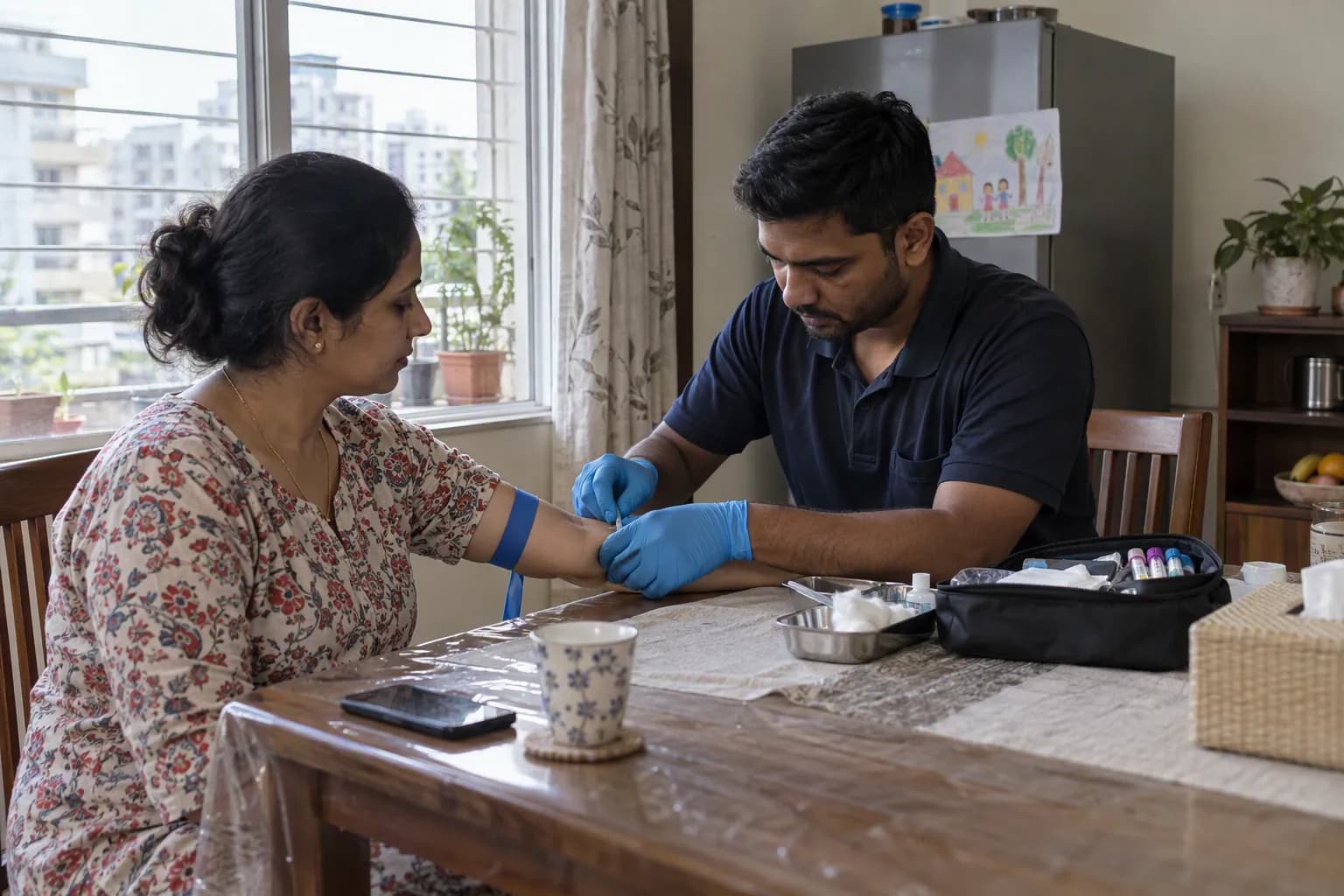
Meera was in the second group, at a 92 cm waist, which is why her surgeon sent her away. At Metaboliq, the doctors start the same way, with a home blood test read with you, and the aim we set with members is "Lose up to 20% of your body weight — and keep your muscle". Results vary; your doctor decides what is right for you. The muscle half of that line matters here, because muscle is what holds the shape you were after once the fat has gone.
45+ markers, one home blood test
- HbA1c
- Thyroid test
- Fasting insulin
- HOMA-IR
- Fasting blood sugar
- Lipid profile
- Liver function test
- Kidney function test
- 39.5%Indian adults with belly obesity
What losing belly fat looks like instead: a week of food and movement
Meera's plan for the months before any surgery is built from her own kitchen in Pune.
Read the full section
The aim is to shrink the fat inside her abdomen and liver, which no procedure can reach, while keeping the muscle that will shape her stomach afterwards.
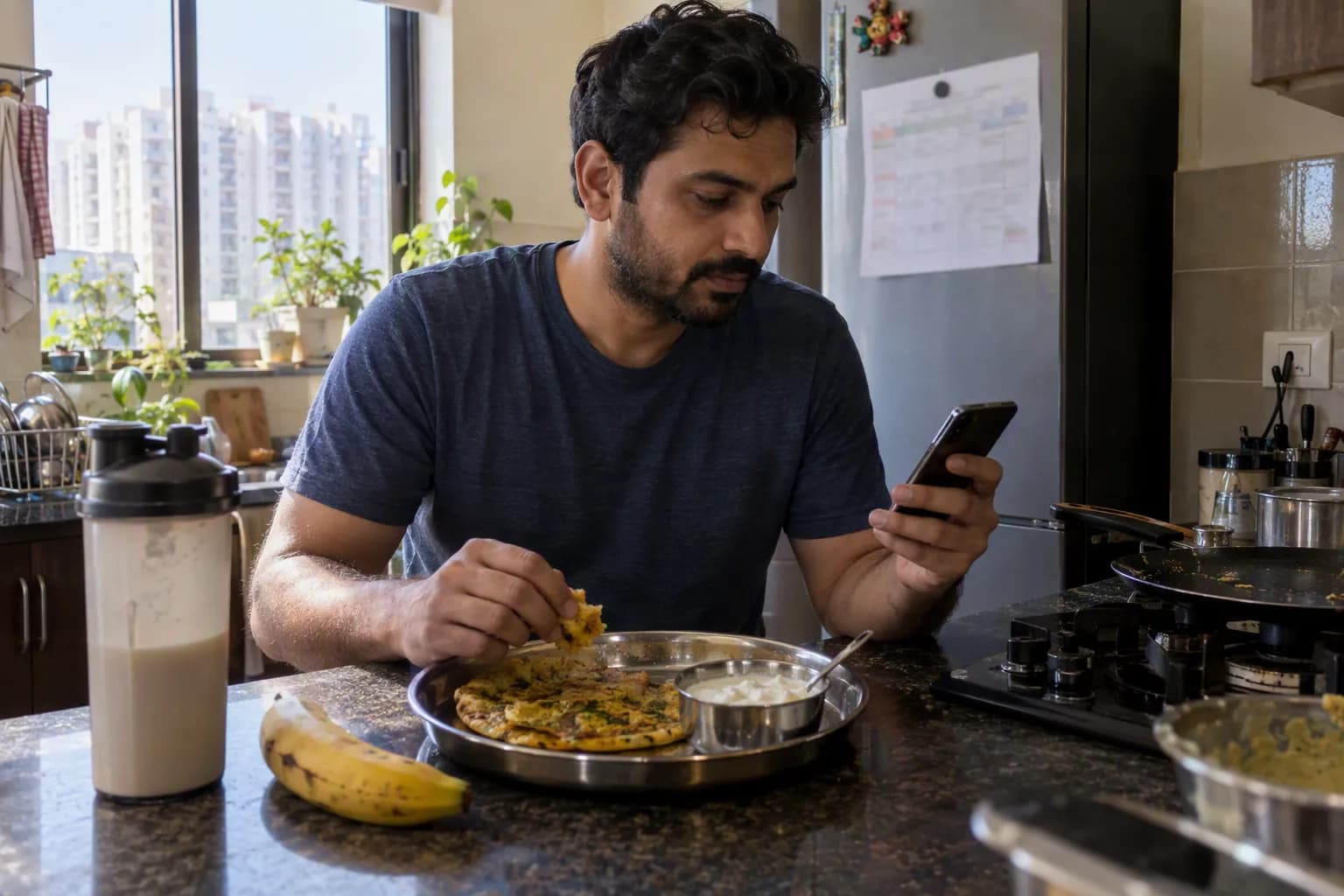
Her breakfast moves from two parathas to a moong dal chilla or two eggs with tea that has no sugar in it. Lunch, packed for school, is two rotis, a full katori of dal and a bowl of curd. At 5 she has roasted chana instead of biscuits. Dinner is paneer or fish with sabzi and one roti, by 8.30, so that she sleeps before 11. A boiled egg carries about 7 g of protein, a 50 g piece of paneer about 9 g, and 30 g of raw moong dal about 7 g, going by the Indian Food Composition Tables.
She walks for 20 minutes after dinner with her younger son on his cycle, and twice a week she does chair squats, wall push-ups and band rows in the living room before the boys wake up. Her doctor added a check of her HbA1c and liver enzymes at three months.
None of this is dramatic, and that is deliberate. A loss of 5 to 10% is where blood sugar and triglycerides start to improve, and it comes from habits a teacher with two children can keep up through exam season and Diwali alike.

Every source, in full (11)
[1] Klein S, et al. Absence of an effect of liposuction on insulin action and risk factors for coronary heart disease
New England Journal of Medicine, 2004. Fifteen women with abdominal obesity had about 9 to 10.5 kg of fat removed by large-volume abdominal liposuction (18-19% of their body fat); 10 to 12 weeks later insulin sensitivity of muscle, liver and fat, blood pressure, blood sugar, cholesterol and inflammatory markers had not significantly changed.
Read the source[2] Ingargiola MJ, et al. Cryolipolysis for fat reduction and body contouring: safety and efficacy of current treatment paradigms
Plastic and Reconstructive Surgery, 2015. Across 19 studies of fat freezing, the treated fat layer shrank by 14.67-28.5% on calipers and 10.3-25.5% on ultrasound; no study found a change in blood lipids or liver tests, and side effects were mostly mild and short-lived.
Read the source[3] Gepner Y, et al. Effect of distinct lifestyle interventions on mobilization of fat storage pools: CENTRAL magnetic resonance imaging randomized controlled trial
Circulation, 2018. In 278 sedentary adults over 18 months, moderate weight loss brought visceral fat down 22% and liver fat 29%; added exercise reduced visceral fat further with either diet, and the Mediterranean low-carbohydrate diet beat low-fat for liver and heart fat.
Read the source[4] Jalian HR, et al. Paradoxical adipose hyperplasia after cryolipolysis
JAMA Dermatology, 2014. Reports a rare effect of fat freezing in which the treated area slowly grows a firm fat mass a few months later, estimated at 0.0051% of treatment cycles, seemingly more common in men and not seen to resolve on its own.
Read the source[5] Hernandez TL, et al. Fat redistribution following suction lipectomy: defense of body fat and patterns of restoration
Obesity, 2011. In a randomised trial of 32 non-obese women, small-volume liposuction lowered body fat at six weeks, but by one year the difference from controls was no longer significant: the thighs stayed reduced while fat came back in the abdomen.
Read the source[6] Wing RR, et al. Benefits of modest weight loss in improving cardiovascular risk factors in overweight and obese individuals with type 2 diabetes
Diabetes Care, 2011. In 5,145 Look AHEAD participants with type 2 diabetes, losing 5 to under 10% of body weight in a year made a half-point fall in HbA1c about 3.5 times as likely, and improved blood pressure, triglycerides and HDL cholesterol.
Read the source[7] Ryan DH, Yockey SR. Weight loss and improvement in comorbidity: differences at 5%, 10%, 15%, and over
Current Obesity Reports, 2017. Blood sugar and triglycerides improve with small amounts of weight loss; obstructive sleep apnoea and fatty liver with inflammation usually need 10 to 15%; more weight loss brings more improvement; people with a BMI over 40 lose the same share of weight with lifestyle care as people at lower BMIs, with equal benefit from modest loss.
Read the source[8] Sjöström L, et al. Effects of bariatric surgery on mortality in Swedish obese subjects
New England Journal of Medicine, 2007. In 4,047 people with obesity followed for about 11 years, weight loss after 10 years was 25% with gastric bypass, 16% with gastroplasty and 14% with banding, while controls stayed within 2%; deaths were lower after surgery (adjusted hazard ratio 0.71).
Read the source[9] Longvah T, Ananthan R, Bhaskarachary K, Venkaiah K. Indian Food Composition Tables 2017
National Institute of Nutrition (ICMR), Hyderabad, 2017. Table 1, Proximate Principles and Dietary Fibre: energy, protein, fat, available carbohydrate and dietary fibre per 100 g edible portion. Every food figure in this page's charts is computed from it for the serving shown.
Read the source[10] Misra A, et al. Consensus statement for diagnosis of obesity, abdominal obesity and the metabolic syndrome for Asian Indians and recommendations for physical activity, medical and surgical management
Journal of the Association of Physicians of India, 2009. Set the Indian adult bands: BMI 18.0-22.9 normal, 23.0-24.9 overweight and 25 or more obesity, with abdominal obesity at a waist of 90 cm or more in men and 80 cm or more in women.
Read the source[11] Anjana RM, et al. Metabolic non-communicable disease health report of India: the ICMR-INDIAB national cross-sectional study (ICMR-INDIAB-17)
The Lancet Diabetes & Endocrinology, 2023. Across 113,043 adults in 31 states and union territories, generalised obesity was 28.6%, abdominal obesity 39.5%, hypertension 35.5%, diabetes 11.4%, prediabetes 15.3% and dyslipidaemia 81.2% of those tested.
Read the source